Whatever is on your heart and mind tonight, give it to God. Sleep well tonight knowing He is in full control.
Good night and may God bless you all. God loves you, and so do I.
I’m living proof that God works in ways that we may not understand right away but ends up being a blessing.
I have NF1, a rare genetic disorder that causes benign tumors to form on the nerves. It is the cause of my epilepsy, migraines, and anxiety, among other things.
I have struggled a lot and have prayed for God to heal me for decades. In the past several years I realized it wasn’t in His plans to heal me and that’s okay. I have come to peace with that.
God has blessed me in other ways. I will probably never marry or have children, but that gives me more free time in which to spread the Gospel and be an encouragement to others. Over the past two years on social media I have been able to post many videos and messages of encouragement and spreading the Gospel and have likely reached millions. I have had many people respond and message me to tell me how I have inspired them but tbh it isn’t me… it’s God working through me.
I feel that if I had had a “normal” life and a husband and kids I wouldn’t be able to do what I do and encourage people every day… what I once asked God to heal me of He has turned into a blessing… and I am very grateful for it all. I wouldn’t go back and change a thing. And through it all, I know God’s grace is sufficient.
God is good, all the time. And I will always praise His name.
Sin is sin, and God’s standard doesn’t have favorites.
Whether it’s pride, gossip, or anything else, the call is exactly the same, repent and turn to Jesus.
We can't pick and choose which sins to judge while ignoring our own. It’s all about heart transformation.
The thief on the cross is a reminder that nobody is too far gone.
In his final moments, he turned to Jesus in faith and found mercy.
As long as there is breath, there is hope in Christ.
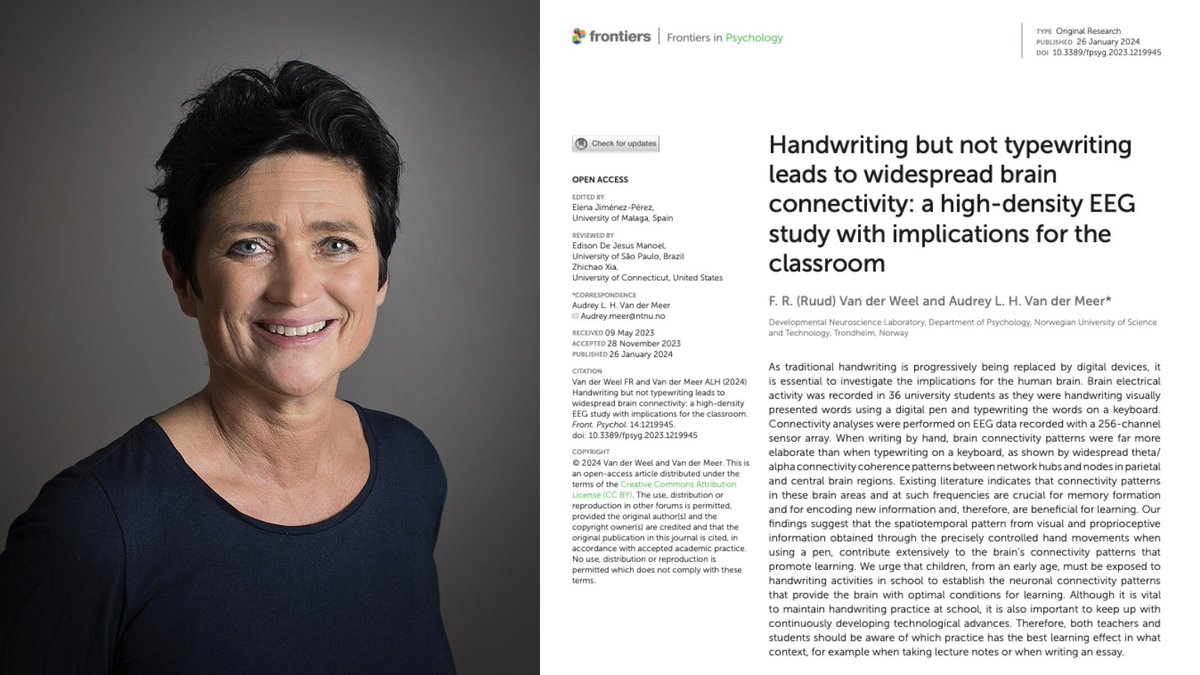
A Norwegian neuroscientist spent 20 years proving that the act of writing by hand changes the human brain in ways typing physically cannot, and almost nobody outside her field has read the paper.
Her name is Audrey van der Meer.
She runs a brain research lab in Trondheim, and the paper that closed the argument was published in 2024 in a journal called Frontiers in Psychology. The finding is brutal enough that it should have changed every classroom on Earth.
The experiment was simple. She recruited 36 university students and put each one in a cap with 256 sensors pressed against their scalp to record brain activity. Words flashed on a screen one at a time.
Sometimes the students wrote the word by hand on a touchscreen using a digital pen, and sometimes they typed the same word on a keyboard. Every neural response was recorded for the full five seconds the word stayed on screen.
Then her team looked at the part of the data most researchers had ignored for years, which is how different parts of the brain were communicating with each other during the task.
When the students wrote by hand, the brain lit up everywhere at once.
The regions responsible for memory, sensory integration, and the encoding of new information were all firing together in a coordinated pattern that spread across the entire cortex. The whole network was awake and connected.
When the same students typed the same word, that pattern collapsed almost completely.
Most of the brain went quiet, and the connections between regions that had been alive seconds earlier were nowhere to be found on the EEG.
Same word, same brain, same person, and two completely different neurological events.
The reason turned out to be something nobody had really paid attention to before her work. Writing by hand is not one motion but a sequence of thousands of tiny micro-movements coordinated with your eyes in real time, where each letter is a different shape that requires the brain to solve a slightly different spatial problem.
Your fingers, wrist, vision, and the parts of your brain that track position in space are all working together to produce one letter, then the next, then the next.
Typing throws all of that away. Every key on a keyboard requires the exact same finger motion regardless of which letter you are pressing, which means the brain has almost nothing to integrate and almost no problem to solve.
Van der Meer said it plainly in her interviews.
Pressing the same key with the same finger over and over does not stimulate the brain in any meaningful way, and she pointed out something that should scare every parent who handed their kid an iPad.
Children who learn to read and write on tablets often cannot tell letters like b and d apart, because they have never physically felt with their bodies what it takes to actually produce those letters on a page.
A decade before her, two researchers at Princeton ran the same fight using a completely different method and ended up at the same answer. Pam Mueller and Daniel Oppenheimer tested 327 students across three experiments, where half took notes on laptops with the internet disabled and half took notes by hand, before testing everyone on what they actually understood from the lectures they had watched.
The handwriting group won by a wide margin on every question that required real understanding rather than surface recall.
The reason was hiding in the transcripts of what the two groups had actually written down.
The laptop students typed almost word for word, capturing more total content but processing almost none of it as they went, while the handwriting students physically could not write fast enough to transcribe a lecture in real time, which forced them to listen carefully, decide what actually mattered, and put it in their own words on the page.
That single act of choosing what to keep was the learning itself, and the keyboard had quietly skipped the choosing and skipped the learning along with it.
Two studies. Two countries. Same answer.
Handwriting makes the brain work. Typing lets it coast.
Every note you have ever typed instead of written went into your brain through a thinner pipe. Every meeting, every book highlight, every idea you captured on your phone instead of on paper was processed at half depth.
You did not forget those things because your memory is bad. You forgot them because typing never woke the part of the brain that would have made them stick.
The fix is the thing your grandmother already knew.
Pick up a pen. Write the thing down. The slower road is the faster one.
Don't worry about anything; instead pray about everything. Tell God what you need, and thank Him for all He has done. Then you will experience God's peace, which exceeds anything we can understand. His peace will guard your hearts and minds as you live in Christ Jesus. -- Philippians 4:6-7
Tonight, church bells are ringing all across the #East. It does not matter what time it is or whether people are asleep. We ring the bells for our Savior and Lord #JesusChrist, who came 2,000 years ago, defeated death, rose again, and saved us all. Happy #Easter ✝️
🇺🇸🙏 WOW: Hundreds of thousands of Christians gathered in Ethiopia ahead of Easter — filling the streets to honor Jesus Christ.
No media coverage.
No spotlight.
Just pure faith.
This is what belief looks like when it’s alive.
Christ is King.
Unpopular but true:
- The Bible has zero contradictions
- The Christian God is the only God
- Being a “good person” won’t get you to heaven
- Jesus alone saves
“It was written by man?” Yes, 40 men.
They lived over a period of 1,500 years.
That means some of them was born before the others died, and some died before the others were born.
They lived on three different continents.
They spoke three different languages.
And yet from Genesis to Revelation, there’s an undeniable unity of thought.
That’s literally impossible: you can’t get 20 people in a room and tell them to write an essay about one topic and get agreement.
Impossible apart from the inspiration of God Almighty.
40 men wrote the Bible by putting in on paper, but YHWH is the true only author of the Book of life.
Trust in him to lead the way and follow the page for more Biblical truths and Christian stories 🕊️