St. Gennadius Scholarius: Christ did not assume an abstract or universal “humanity”, but a concrete, singular human nature in which humanity is said to exist wholly.
‘He [Christ] assumed neither a separated form and Idea of humanity—for no such form exists [...]—nor the universal form; for such a form is not a thing subsisting in itself, but exists only according to our conceptual apprehension, being constituted by abstraction from particulars only in the human intellect [...].
In reality, however, it exists only in each of the individuals, and wholly in each [...]; for each possesses the whole of humanity [...] in so far as the whole of it is enclosed in each of them in reality, according to its own principle and according to the what-it-was-to-be (τί ἦν εἶναι) which belongs to the thing itself.
We therefore neither think nor say that the divine Word assumed the whole of humanity by assuming the Idea of humanity, nor by assuming the universal conception of it, but, first, by reason of the singularity of such a union. For each singular thing is and is called a whole [...] because it possesses the whole form in actuality—as, for example, Peter does [...].’
–St. Gennadius (Scholarius), On the Humanity of Jesus Christ, Q. 4 (OCGS, Vol. 3, pp. 390–396)
My diocese’s—Sourozh’s—catechetical offering (Pt. 2, the atonement & penal substitution):
‘“And He is the propitiation for our sins: and not for ours only, but also for the sins of the whole world”(1 Jhn 2:2) teaches St. John the Theologian. Justice and love are properties of the same God. Mercy and judgement come together as we read in Psalm 100 [101] and in many other psalms. The mercy of God and the justice of God are mentioned one after the other.
Sin is the violation of the will of God, and by divine justice sin must be punished. However, out of love for man, the Son of God becomes Man and takes the punishment for sin on the Cross upon Himself. Man should have been punished, but man couldn’t save Himself, so the remedy should have been divine. Hence, the Incarnation of God, and hence, the Cross.
Atheists like Christopher Hitchens—the New Atheists like Richard Dawkins—they picture Christ [here] as a passive victim of domestic violence, so to speak. However, according to the Trinitarian doctrine, the Father, the Son and the Holy Spirit possess one will. Christ goes to the Cross completely voluntarily.’
–Fr. Eugene (Selensky), Sourozh Catechism (2026), The Creed: Article 4.
‘Q (Catechumen): I’ve been under the impression that penal substitution is not something that is believed in the Orthodox branch, so I have been finding it slightly difficult to distinguish between propitiation and penal substitution.
A (Selensky): ‘It is a theological question... [...] If you look at the terminology used by the Apostles—“And he is the propitiation for our sins: and not for ours only, but also for the sins of the whole world”—so this is the apostolic teaching. But the Atheists actually picture Christ as a passive victim of domestic violence, but this of course is not correct. He dies willingly on the Cross. You see, the justice and the mercy of God are properties of the same God. The justice of God required sin to be punished. But the punishment is taken upon Himself. Christ takes upon Himself the punishment for the sins of the world. This is done out of love for man.
Q (Catechumen): So, just to clarify: am I understanding correctly then that we do believe in penal substitution then—that Christ dies instead of us?
A (Selensky): Yes, yes, [and] Christ dies for a reason: for us to be saved.
Q (Catechumen): So instead of us dying, He dies.
A (Selensky): He dies as a man, as a mortal man, and He grants us justification as He rises from the dead. In fact, St. Apostle Paul says—I had another quote from Holy Scripture (cf. Rom. 4:25)—that He is raised from the dead for our justification. So this is the apostolic teaching.
He dies for our sins, and He is raised from the dead to justify us, so that when we accept Him personally—you, me, other people—we are justified as well. So, when we are baptised, the sin of Adam is no longer on us. But we all sinned in the old Adam, so that’s why we need a second birth: the birth through Baptism.
Q (Catechumen): That does align, that makes sense for me... I’m just trying to also understand with, for example, the story of the prodigal son where there is no penal substitution, so to speak, but the son has been accepted by the father.
A (Selensky): The son has been accepted by the father, but, in the same parable, Christ mentions the fatted calf which is slaughtered for the banquet.
Q (Catechumen): OK, that’s very good, thank you.
A (Selensky): Thanks, thanks... It’s such a very deep theological question.’
–Fr. Eugene (Selensky), Sourozh Catechism (2026), The Creed: Article 4.
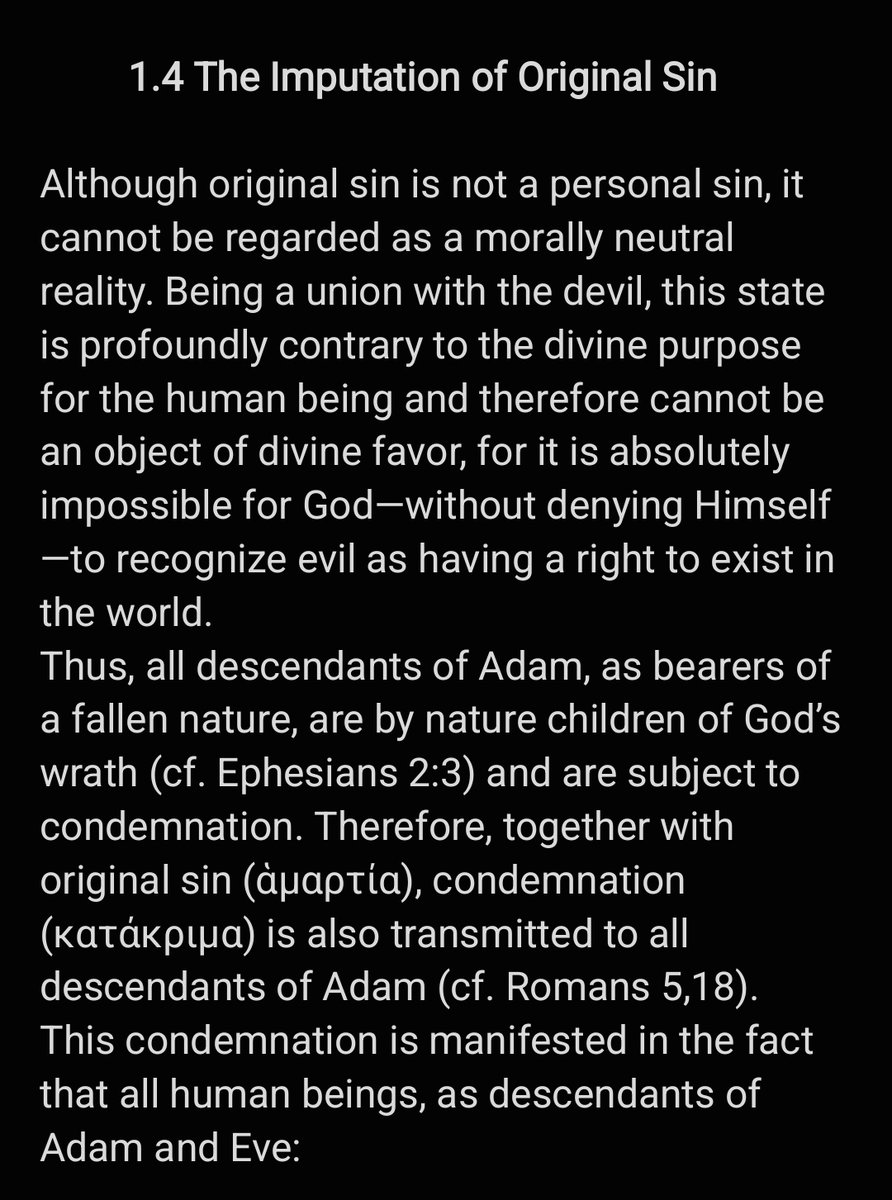
@blessedmikko So, all humanity, including infants, inherit not only mortality, but sin "and consequently death". I though no living clergy believe that...
"The urge to insult is a weakness of mind, a misfortune of the soul with its healthy intelligence crippled."
--St Gregory of Nyssa, 'Against Eunomius' 2.617
ἡ τοῦ ὑβρίζειν σπουδὴ λογισμῶν ἐστιν ἀρρωστία καὶ δυσκληρία ψυχῆς τὸν ὑγιαίνοντα λογισμὸν λελωβημένης.
"Hence, those who now disobey the teaching of the Spirit through our Holy Fathers and insult us who confess the same as them, say that many gods come to be or that the one [God] is composite, if indeed the Divine Energy differs from the Divine Essence and if anything is fully contemplated to God's Essence; For they ignore, that not acting and energy, but being acted upon and passion causes composition (οὐχί τό ἐνεργεῖν καὶ ἡ ἐνέργεια, ἀλλὰ τὸ πάσχειν καὶ τὸ πάθος ποιεῖ τὴν σúvěεσiv). But God acts, neither being passive (πασχῶν) Himself nor changing (ἀλλοιούμενος); Therefore, He will not be composite through the energy."
St. Gregory Palamas, Capita CL, 145, ed. CHRESTOU, p. 116, 3-11
“[…] there is a sense in which essence and energy are identical in God and a sense in which they differ from one another, as is clearly shown in the writings of the Fathers.”
St. Gregory Palamas, Letter to Daniel of Ainos, 4 (Chrestou 2, 377 or EΠΕ 63:183)
St. Mark of Ephesus says the same basic thing in different words, the divine predicates are not “diverse things” in the sense of primary substances or composite realities. They are real in God, but the kind of “thing” involved is not the same as a created thing, and the distinction is not a real separation. 3
St. Philotheos Kokkinos is especially clear that essence and energy are “two things” only in a qualified sense; they differ “not really, but conceptually,” while their unity is real. However, he says “conceptual” i will be explaining that, κατ᾽ἐπινοίαν does not mean that the distinction is invented by the mind. It refers to the mode in which the intellect considers something that is objectively inseparable in reality. 4
There are two senses of “conceptual” that need to be distinguished:
A conceptual consideration of something objectively real means the intellect distinguishes something that already exists in reality, but because it cannot exist separately, it is only grasped under its own concept.
A merely conceptual distinction means the distinction exists only because the intellect thinks differently about the same thing. Outside the mind, there is no objective difference.
St. Mark of Ephesus rejects the second sense. He explicitly calls the energies realities, so they are not mere beings of reason or mental constructs. Yet he still says they are distinguished κατ᾽ἐπινοίαν because the energies are not substances existing per se. They are always the natural activity of the one divine essence. Therefore, when the intellect speaks of “the energy” by itself, it is abstracting or considering separately something that is never actually separated from the essence.
The Synodal Tome of 1351 says the same thing; the essence and energies are not to be separated into complete division, nor treated as alien to one another. They are distinguished only “by reason” or “only notionally,” while remaining inseparable by nature. 5
(3). St. Mark of Ephesus, First Refutation of Manuel Calecas and 2nd Refutation of the 2nd of Manuel Calecas’ Pieces Against the Synodal Tome.
(4) St. Philotheos Kokkinos, Antirr. V, Antirr. VIII, and Antirr. X.
(5) Synodal Tome of 1351 / Council of Constantinople 1351.
The quote by St. Mark of Ephesus is likely taken from Lossky's translation of it in his book (This passage is not in W. Gass, op. cit.: it is to be found in Canon Oxoniensis, 49. It is quoted by M. Jugie in the article “Palamas,” Dictionnaire de théologie catholique, XI, 1759ff.)
I will supply a better translation by Tikhon Pino:
"We need not marvel that the distinction between the divine essence and operation was not revealed distinctly (τρανῶς) and in detail by the saints. For if now, after the truth has been so firmly established, and the monarchy is understood all over the world, those who rely on secular learning, or, rather, foolishness, have brought such charges against the Church, even accusing her of polytheism, what would they have done then, they who boast and seethe with empty wisdom, and who are eager to lay hold of some excuse against our teachers?
For this reason the theologians appear to emphasize the simplicity of God more than the distinction. For it was not proper to further impose the distinction of operations on those who had not yet accepted in a pure manner the distinction of hypostases.
For each of the divine dogmas is divided in its own time, economically, the ineffable Wisdom making opportune use, as is customary, of the madness and hostility of the heretics (cf. 1 Cor. 11:19)."
St. Mark is explaining why the early Fathers did not always articulate the distinction between God's essence and his energies with the same precision as St. Gregory Palamas. First, the early Fathers had a pastoral and theological reason for mostly focusing on divine simplicity. Hence, he says: "For this reason the theologians appear to emphasize the simplicity of God more than the distinction." He explains that the early Christians were already struggling to understand and accept the distinction between the divine hypostases (Father, Son, and Holy Spirit). Consequently, it would have been inappropriate to introduce an additional distinction between divine essence and divine operations with equal prominence. He then says "For each of the divine dogmas is divided in its own time, economically, the ineffable Wisdom making opportune use [...] of the madness and hostility of the heretics." The word οἰκονομικῶς is important. God permits controversies to become occasions for the Church to explain more precisely what she believes. For example, St. Gregory explains that the divinity of the Son was not proclaimed as explicitly before the divinity of the Father was acknowledged, and the divinity of the Spirit was not fully manifested before the divinity of the Son was recognized. "Gradual additions [...] advances and progressions from glory to glory." (Oration 31.26)
@sivartus@BrotherAugusti2 They think that in our times a heretic can only be a protestant pastor wearing a suit, and not someone who may have an outward appearance of piety, with a long white beard, an ascetic, a monk, fluent in greek, perhaps even a bishop.
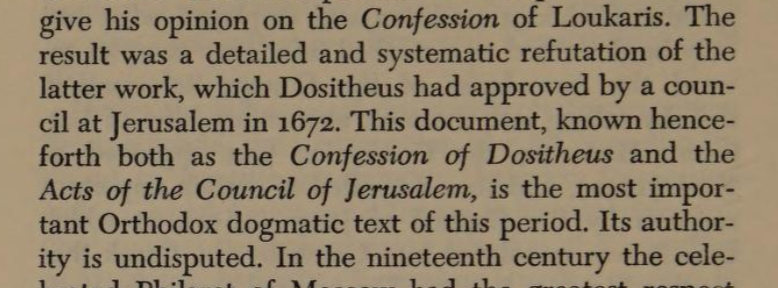
Here is John Meyendorff saying that the authority of the Confession of Dositheus is undisputed.
Even Meyendorff rejects the error of the anti-Dosithean modernists!
(Source: Meyendorff, The Orthodox Church, p. 96.)
The first line of the Nicene Creed does not strike me as a good argument for the idea that “only the Father is properly called God” for the simple reason that the next part begins “and in one Lord, Jesus Christ…” shortly followed by “And the Holy Spirit, the Lord, the giver of life…”
If calling Jesus the “one Lord” doesn’t prevent the Holy Spirit from also being called “the Lord” then why would calling the Father “God” mean the other Persons can’t also be called God?
‘St. Philaret [of Moscow] explicitly employs the concept of the “imputation of righteousness”. According to St. Philaret, to impute means “to place to someone’s account”, or even “to ascribe to someone a certain quality, one which may at times be alien to him”. As we can see, St. Philaret thinks entirely within the framework of the juridical conception of salvation and is not ashamed of it.
The dogmatic controversy between the ethical and juridical conceptions of salvation in the 20th century is well known. Both, when carried to their extremes, are one-sided: the result is either the scholasticism of juridicism or moralism’s warfare against the Cross. Holy Scripture embraces both conceptions in their inseparable unity.
Righteousness is necessary both as deification and as sanctification; righteousness is also necessary as the imputation to those who have sinned of what Christ has accomplished. Faith is the means and the way to this. It was Abraham who first marked out this way.’
–Archpr. Gennady (Fast), Studies on the Old Testament: A Guide to the Study of Holy Scripture, Bk. I