The debate over falling U.S. birth rates keeps asking: is it educated women choosing careers, or working-class women facing economic pressure?
New SFRI research from @kearney_melissa and @phil_wellesley says that's the wrong question
Fertility is declining across the board 🧵
How do age verification laws affect online pornography use?
New research in @nberpubs by SFRI Graduate Student Affiliate Emily Davis + coauthors finds that these laws reduce time on adult websites, but circumvention by both firms and users undermines their effectiveness 🧵
Although browsing data for minors is unavailable, the authors use young adults (aged 18-24) as a proxy for teenage behavior to provide indirect evidence on how these laws may affect the age group they’re designed to protect
Great thread on research by our Faculty Affiliate @LeeGettler! Evidence that fatherhood produces measurable biological changes in men helps us better understand parental investment and family formation 🧠
Men are, actually, hardwired to connect with their babies. A landmark PNAS study (n=624) tracked young men in the Philippines over 4.5 years and found that becoming a father causes large, measurable drops in testosterone.
https://t.co/wUqEUX5X4S
Early childhood was at the forefront of the policy discussion this weekend.
Research by our Faculty Affiliates shows what works for children and their families 🧵
Same story with Head Start: expanding program hours significantly boosts maternal employment.
The evidence is consistent — reducing caregiving constraints helps mothers work
From @chloergibbs:
https://t.co/0N7dybkCbB
@kearney_melissa joined @SoumayaKeynes to discuss what declining birth rates mean for the workforce, fiscal policy, and the limits of pro-natalist policy
Via @AspenEcon
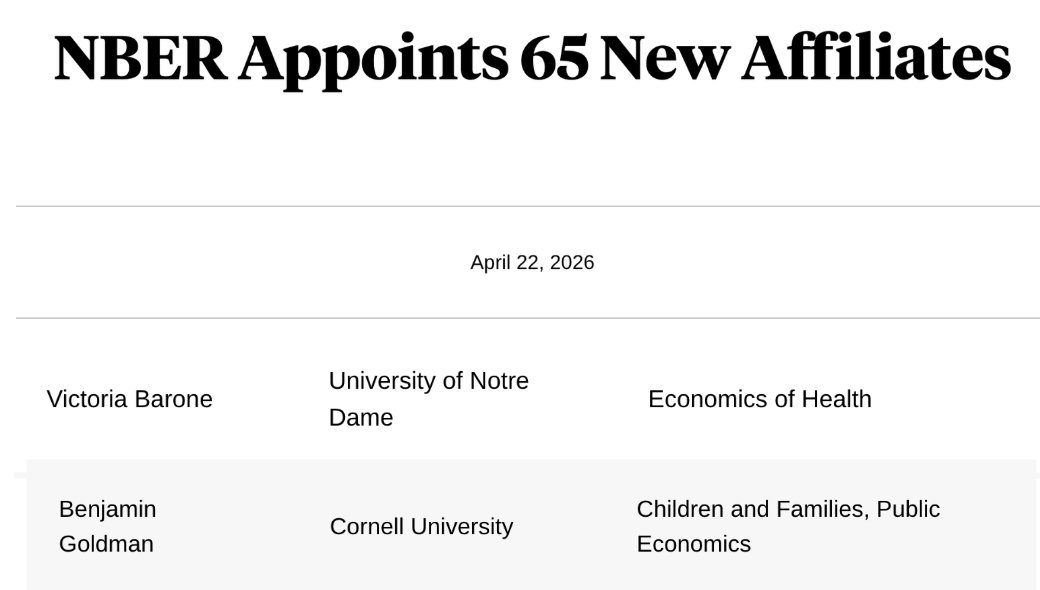
Congratulations to our Faculty Affiliates, Victoria Barone (@Viquibarone) and Benny Goldman on their appointment to @nberpubs!
Both study how community conditions shape family life and economic opportunity (1/)