Ed Feser's philosophy blog —updates for/by readers
@FanFeser
Links to Dr Edward Feser's blog posts and lectures on philosophy, known for wit and clarity. For readers' convenience. Unofficial, unaffiliated w/ @FeserEdward.
1/10
Roundups of Ed's blog articles! A thread 🧵
Compiled under the following broad themes (list not exhaustive):
🔹MIND-BODY PROBLEM
🔹LOVE & SEX
🔹MIND AND COSMOS
🔹CLASSICAL THEISM
🔹COSMOLOGICAL ARGUMENT
🔹INTELLIGENT DESIGN VS. ARISTOTELIAN THOMISM
🔹SCIENTISM
🔹POP CULTURE
Early modern philosophy and science put what is often called a “mechanical” or “mechanistic” conception of the natural world at the center of Western thought. But what exactly does that amount to? “What is the mechanical world picture?”, over at the blog: https://t.co/L2Gwz2DwRB
Leo is in general more like Benedict XVI than like Francis. As I have noted in this article and elsewhere, he has in several ways quietly pulled the Church back from some of Francis’s doctrinally problematic words and actions: https://t.co/1auhiJBoUp
Two twentieth-century history of science classics on the origins of the mechanistic and mathematized conception of nature that has hypnotized the modern Western mind. Best read while listening to Pink Floyd’s “Welcome to the Machine.”
There is (a) military force used for the purely defensive purpose of repelling an invasion or the like, and (b) military force for purposes that go beyond this. The pope has explicitly acknowledged elsewhere that (a) can be legitimate. What he means by “just war” here is a war of type (b) that meets traditional just war criteria. What he is saying is that while in theory there can be such wars – and have been in the past – in practice under modern conditions there cannot be, given the enormous damage war now typically inflicts on civilian populations. (I wish he would not use the phrase “just war” in this narrow way, because it is usually used in a broader sense to cover (a) as well, as one particular kind of just war. But that issue is semantic rather than substantive.) Leo’s position is not novel, but is one that became increasingly common among orthodox Catholic moral theologians and churchmen after WW2, as I discuss here: https://t.co/K8OrbTKYV5
For those who prefer print over digital, American Catholic Philosophical Quarterly Vol. 100, No. 1 is now out. My article “The New Neo-Scholasticism” can still be accessed online (and so can other articles from the issue): https://t.co/1aCGZVa0Lc
On @Pontifex’s Magnifica Humanitas. “Leo XIV contra the new Babel: Reflections on the pope’s landmark encyclical,” over at the blog: https://t.co/K8OrbTKYV5
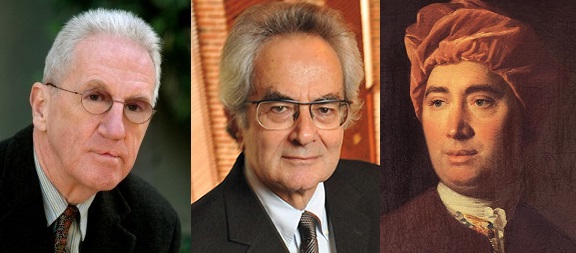
Are causality, necessity, and value real features of the objective world? Or merely projections of the human mind, as Hume argued? “Nagel on Stroud on the possibility of metaphysics,” over at the blog: https://t.co/SgFxHBja6a
In connection with @Pontifex’s forthcoming encyclical on AI, some readers might be interested in chapter 9 of my book Immortal Souls: A Treatise on Human Nature, which sets out the deep metaphysical reasons why so-called artificial intelligence – whether on the traditional Turing machine model, or LLMs and other forms of machine learning, or whatever – is not and cannot be genuine intelligence. Available via Amazon: https://t.co/lRdfZKiwnT
As a rational animal, a human being is neither angel nor ape but something that combines into a unity a little of both. Our rational powers transcend matter and make it possible for a residue of a human being to survive death, reduced to just a disembodied intellect. But that is not our normal condition, and what makes the human mind distinct from that of an angel is its deep dependence on embodiment for its normal operation and the molding of its character over time.
There are two families of opposite extreme errors concerning human nature, those that exaggerate our dependence on matter and those that exaggerate our independence of matter. The first family of errors include materialist philosophical theories that try to reduce thought to physiological processes, and psychological theories that blur the distinction between human cognition and language on the one hand and that of non-human animals on the other. The second family of errors include the Cartesian dualist thesis that mind and body are two radically independent substances, and transhumanist theories according to which we might radically alter our bodily nature as we wish, or even transcend it altogether by uploading our minds into a virtual reality.
My book Immortal Souls: A Treatise on Human Nature is a sustained, rigorous refutation of both families of errors. It is available from Amazon: https://t.co/lRdfZKiwnT and Barnes and Noble: https://t.co/qOkhXhKU7I
Here are the back cover copy, endorsements, and table of contents:
Immortal Souls provides as ambitious and complete a defense of Aristotelian-Thomistic philosophical anthropology as is currently in print. Among the many topics covered are the reality and unity of the self, the immateriality of the intellect, the freedom of the will, the immortality of the soul, the critique of artificial intelligence, and the refutation of both Cartesian and materialist conceptions of human nature. Along the way, the main rival positions in contemporary philosophy and science are thoroughly engaged with and rebutted.
“Edward Feser's book is a Summa of the nature of the human person: it is, therefore, both a rather long – but brilliant – monograph, and a valuable work for consultation. Each of the human faculties discussed is treated comprehensively, with a broad range of theories considered for and against, and, although Feser's conclusions are firmly Thomistic, one can derive great benefit from his discussions even if one is not a convinced hylomorphist. Every philosopher of mind would benefit from having this book within easy reach.” Howard Robinson, Professor Emeritus of Philosophy, Central European University
“Feser defends the Aristotelian and Thomistic system, effectively bringing it into dialogue with recent debates and drawing on some of the best of both analytic (Kripke, Searle, BonJour, Fodor) and phenomenological (Heidegger, Merleau-Ponty, Dreyfus) philosophy. He deftly rebuts objections to Thomism, both ancient and modern. Anyone working today on personal identity, the unity of the self, the semantics of cognition, free will, or qualia will need to engage with the analysis and arguments presented here.” Robert C. Koons, Professor of Philosophy, University of Texas at Austin
CONTENTS
Preface
Part I: What is Mind?
1. The Short Answer
2. The Self
3. The Intellect
4. The Will
Part II: What is Body?
5. Matter
6. Animality
Part III: What is a Human Being?
7. Against Cartesianism
8. Against Materialism
9. Neither Computers nor Brains
Part IV: What is the Soul?
10. Immortality
11. The Form of the Body
Index
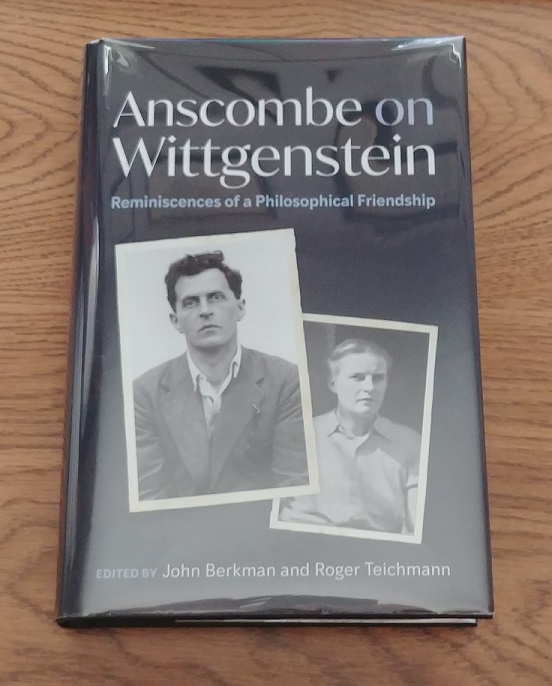
Wholesome reading. Wittgenstein and Anscombe were interesting as human beings and not only as thinkers, in part because they embodied the Socratic ideal of philosophy as something that is not a mere profession but ought to transform one’s life.
Debunking a tiresome bit of sophistry routinely trotted out by defenders of the war. “No, the U.S. has not been at war with Iran for 47 years,” over at the blog: https://t.co/4CULjIMjoe
On the later Scholastics’ conception of political power and its relationship to liberalism and postliberalism. “The transmission theory of authority,” over at the blog: https://t.co/7KY8E3sJf6
Then the message is dead wrong. Neo-scholasticism is back and its intellectual muscle is essential to articulating and defending orthodoxy today, but its new incarnation is not the straw man the critics have tiresomely been attacking for decades: https://t.co/spIt8FIRXv
A reply to a fallacious objection to my recent @firstthingsmag article on just war and moral certainty. “Misunderstanding the 'just cause’ condition of just war doctrine,” over at the blog: https://t.co/laKzAtrVeX
Sexual sins are not the worst sins, but the common opinion that they are “no big deal” is idiotic. They are a very big deal and we need to recover the courage to say so, precisely because so many don’t want to hear it. I defended the traditional view about their gravity in a two-part article “What’s the deal with sex?” Part I: https://t.co/UZezpwmbAC and Part II: https://t.co/MnUksA5Ytz
At @firstthingsmag I show that the standard view in the Catholic just war tradition is that for a war to be just, it's not enough that it be merely arguable or even probable that it meets all just war criteria. We must be morally certain that it meets them https://t.co/gIeMHsrtnG