Gold is not an inflation hedge. It is a safe haven and there is a huge difference.
Bullion's bull runs over the last twenty years have specifically coincided with DEFLATIONARY events.
Given that history, why is gold surging? Why now?
https://t.co/639Bcv6Xg0
People simply repeat something because they heard "everyone" else say it: low interest rates are stimulus; the Fed prints money; gold rises during inflation.
Just look at any chart for gold and pay close attention to the timing of the biggest moves.
It isn't random coincidence gold's first major surge started in the middle of 2005. Sure enough, given what was happening at the time (rising oil, falling dollar, hawkish Fed - sound familiar?), everyone said gold is a signal for looming inflation.
Nope. Not even close. While some people may have bought some bullion fearing 70s-style inflation, gold was actually rising as a safe haven. It wasn't inflation people were increasingly worried about, rather the drastic and deflationary consequences of that whole housing bubble thingy.
Gold jumped at the same time the bond market began to price the same possibilities. Those two go hand in hand; interest rates being the primary opportunity cost for owning gold.
Safe haven demand goes up, interest rates look like they'll go way down in the future, gold skyrockets.
The same thing also happened in 2018-19, by the way. Gold's second bull began in October '18 - the LANDMINE - which began another deflationary descent. The global economy hit a recession and interest rates dumped throughout 2019 even though hawkish policymakers in 2018 promised there'd be more inflation.
Gold is not an inflation hedge. It is a safe haven and that's a huge difference.
That difference is useful in telling us what the market is perceiving about risks and, even better, the intensity of those risks.
With oil prices surging, that only adds more to the disinflation potential (remember, we just did this with crude six months ago and it did NOT end up like 1973; the opposite, actually).
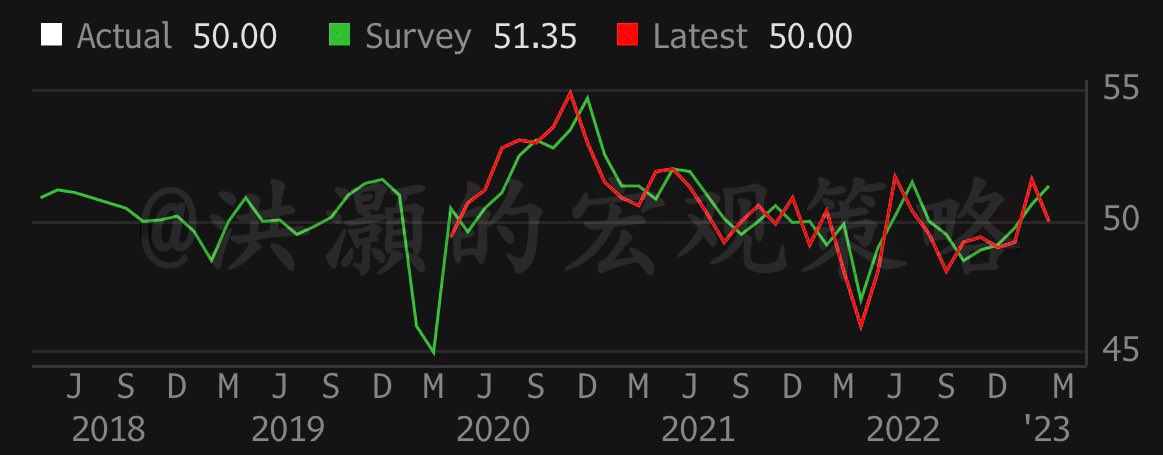
China CAIXIN Manufacturing PMI disappoints. This is an indicator tilted disproportionally towards China’s export sector and SMEs. Today’s Caixin PMI disappoints because of very strong official PMI data last week. At Bo’ao, the Premier mentioned that the Chinese economy continued to improve in March in his keynote speech.
So where is the disconnect?
As aforementioned, the official PMI is titled towards larger SOEs, while the Caixin towards export and SMEs. Apparently, the SMEs are still struggling to find their footings while the SOEs are recovering with policy assistance. This may help explain why the authority is calling for more support for the private sector and SMEs.
The official service PMI surprised big on the upside last week. Such upside surprise may have heightened the disappointment today towards the Caixin PMI. But note that the service PMI has been driven by building and construction activities, rather than a genuine service recovery. This is consistent with continuing rising deposits in the bank system and a muted retail growth.
After a marked improvement in Jan/Feb, new home sales appear to continue to improve in March. And the improvement is across the T-1/2/3 cities, with T-1 cities improving sequentially. That’s said, SOEs developers continue to better private ones, who are still registering small Y/Y decline. This divergence between SOE and private developers is consistent with the divergence between the Official and Caixin PMI.
But land sales in 100 cities slowed in March, although again SOEs better private developers. This is an important leading indicator for future property investment. It suggests that the private developers are still hesitant to commit, and confidence recovery takes time. Fortunately, land purchase is not counted in GDP calculation and thus won’t affect GDP growth in 2023.
In sum, today’s Caixin PMI doesn’t really disappoint when considering its survey sample. Service PMI recovery is driven more by construction activities rather than a genuine consumption recovery. Property sales are improving, but land purchase suggest that private developers are still too diffident to commit. More work still needs to be done.