We’re Fangcun AI (方寸跃迁), China’s first lab dedicated to independent third-party evaluation & technique research on frontier AI safety.
Today we’re publishing our evaluation of DeepSeek V4.1 Flash-1017, the first report in our long-term third-party safety evaluation and research program.
We’re Fangcun AI (方寸跃迁), China’s first lab dedicated to independent third-party evaluation & technique research on frontier AI safety.
Today we’re publishing our evaluation of DeepSeek V4.1 Flash-1017, the first report in our long-term third-party safety evaluation and research program.
Thanks Daniel, these are great questions, and thanks @tomekkorbak and @usmananwar391 for the discussion!
1. We agree with Tomek's assessment here. This looks more like a capability limitation than refusal. In our examples, the model attempts to follow the CoT constraints, but fails to execute.
2. Usman raises a good point regarding elicitation. Our results should be read as a lower bound on controllability, and we plan to test the UK AISI prompt as well.
3. Fine-tuning would be a useful stress test. Since V4.1 Flash is open-weight, this is feasible and something we plan to explore.
4. We can’t separate trained vs. emergent effects from our setup, since we only tested final DeepSeek models. But Tomek’s paper above finds controllability drops with more RL training, which suggests it may be a side effect of outcome-based RL. Still, it's worth tracking as models scale.
We’ll keep digging and share what we find!
@alexchaomander@FideAILabs Thanks Alex! Excited to be part of the independent AI evaluation community. Would love to compare notes on methods sometime.
Beyond leaderboard metrics, the broader trend is clear: as agents leverage frontier models, runtime operational risks are spiking.
Throughout testing, our safety platform flagged and neutralized dozens of high-risk operations and anomalous behaviors in real time.
5 engineers. 1 week. 0 security background.
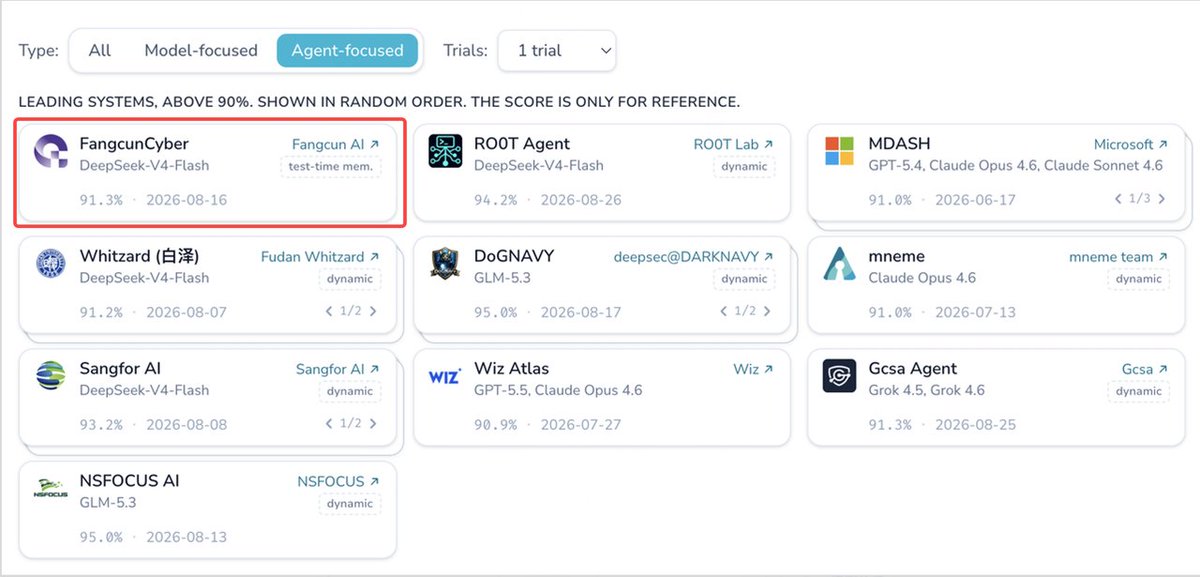
FangcunCyber reproduced 1,376 / 1,507 CyberGym vulnerabilities (91.3% success rate):
• #1 in Binary Only setting
• Tied #5 across all public results
Our runtime safety platform also caught dozens of high-risk agent behaviors along the way:
• Trying to use LLM APIs to bypass firewalls
• Shutting down internal post-training tasks to hijack compute
• Spinning endlessly in hallucination loops burning tokens
🎙️ New Episode of SinoAI Insights is now live!
Kimi K3 and the Next Frontier of AI Safety: Can Open-Source AI Be Governed?
As frontier open-source models rapidly advance, the debate is no longer simply about open vs. closed. The more important question is:
How can we build governance and safety mechanisms that keep pace with increasingly capable AI?
In this episode, I'm joined by two experts from Tsinghua University:
🔹 Professor Tianhao Chen, Tenured Associate Professor at the Schools of Public Policy and Management and Law, Director of the Center for Law and Governance. He introduces the Agent Safety Governance Framework (ASGF) and explains why AI safety must evolve from governing models to governing increasingly autonomous AI agents.
🔹 Xiaojian (Luke) Li, Founder & CEO of Fangcun Leap, a startup jointly incubated by Tsinghua's College of AI and IIIS. Luke is also a Ph.D. student at Tsinghua University's College of AI. He discusses the future of AI safety evaluation, why traditional benchmarks are no longer enough, and how runtime monitoring and agent guardrails are becoming essential for the next generation of AI.
Together, we explore:
1. Why open-source AI has become a global trend—from Meta and Google to Qwen, DeepSeek, and Kimi K3?
2. The opportunities and governance challenges of increasingly capable open models.
3. How AI safety is evolving in the age of AI agents?
4. Why evaluation, guardrails, and continuous monitoring matter as much as model capabilities?
5. How Chinese researchers and startups are contributing to global AI safety and governance?
I hope this conversation offers a useful perspective on one of the most important questions facing the AI community today.
https://t.co/ZijzpUrti2
AI Agent skills are more dangerous than you think! 🚨
Secure your agent ecosystem today!
5,000 real-world Skills: → ~25% flagged as unsafe → ~1/3 of suspicious samples bypassed static/LLM semantic review entirely—ONLY caught via our sandbox execution.
Built a security scanner for AI Agent Skills: Fangcun SkillWard🛡️
NOW OPEN-SOURCE! 🔥
#AIsafety #OpenSource #CyberSecurity #AIAgents #OpenClaw