Today, we are launching Pioneer: the world’s first agent for fine-tuning and inferencing SLMs and LLMs.
With Pioneer, you can fine-tune and deploy models like Qwen, Gemma, and Llama and achieve state-of-the-art performance in minutes, with a single prompt. Models are continuously optimized on live inference data, meaning that models in production improve over time.
Additionally, Pioneer is the only platform in the world to offer fine-tuning for small encoder-based language models including GliNER2, offering frontier-model quality on specific tasks at small-model cost and speed.
Start for free at https://t.co/57VlSchQa2.
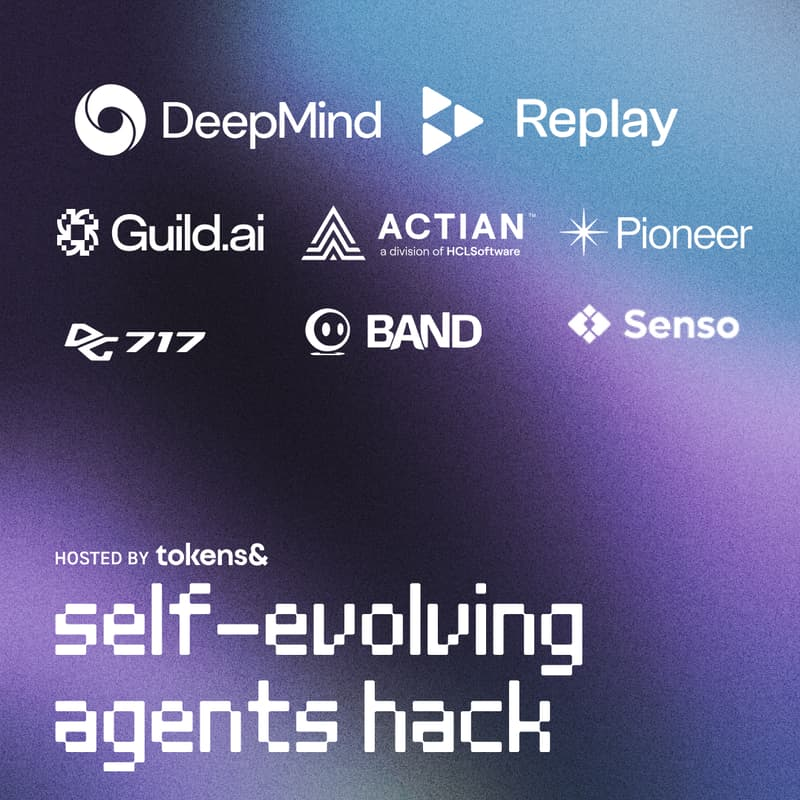
Build an agent that improves itself and compete for $40k+ in prizes.
We’re excited to be partnering with @tokensandai along with teams at @GoogleDeepMind, @GuildAI, @replayio, @GoSenso, @band_hq, @ActianCorp, and @dg717sf to co-host the Self-Evolving Agents Hackathon.
Throughout the event, you'll get direct access to experts and hands-on time with some of the top tools in the agent ecosystem.
Spots are limited. Register now: https://t.co/BHE4dsrG9p
Big news: our researcher @urchadeDS's paper on GLiGuard has been accepted to COLM (Conference on Language Modeling) 2026 📄
The paper discusses how GLiGuard, a 0.3B encoder-based SLM, approaches safety moderation as a text classification problem rather than text generation one, allowing it to perform four safety moderation tasks in a single forward pass.
Congratulations, Urchade! 🎉
Links to the full paper and model page on @huggingface below.
GLiNER2 just crossed 1 million monthly downloads. 🎉
Two years in, and the GLiNER community has only grown. To everyone building and shipping with our models: thank you.
We're not slowing down. Last week we shipped GLiNER2-Guardrails-PII-Multi, which runs safety moderation and privacy filtering in a single forward pass.
A real world example of what small language models can handle.
All GLiNER models are available on the @huggingface hub 🤗: https://t.co/8sQ18eI2FT
Just wrapped up at @RaiseSummit and we had over a hundred conversations around something we haven’t announced yet. 👀
More details on what we showcased coming soon. In the meantime, here’s few highlights. Au revoir Paris, until next time. 🇫🇷
Our newest open source model is a guardrail + PII combination!
A quick overview:
> 0.3B parameters
> 4 guardrail tasks (classification) + PII extraction in a > single forward pass
> Performance matches the individual models
> 🤗 Weights are on @huggingface.
Huge shoutout to @urchadeDS on this one!
We hosted a World Cup Watch Party yesterday and it did not disappoint.
We partnered with the teams at @ExaAILabs, @lancedb, and @ExtendHQ to bring together builders, researchers, and engineers who also happen to love soccer.
Whether you came for the game, or just the conversations about where AI is headed, we're glad so many of you could join us.
Thanks to everyone who came out. We'll see you at the next one.
We’re heading to Paris!
Fastino Labs is flying halfway around the world to sponsor @RaiseSummit next week, alongside companies like Google, Anthropic, Cursor, and NVIDIA.
Come find us at booth B6 for Pioneer demos and grab some cool swag.
Fugu Ultra is a little different.
It’s not a single model, but rather an orchestrator model trained to compose workflows of multiple frontier LLMs (Gemini, Claude, GPT) to solve hard problems.
Rather than picking one model, it outputs multi-step agentic workflows as natural language, breaking tasks into subtasks and assigning each to the best-suited agent.
Fugu Ultra achieves state-of-the-art performance across coding, reasoning, and science benchmarks by intelligently combining the complementary strengths of its agent team.
And now you can use it on Pioneer.
🔗: https://t.co/9PwdB9TwQl
We combed through Reddit, X, LinkedIn, and YouTube to see what real devs are saying about GLM 5.2 by @deepseek_ai.
The community consensus is striking: developers are consistently reporting that GLM 5.2 feels like a breakthrough for open-weight models, delivering coding and agentic abilities that rival closed frontier models like Claude Opus 4.8, costing a fraction of the price.
👍 What developers like about GLM 5.2:
- Great at autonomous bug-hunting, UI redesigns and multi-file refactors
- 1M context window is actually very effective, with noticeable degradation starting only after 400k tokens
- Avoids common anti-patterns for design and front-end work (like purple gradients)
👎 What developers don’t like about GLM 5.2:
- Verbose, with a tendency towards going in circles (”thinkslop”)
- Token hungry, sometimes burning through 5x more tokens than GPT-5.5 for identical tasks
Overall, devs report that GLM 5.2 can be an effective and much cheaper drop-in replacement for Opus 4.8 for many coding tasks. Though it uses far more tokens than Opus 4.8, it is still considerably cheaper, and offers excellent performance.
If you’ve been thinking about trying out GLM 5.2, this is your sign.
Try GLM 5.2 in your favorite coding agent today with Pioneer.
🔗: https://t.co/gUX9C9dyuo