BREAKING:
7 Christians killed in a church in Jordan after 2 gunmen attack a funeral.
Security forces are chasing the attackers behind what seems to be an Islamist terror attack.
Pope Leo XIV will not make his scheduled visit to Assisi on October 27 in order to “aid his recovery” following his recent thoracic surgery, according to the Holy See Press Office.
The Pope will instead send a message to express his closeness to the organizers and attendees of the “Unarmed and Disarming Peace” meeting, which marks the 40th anniversary of the World Day of Prayer for Peace convened in the Italian city by Pope St. John Paul II.
“To aid his recovery following the thoracic surgery he underwent on Tuesday of last week, Pope Leo XIV will be unable to attend the ‘Unarmed and Disarming Peace’ meeting in Assisi on October 27, as planned,” read the statement.
The Press Office assured everyone that the Holy Father remains convinced “that the ‘Spirit of Assisi’ dialogue and the search for words and gestures of peace are valuable resources in an age of conflict.”
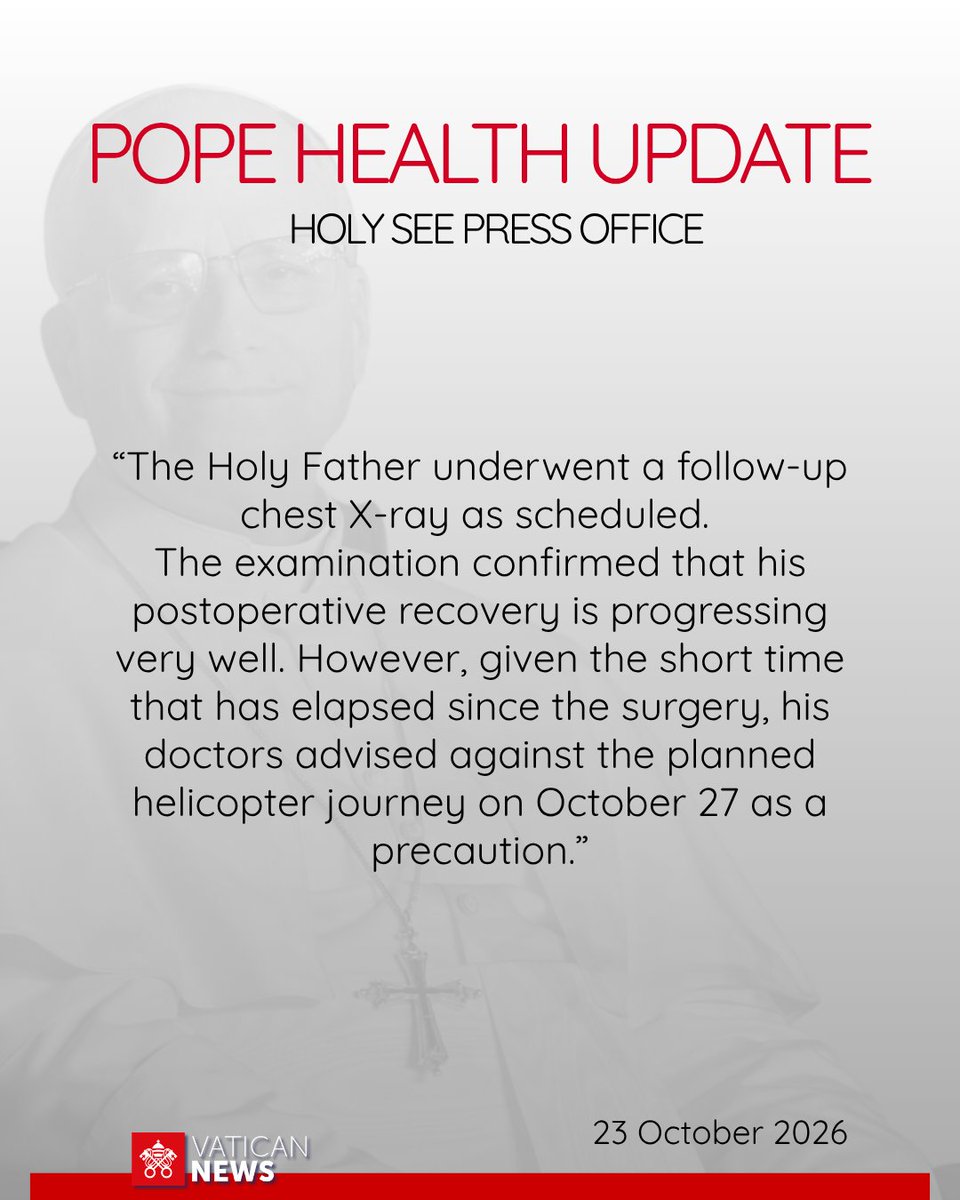
At the same time, Dr. Luigi Carbone and Professor Stefano Margaritora said the Holy Father underwent a scheduled follow-up chest X-ray, which confirmed that his “postoperative recovery is progressing very well.”
“However, given the short time that has elapsed since the surgery, his doctors advised against the planned helicopter journey on October 27 as a precaution,” they noted in the statement released on Friday by the Holy See Press Office.
You may know that St. John Paul II was the second-longest-serving pope in modern history with 27 years of pontificate, and he was the first non-Italian pontiff since the Dutch Pope Adrian VI in 1523.
But did you know that he also changed the Catholic Church forever during those 27 years? Here are five ways he did that: https://t.co/4NSFnaeoye
Addressing a delegation of the American Jewish Committee, Pope Leo encouraged everyone to work together to promote human dignity, defend religious freedom, and reject all forms of religious and ethnic hatred and discrimination.
https://t.co/5srsqFD3xp
Every October 22nd, the Church celebrates the feast of Saint John Paul II, the pilgrim Pope.
He traveled the world bringing the Gospel to all corners of the earth: 104 trips, 129 countries, millions of miles.
And his final journey took him to France. He returned to Lourdes—a place that held a special piece of his heart, the shrine of the Virgin Mary, to whom he had entrusted his entire life: Totus Tuus, “Totally Yours.”
Lourdes, in August 2004, was his final destination. Months later, he would depart for the Father’s house.
There, with his strength fading, he gave the world his greatest lesson. He preached not with a speech, but with his frailty. The world saw him pray with all his heart, in tears, unafraid to show his weakness before cameras from across the globe.
This giant sustained the Church and the world until his dying breath. Saint John Paul II, pray for us.
UPDATE ON POPE'S CANCER TREATMENT from the Vatican:
"Dr. Luigi Carbone and Professor Stefano Margaritora communicate the following regarding the Pope's post-operative recovery: Today, the final histological examinations and molecular biology tests on the material removed during the Holy Father's surgery were reported. The results confirmed that the tumor was a localized lung adenocarcinoma.
A subsequent oncological evaluation confirmed that no further treatment is necessary."
The feast of St. John Paul II is celebrated on October 22 because it marks the anniversary of the inauguration of his pontificate in 1978.
On October 22, 1978, he celebrated the Mass inaugurating his ministry as Pope, delivering his famous appeal to the world:
“Be not afraid! Open wide the doors for Christ!”
He was elected Pope on October 16, 1978, but the Church chose October 22 as his liturgical memorial to commemorate the beginning of his papal ministry.
St. John Paul II was canonized by Pope Francis on April 27, 2014, Divine Mercy Sunday.
🙏 October 22 is therefore a day to remember his extraordinary pontificate and his call to the world to open its heart to Christ.
The Catholic faithful are mourning the death of Father Patricio Alfredo Sánchez Molinari, parish priest of the Church of Our Lady of Perpetual Help in Guayaquil, Ecuador, which occurred tragically on Saturday, Oct. 17.
The 53-year-old Redemptorist priest passed away after a crucifix mounted on the wall behind the altar fell on him during Mass.
The Archdiocese of Guayaquil issued a statement, signed by Cardinal Luis Cabrera, announcing that the priest “has departed for the Father’s House to enjoy His presence and His glory” and expressing that it joins “in prayer for the eternal rest of his soul, while offering its solidarity, affection, and care to the Redemptorist family, as well as to his own family and friends.”
In addition, the Congregation of the Most Holy Redeemer (Redemptorists) and the Archdiocese of Guayaquil celebrated an Oct. 18 evening Mass for the soul of Sánchez at the same Church of Our Lady of Perpetual Help.
Following the news of his passing, many colleagues and members of the faithful took to social media to express their shock and remember the priest.
“We thank God for all the good received through Father Patricio Sánchez, who accompanied the Daughters of Mary Help of Christians and the young women — especially in our communities in Guayaquil — with closeness, love, and pastoral dedication,” the Salesians wrote regarding the priest, who was born in Cuenca.
“We are certain that he is already enjoying the presence of God. May the Lord, in His infinite mercy, welcome him into His Kingdom and grant comfort and strength to all of us who mourn his passing,” they added.
“May his soul have been received by Almighty God. We are deeply saddened by this situation. Death came upon the priest while he was in the midst of celebrating Holy Mass,” noted Betty Montaño.
Mari Pérez expressed her hope “that he is now rejoicing with God,” while adding: “but we must look into what caused this accident — there needs to be greater care taken when positioning religious images.”
“For a priest, it is an honor to depart from this world to the Father’s house while celebrating Holy Mass; it is a true reflection of Jesus, who died on the cross. He is now in heaven, enjoying the delights that God had prepared for him beforehand,” remarked Carlos Alberto Pastrello.
More: https://t.co/QXayfqJP7W
Father Andrii Stebivka, a priest of the Greek Catholic Eparchy of Mukachevo, was forcibly detained by recruitment officers and taken to a military training camp from where he could potentially be sent to the front lines of the war with Russia, his family stated.
The incident took place on Oct. 12 at a checkpoint in the Rivne region of northwestern Ukraine. The 38-year-old priest, who was ordained two years ago, was returning from participating in a spiritual retreat, according to his parents, Bohdan and Natalia Stebivka.
Stebivka was recently transferred to a different parish, but administrative delays inherent in this change of pastoral assignment created a temporary gap in the state registry that formally certifies the pastoral work and ministerial service of priests in Ukraine.
Despite repeated efforts to provide proof of his active clergy status and ongoing pastoral service to the faithful, recruitment authorities rejected his documentation and sent him to a military training center. According to his family, he has already been assigned to a special assault unit and is expected to enter combat in the near future.
The bishop of the Eparchy of Mukachevo, Teodor Matsapula, and the apostolic nunciature in Ukraine are taking formal steps with government authorities to clarify the priest’s status and secure his reinstatement to his parish duties. So far, these requests have gone unanswered.
Stebivka, who was ordained a priest in June 2024 at the Cathedral of the Exaltation of the Holy Cross, is also noted for his artistic work as an iconographer.
Throughout his ministry, he has created sacred compositions and apse murals in churches in Dublin, Boston, and various Ukrainian cities, such as Kyiv, Zhytomyr, Rivne, and Uzhhorod.
Faced with the imminent risk of being sent to the battlefield, the priest’s parents have made a public appeal to civil, military, and diplomatic authorities, requesting that the pastoral nature of his vocation be recognized and that he be permitted to continue carrying out his priestly ministry in Mukachevo.
More: https://t.co/h6EFYbnNnF
At his first Wednesday General Audience after having undergone surgery, Pope Leo thanked everyone for their prayers and reflects on the role of families as the foundation of society, emphasizing the important bond between spouses and the gift of having children.
https://t.co/05O0PDj1Dc
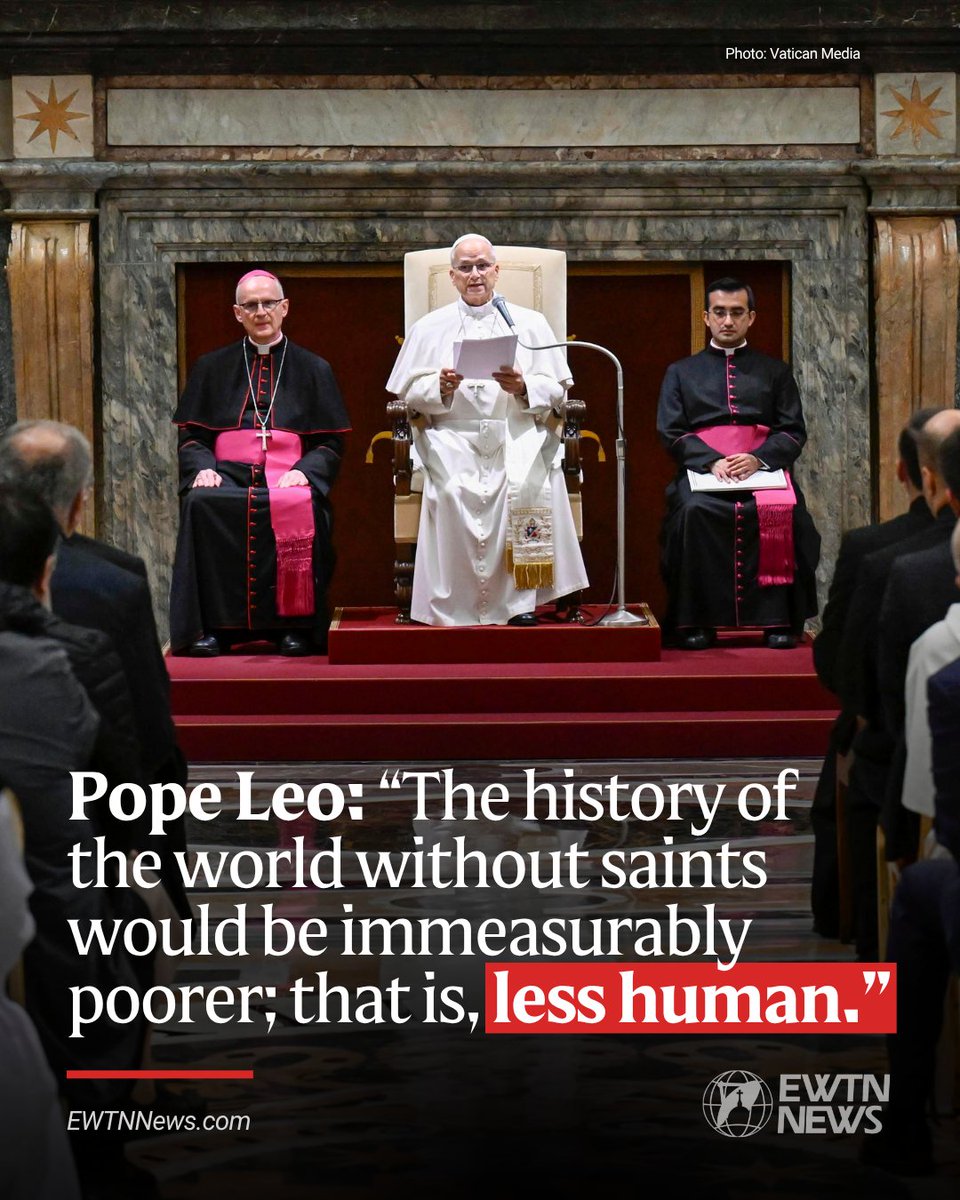
Pope Leo XIV, in his first private audience since undergoing surgery on Oct. 13, said the history of the world is inseparable from the history of the saints.
“The history of the world without saints would be immeasurably poorer; that is, less human,” Leo said in his address.
The pontiff met on Wednesday with participants of the “Holiness in History” conference, held at the Patristic Institute Augustinianum center in Rome from Oct. 19–21. Organized by the Dicastery for the Causes of Saints, the conference explored the role of historical research in determining whether to declare someone a saint.
In his remarks, Leo referenced Pope Pius XI, who established the dicastery’s historical section in 1930, and emphasized that recent causes for canonization must continue to be carefully evaluated against historical evidence of one’s holiness.
“The treatment of ‘recent causes’ likewise cannot dispense with a serious and rigorous examination of all the material collected,” Pope Leo said. “Causes of saints make use of the tools proper to the study of history, even though their aim is not to produce historiography, but rather to bring to light the exemplary nature, spirituality, and reputation for holiness of those proposed for the altars.”
Leo also explained the importance of placing canonized saints in the context in which they lived, eliminating stereotypes and misunderstandings.
“As the ages pass, even the profile of saints may undergo development: not to follow the stereotypes of the moment, but to interpret a particular experience through the categories of the Gospel lived out,” Leo said.
“For this reason, placing the witness of a saint within the context in which he or she lived is very important. The people of God seek models for living in the present, intercessors who help members of the Church face today’s challenges and recognize their opportunities.”
More: https://t.co/k22OttPP43
In a telephone conversation with the Ukrainian President, Pope Leo XIV expressed his hope for cooperation to allow food and medical aid to reach civilians in Oleshky, in the Kherson region, and for their safe evacuation.
https://t.co/ROzBRZWf7F
Sts Isaac Jogues, Jean de Brébeuf, and companions were Jesuit missionaries who brought the Gospel to Native Americans in 17th-century Canada. Despite persecution and terrible suffering, they remained faithful to Christ. Martyred between 1642 and 1649, they were canonized in 1930.
Pope Leo XIV will not travel to his residence in Castel Gandolfo this week but instead continue his recovery at the Vatican, and will hold his Wednesday General Audience on October 21, according to the Holy See Press Office.
https://t.co/SVWqY9WNXj
Today we Catholics celebrate Saint Luke the Evangelist, physician, loyal companion of Saint Paul, and inspired author who gave the Church both his Gospel and the Acts of the Apostles.
With a physician's gentle heart and a historian’s care, Luke illuminated Christ’s boundless mercy for the poor, the sick, and the marginalized. Through his writings, we are gifted the tender mysteries of the Incarnation, the Magnificat of Our Lady, and the enduring parables of the Good Samaritan and the Prodigal Son.
Saint Luke the Evangelist, pray for us!
St. Luke was a physician, missionary, and companion of St. Paul, and he wrote the Gospel of Luke and the Acts of the Apostles, two New Testament books. Although he was not one of the Twelve Apostles, he became an important member of the early Christian community.
St. Paul refers to Luke as “the beloved physician” in his Letter to the Colossians. Luke later accompanied Paul on several missionary journeys. The “we” passages in Acts suggest that he traveled with Paul during portions of his ministry, including the journey to Rome. Near the end of Paul’s life, Paul wrote that Luke alone remained with him during his final imprisonment.
Luke’s Gospel has a distinctive emphasis on God’s mercy and Christ’s salvific mission. He frequently draws attention to the poor, sinners, the suffering, and the marginalized. His Gospel also gives particular attention to women. He includes several well-known accounts found nowhere else, including the Annunciation, the Visitation, the Good Samaritan, the Prodigal Son, and the disciples on the road to Emmaus.
His writings also have special accounts about Mary. His opening chapters provide the most extensive Gospel account of Mary’s role in the events surrounding Jesus’ birth, including her Magnificat. He is also traditionally associated with painting the first Christian icons of the Virgin Mary.
Continuing the story of salvation in the Acts of the Apostles, Luke describes the growth of the Church from Jerusalem to Rome. The Holy Spirit is central throughout his narrative, guiding the Apostles and strengthening them to proclaim Christ.
Tradition holds that St. Luke died in Boeotia, Greece. He is honored as the patron of physicians and artists.
https://t.co/8NGSlzoqJf
During today’s Angelus, Pope Leo XIV thanked everyone who prayed for him during his recovery, expressing special gratitude to the doctors, nurses, and staff at Gemelli Hospital.
He said the experience brought him closer to those facing illness and infirmity and that he will gradually resume his activities “with God’s help and your prayers.”
Let us continue to pray for Pope Leo XIV and all those who are sick.
Pope Leo XIV’s surgeon has approved his Nov. 6–17 apostolic journey to Uruguay, Argentina, and Peru following successful lung cancer surgery, clearing the way for his highly anticipated South American visit.
https://t.co/6DR04RVhQU