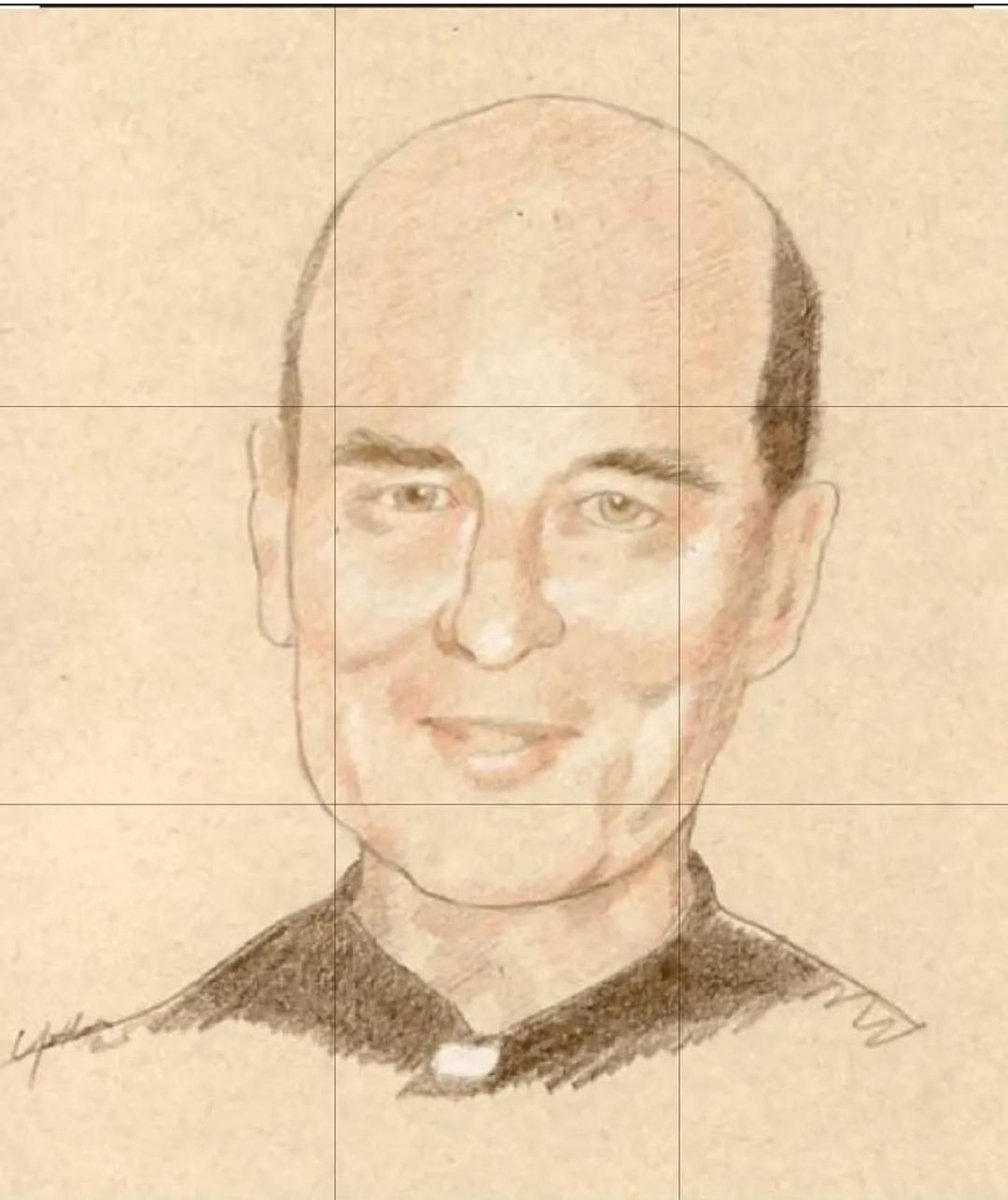
22 June is also the anniversary of the death of Martin Thornton—11 Nov. 1915 – 22 June 1996.
The eulogy of him by Graham Leonard finishes with these words:
“Thank you, Martin, for what you were, what you are, and, because you took God at His word, what you will be. May you enter the glory of which you gave us a vision. May we benefit from your prayers in heaven as we did on earth.”
The audio of my talk at the 2026 Breck Conference at Nashotah House is live!
It is entitled “The English Spirituality of Martin Thornton"—in which I talk about his life, his spirituality, and matters pertaining to his book, English Spirituality.
See links below. 👇
This is the most important lecture on the life of Fr Thornton ever given because of Fr Dallman’s work with the Thornton family, his extensive academic work in Fr Thornton’s corpus, and his contextualization for Fr Thornton’s best-known book, English Spirituality.
A must-listen.
"If prayer can be defined as the living relation between man and God then it is at the very peak of human experience and the greatest of human values which cannot be made subservient to anything else—however "practical.""- Martin Thornton, The Function of Theology
Fr Thornton: "Margery may not be much of a mystic but she was a first-class parishioner, with all the faults and failings that first-class parishioners have. I realize that that is a startling statement; let us call her an ordinary Christian matron, an ordinary parishioner,》
It may be just possible to learn music, algebra, chemistry, or golf by a mixture of text-books, public lectures, and private experiment, but there is no real substitute for personal tuition. Even in more commonplace things such as housework, cooking, or gardening, we rely more than we realize on the advice of others: our parents or our friends. In very little are we really "self-taught"; the successful gardener who makes such a claim has probably spent the early years of his life asking his neighbour if it is time to plant cabbages, and consulting his fellow over the road about pruning roses. In its barest essence, spiritual direction is just as common an everyday principle applied to religious life. In prayer as in most other things the self-taught are not usually very proficient, except possibly in the case of genius and here we are not concerned with genius but "ordinary" Christians, and the more "ordinary" they are the more they need personal direction.
(Chr. Prof., ch. 4)
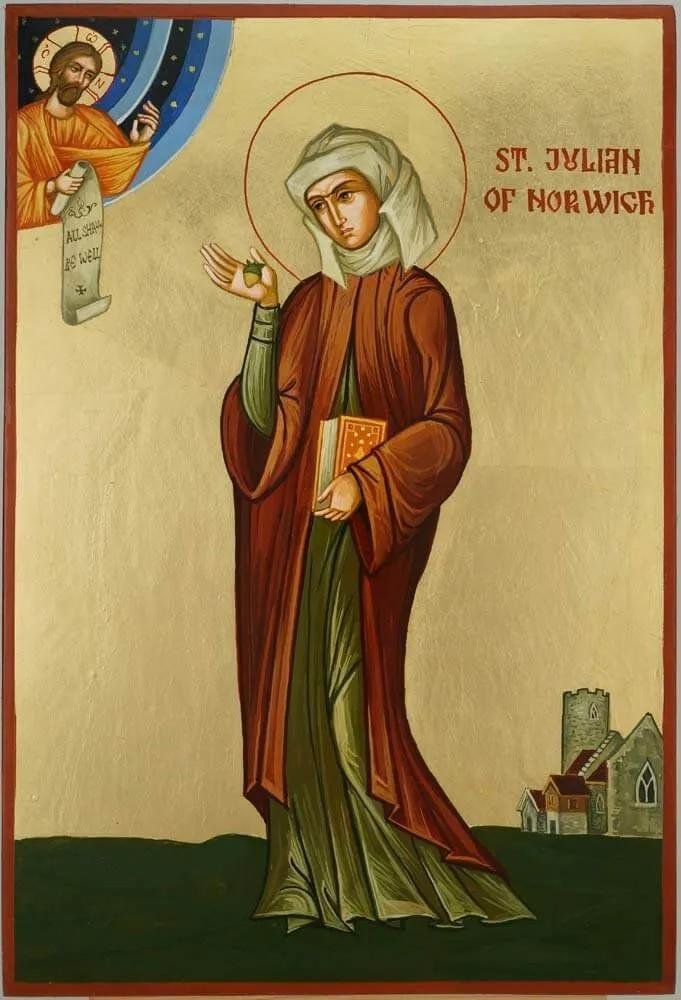
Beneath the political, intellectual, social, and ecclesiastical factors of the Reformation, the English spiritual tradition, after a thousand years of development, continued to flow on in its unobtrusive, or even underground, channel. I suggest that the deep, pastoral religion of the Church, the maturing ascetical integrity of the faithful, retained their native instincts and qualities whatever kings, popes, and prelates may have said or done. Whether by accident or design, Taylor and Ken inevitably succeed Hilton and Rolle, just as they succeeded Anselm and Francis. Julian is spiritual mother to George Herbert and grandam to Keble. Margery Kempe is sister to John Donne, and Little Gidding bears the family resemblance of Sempringham. There are great differences because a tradition lives and moves, but it is the same living stream, the same lineage.
(Eng. Spir., ch. 18, sec. 3)
Although many common Christian duties largely depend on our free-will, acetical theology is grounded on the doctrine of prevenient grace. God always acts first, so there is a sense in which everything is His direct gift.
(Eng. Spir., ch. 2, sec. 1)
It is admirable that Anglican archbishops should meet with Orthodox patriarchs and Roman prelates, but that many an English village parish is grinding to a standstill is no help to the success of such meetings.
(Eng. Spir., ch. 1, sec. V)
At the heart of Anglicanism is the insistence on historical continuity; if our claims are true then our spirituality, that is our total expression of Christian life, as well as our theology, liturgy, and polity, must be retraceable through the medieval and patristic ages to the Bible. I have tried, therefore, to portray the English School as a living tradition, drawing its inspiration and character from all ages, while set within the glorious diversity of Catholic Christendom. Rather than preoccupation with the past, I believe that it is this comprehensive view which can inspire creative insights into the spiritual needs of the twentieth century: a good tree, especially an ancient one, bears new fruit only when attention is paid to its roots.
(English Spirituality, p. xiv)
The Church is the Body of Christ because it feeds on His Eucharistic Body and Blood. The consecrated elements are Christ to the communicant; wholly and completely Christ, divine them into ten thousand fragments and each is *the* Body and Blood of Christ. So the parish is the Catholic Church in microcosm. This Church, moreover, is threefold. The holy concourse in paradise and in heaven does not split itself up into insular parties of patrons-per-parish. If the whole Body is complete at every altar, the whole Communion of Saints are in attendance at every altar. As Lady Julian saw all creation in a hazelnut, so her hazelnut comes to universal size. When parochialism is organic and when ye are the Body of Christ, it is the antithesis of narrow but it is, in place, the Catholic Church. There is but one Bread, so each altar is microcosmic of the Throne of the Lamb in heaven. There is one Church and one Body, so that the work of each server, each organist, each verger, each good lady who arranged the flowers is of Catholic significance *because* it is truly parochial. This is why the Church's Office, said by two souls in the village church on Monday night, is an infinitely tremendous thing; the “special” service with its teeming congregation is trivial by comparison.
(Pastoral Theology, ch. 4)
When I am on a long journey I sometimes like to think of our Lord sitting in the car beside me. That is a sensible act of recollection, and it is no use the scholars objecting because there is no record of Jesus riding in a car. It would be equally wrong for me to claim that he did and start building theories on it. But of course meditation is necessarily guided by grace and so the plain fact is this: complete imaginative freedom in meditation is earned by “necessary obedience,” so let us make our Communion regularly, recite the Office constantly, live truly with the mystical Body; then sit in an arm-chair with the New Testament and give our imaginative faculties reasonable freedom: let our Lord really live in our hearts and in our homes. But we are in danger so soon as any part of the total Christian life gets left out.
(Purple Headed Mountain, ch. 6)
Anglicanism ever refutes the notion that is a sui generis seventeenth-century invention, but rather that it is the result of continuous historical development. The seventeenth century may indeed be seen as the first full flowering of our tradition; a glorious new bloom that, like any pure breed, is derived by careful selection and cross-fertilization. Anglicanism has a pedigree going back to the New Testament, a spiritual lineage derived from the accumulated wisdom of the past.
("The Anglican Spiritual Tradition")
Our hope lies not in the precarious security of international alliance, neither in material schemes for social improvement nor even in mass exhibitions of religious emotion, but in a spiritual, creative power, emanating from some modern equivalent of Isaiah’s “Faithful Remnant.” But can we find such a modern Remnant? Or is there any sphere within the modern world wherein the fullness of personality might be nurtured?—which remains fundamentally free from those modern encroachments which are so truly, if subconsciously spoken of as soul-destroying?
(Rural Synthesis, ch. 1)
It would be untrue to say that Protestantism inevitably reduces the Church to a mere congregation of believers in this world, yet, in general, it remains suspicious of the full Catholic doctrine of the divine, ontological entity, eternally grounded in the permanence of the sacred humanity of Christ, embracing the saints in heaven and the departed in paradise; the Mystical Body of Christ in its fullness.
It is not the purpose of this book to argue the question of the doctrine of the Church as such, but rather to point out what is so often overlooked; that it is this confused view of the Church which prevents Protestantism from formulating any consistent doctrine of prayer. Whatever view is held by individual writers, few acknowledge the inseparable connection between the doctrines of prayer and of the Church, thus prayer is divorced from worship, and degenerates into an appendage to life: diversity of gifts have been abstracted from the unity of the Spirit. It will be argued that, if ascetical theology depends upon an accepted doctrine of the Church as the Body of Christ, then Anglicanism fares no better than Protestantism, exemplified by my quotation from Brunner. And equally varied body of opinion may be found in the ranks of the Church of England, but the significant difference is that, however abused, misused, and misunderstood, Anglican ascetic is rooted in the Book of Common Prayer, which follows the universal pattern of Eucharist, divine office, personal devotion and habitual recollection, traceable through Saint Benedict to the New Testament. As an ascetical system the Book of Common Prayer presupposes the Catholic doctrine of the Church. As an ascetical system the Book of Common Prayer presupposes the Catholic doctrine of the Church.
(The Rock and the River, ch. 2)
In Anglican practice, common rule is embraced in one of two ways: by becoming an oblate, tertiary or companion of an established religious order or society, or by a purely parochial prayer-group or guild (there is nothing whatever to prevent half a dozen friends or parishioners from setting up a common rule among themselves.)
In favour of the former it is argued that great profit ensues from being associated with a large and firmly established community of prayer. The companion of a religious order both takes and gives his share in the total spirituality of the whole; guidance is forthcoming, and in times of relaxation, aridity, or sickness there is something comfortably solid and stable upon which to fall back. It is the doctrine of the Catholic Church expressed locally and tangibly. Such advantages are not lightly to be set aside; yet I think, on balance, that the more precarious parish prayer-cell or guild—or even group of friends—offers the more creative method.
The former is inclined to get littler further than comforting theory. Nothing very practical is added to the mere doctrine of the unity of all in the mystical Body when one’s “companions” in the companionship are dispersed over the globe; there is little practical significance in keeping common rule with merely a list of names.
The latter method—the parish group—forfeits the admitted value of strength and stability, but I think the loss is offset by the factual expression of love, fellowship, and support of those in close social proximity. There are two further advantages of considerable importance. All Christianity must contain a local element. Whatever our rule, our relations with others, or with a director, we are, by virtue of being Christians, essentially parishioners. If you cannot have an “isolated” Christian, nor can there be one who is not a member of, in the widest theological sense, a “parish,” because that is the working unit of Christian sacramental life. “Parochialism” is a question, not merely of organization and administration, but of theology.
Secondly, with rule on a parochial basis, much of it can be shared literally in common; certain the Eucharist and possibly the Office. Once the Office is recognized as the offering of the Church, it may be of some significance to know that it is being shared by a particular list of people whose names and addresses are familiar; but to say the Office in your parish church with George from next door and Mary from over the way is a much more creative thing.
We must not rule out the possible ideal of combining the best of both sides. If a parish contained six or eight tertiaries or companions of the same community, we should have an arrangement as nearly perfect as one dare hope.
(Chr. Prof., ch. 5, sec. 3)
Rule is just not intended for legalists, it is completely incompatible with that type of outlook: it pre-supposes a soul enlightened by the living Spirit of Christ, it has no use at all for the dead letter of the law.
(Chr. Prof., ch. 5)