@fathomjournal published over 130 pieces in 2024. There was hopefully something for everyone (we used to promise that there would be one essay in every issue that someone wouldnt like!). Here are 13 of my favorites - a thread
David Stromberg explores his bond with Israel in relation to that of the writer Jean Améry. Like Améry, he feels alienated by aspects of Israeli politics. Unlike Améry, however, Stromberg’s bond with Israel is that of an Israeli and not of a Diaspora Jew. ‘I can relate to the ineffable nature of this connection – to the sense that something that can’t be put into words but that can be experienced in extremely powerful ways binds you to this country.’ https://t.co/ic2338u89M
@goldman1007 details what he terms the cynicism behind Israel's new death penalty law & maps how the Talmudic tradition and mainstream religious Zionist broadly opposes the death penalty. ‘The real story is not the gallows,’ he adds, ‘It is the mechanism by which a culture-war manoeuvre was laundered through the language or perversion of Jewish law, national security, and the grief of bereaved families.’ https://t.co/rgcBHJWgBY
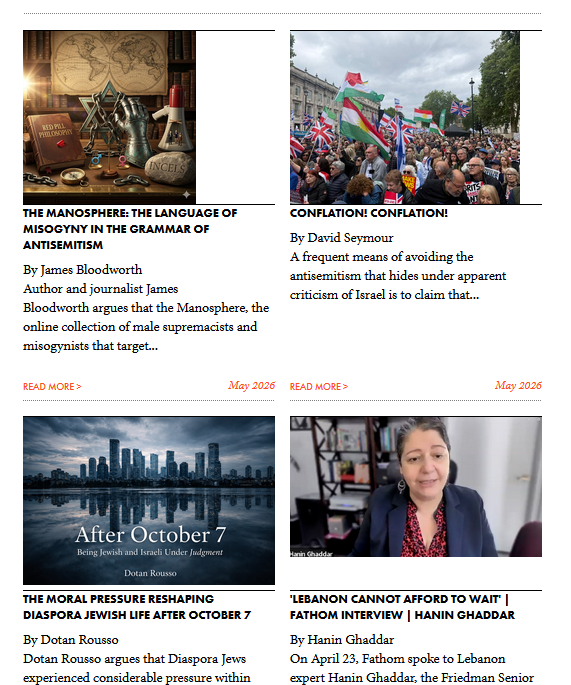
Dotan Rousso maps how following the Hamas attacks of Oct 7, Diaspora Jews experienced considerable pressure within their personal, professional, and social spaces to distance themselves from Israel. "In these settings, nuance did not soften the accusation; it merely complicated its delivery.” https://t.co/Kgd6G9yKmZ
In his essay, Conflation! Conflation! David Seymour contends that a frequent means of avoiding the antisemitism that hides under apparent criticism of Israel is to claim that hostility to Israel is legitimate and accusations that it could be antisemitic are an unfair conflation. https://t.co/VJe1vJkENO
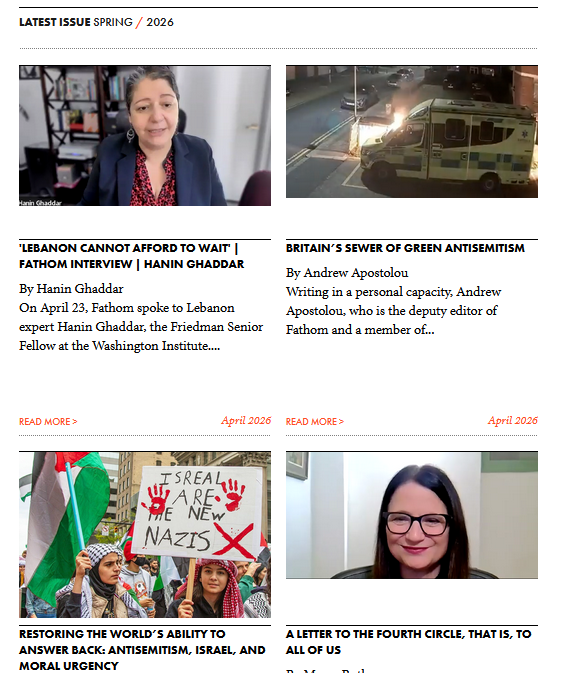
Joanne Strasser examines why discussions about antisemitism are so fraught. She argues 3 factors prevent an actual exchange of views about facts: people confuse what is the case, what social conventions allow them to say, and what appears to be the moral urgency. https://t.co/07g4tcJEZD
Andrew Apostolou argues that the Green Party has allowed antisemitism in its ranks and fails to grasp the seriousness of recent violence against synagogues and Jewish institutions. “Polanski is certain there was a genocide in Gaza,” Apostolou notes, “but unsure that firebombing synagogues is a real form of unsafety.” https://t.co/OdpvlpJbjd
TO DANCE WAS FORBIDDEN. TO SING WAS FORBIDDEN. TO LOVE WAS FORBIDDEN
سی صد گل سرخ و یک گل نصرانی –ما را ز سر بریده میترسانی؟
Three hundred red roses and one wild rose – and you think a severed head frightens me?
https://t.co/u17uwBpd5y
@AlirezaNader@omid9
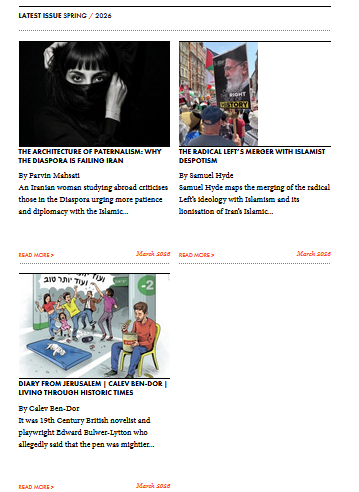
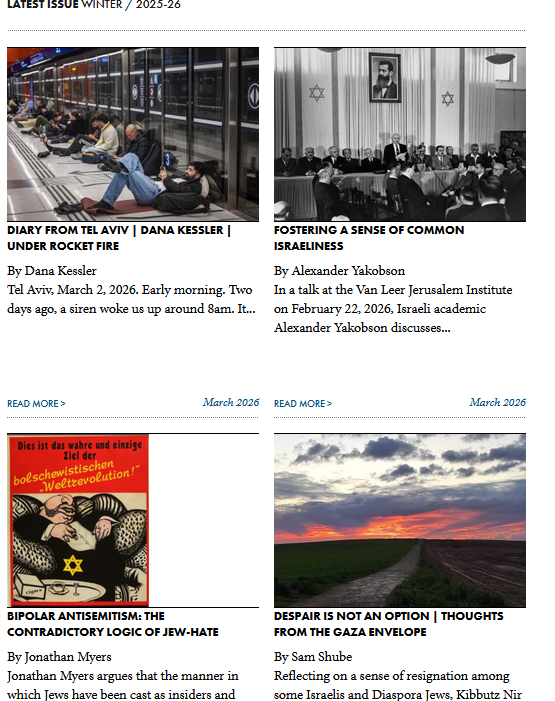
@Fathom_Editor reflects on living in historic times while dealing with prosaic challenges of daily life with missiles and safe rooms. For Yehuda Amichai, the real miracles happen at the next table of a restaurant in Albuquerque, where two women are sitting and the other said, I kept it together and didn’t cry. For us, they happen when Israelis run with children to shelters at 4.10 am, or sleep in metro stations. https://t.co/BCjBmy4a8Z
Samuel Hyde maps the merging of the radical Left’s ideology with Islamism and its lionisation of Iran’s Islamic revolution arguing that the demonstrations after Khamenei’s death and the pledges of allegiance to the Iranian regime represent the continuation of this intellectual inheritance https://t.co/qAXUIGYr27
Jonathan Myers argues that the manner in which Jews have been cast as insiders and outsiders, victims and oppressors, moral exemplars and moral failures represents ‘bipolar antisemitism’ https://t.co/4CXYb1CT7A
Alexander Yakobson discusses national and civic identity in Israel as a Jewish and democratic state. He suggests distinguishing between: Jews in Israel & Diaspora as a ‘people’, Jews in Israel as a ‘nationality’, & an Israeli ‘civic nation’ that includes all the citizens of the state – Jews, Arabs and others https://t.co/upJThm2BSB