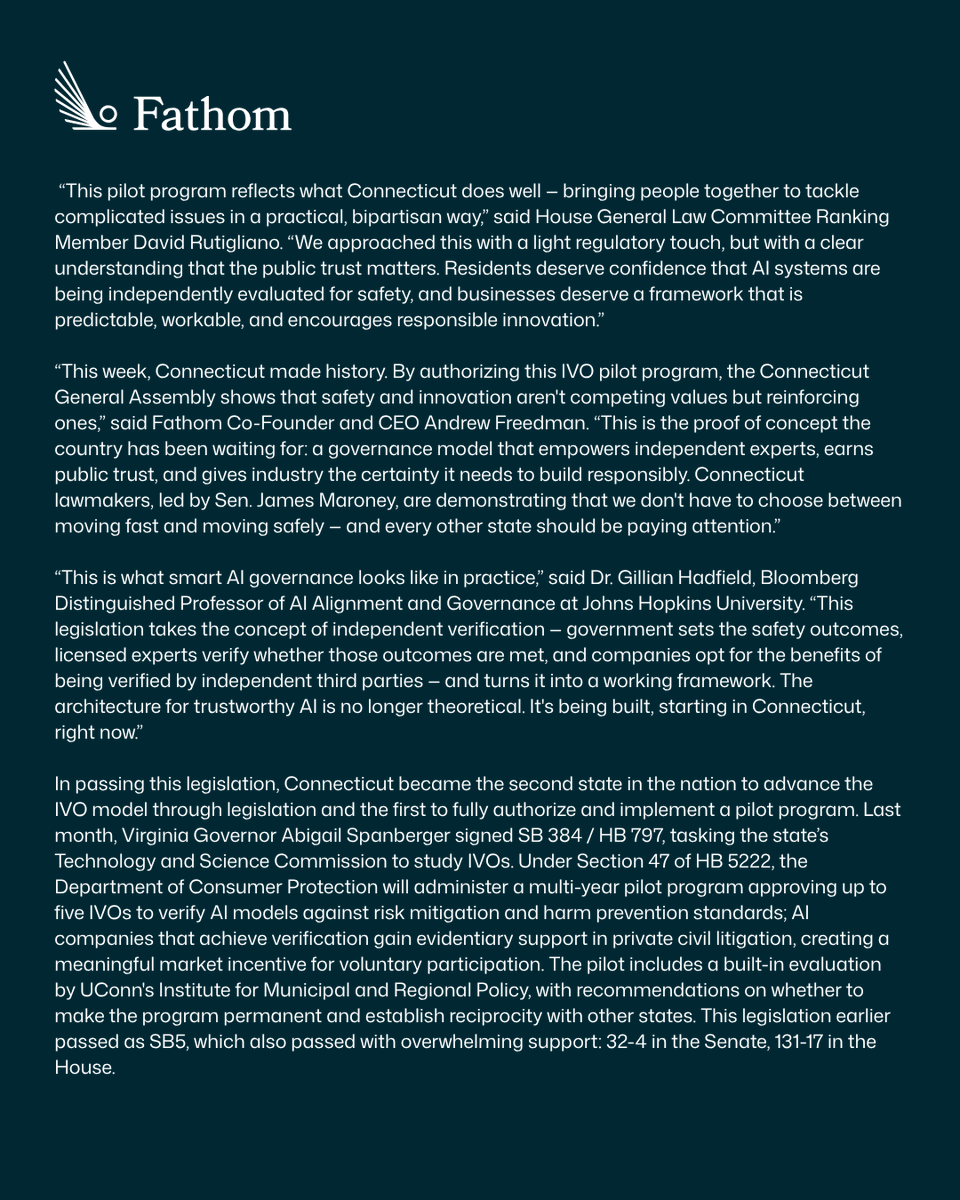
The Connecticut General Assembly passed House Bill 5222, legislation that includes a first-in-the-nation voluntary pilot program for Independent Verification Organizations (IVOs) in Connecticut.
Our full statement:
Sam Altman called for a New Deal-scale social contract for AI. Weeks later, he said the “jobs apocalypse” he’d braced for hadn’t arrived.
That tension captures the challenge: AI’s impact on work is uncertain, but the window to prepare may be short.
History won’t hand us a playbook. But it can stress-test our assumptions.
New on our Substack ⬇️
IVOs don't replace tort law or hand companies immunity. They give everyone — users, companies, deployers, regulators — a shared standard to aim at before harm occurs. Florida confirms the tort storm is here. The question is whether we govern AI one lawsuit at a time, or pair litigation with proactive verification.
Full analysis: https://t.co/j4PYPoewBT
Florida recently sued OpenAI and Sam Altman — the first state to target an AI company over product design and safety. We saw this coming.
A thread on AI liability and what's really at stake 🧵
Florida's attorney general filed a lawsuit against OpenAI and its chairman Sam Altman, alleging that the AI startup’s ChatGPT is unsafe.
It contends that ChatGPT has provided assistance for mass shootings, and poses addiction and suicide risks to users.
https://t.co/MPsUYyMe0F
That predictability gap is why we call for Independent Verification Organizations: expert bodies that translate goals like "don't materially encourage self-harm" into concrete, continuously updated, testable criteria — verified on an ongoing basis, not reconstructed after a tragedy.
Crucially, verified compliance becomes evidence of reasonable care that companies can point to in court. That's the incentive to actually meet the bar.
Thank you to @SenatorMaroney for championing SB 5 and building the bipartisan coalition behind it. The IVO pilot signed today empowers independent experts, earns public trust, and gives industry the certainty it needs to build responsibly.
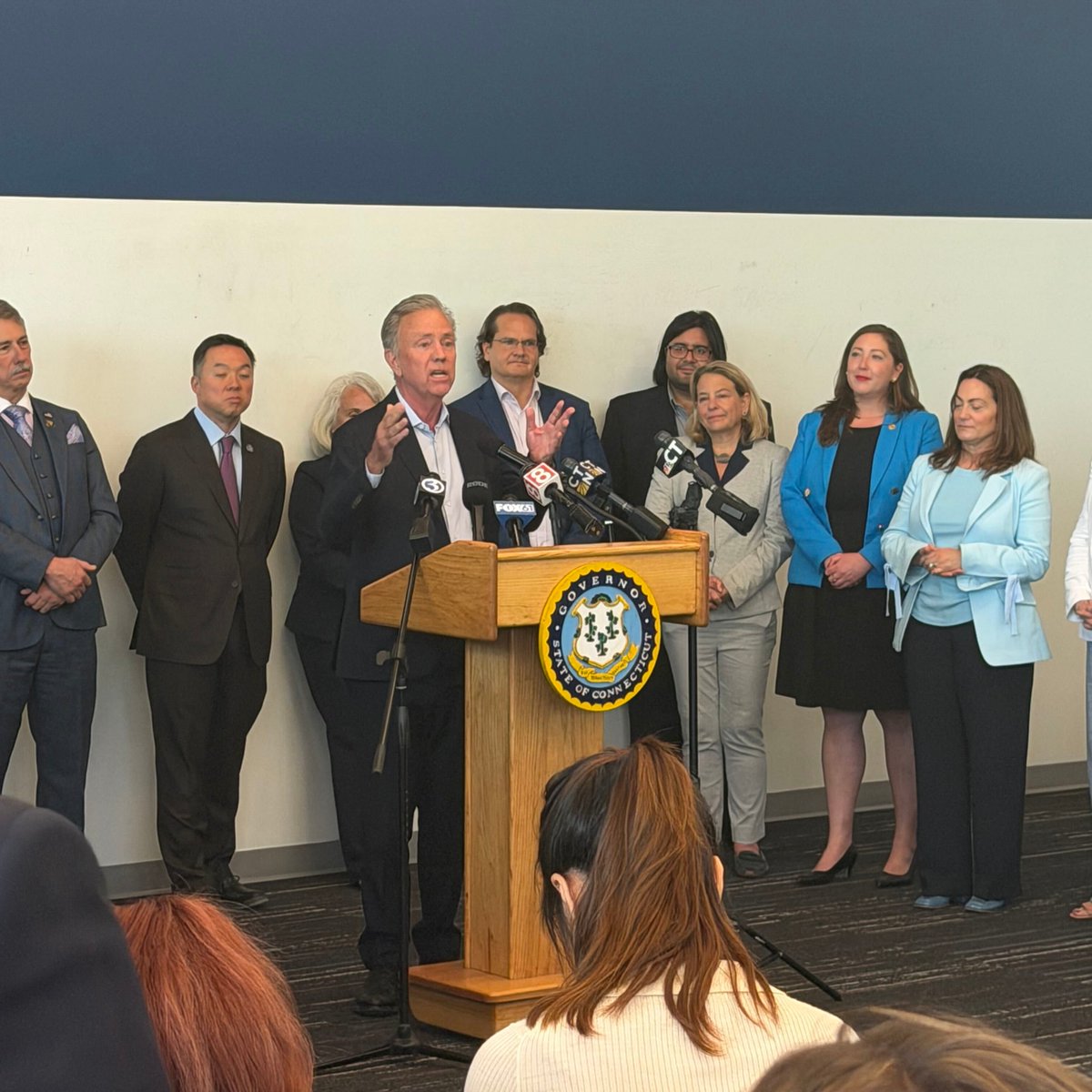
Today, Gov. Lamont signed SB 5 into law, officially establishing a voluntary pilot program for Independent Verification Organizations (IVOs).
The government sets safety outcomes. Independent experts verify whether AI products meet them.
Companies that voluntarily participate earn a trusted signal in the market, building consumer confidence while supporting innovation.
ICYMI: Rep. Ty Mathews Op Ed on why Ohio's IVO framework works. HB 628 creates a marketplace of independent, expert-led bodies to test AI products against real safety goals. Not red tape. Market-driven assurance.
Government sets the goals and maintains oversight. Independent verifiers do the testing.
Right now, the gap is real: parents can't tell which AI tools are safe for their kids, hospitals lack assurance on privacy protection, banks have no way to verify resilience.
@mathews4ohio's closing point: smart governance and innovation aren't in tension, they're mutually reinforcing. Voluntary certification becomes a market signal. That's how Ohio leads.
Huge congrats to @Thomas_Woodside and SAIP, and to @EncodeAction, on passing SB 315! This is a major moment for AI accountability in Illinois and across the country -- kudos to all involved.
.@mathews4ohio explains why Ohio's HB 628, a voluntary, market-driven framework for independent AI verification, is how you attract innovation and build public trust.
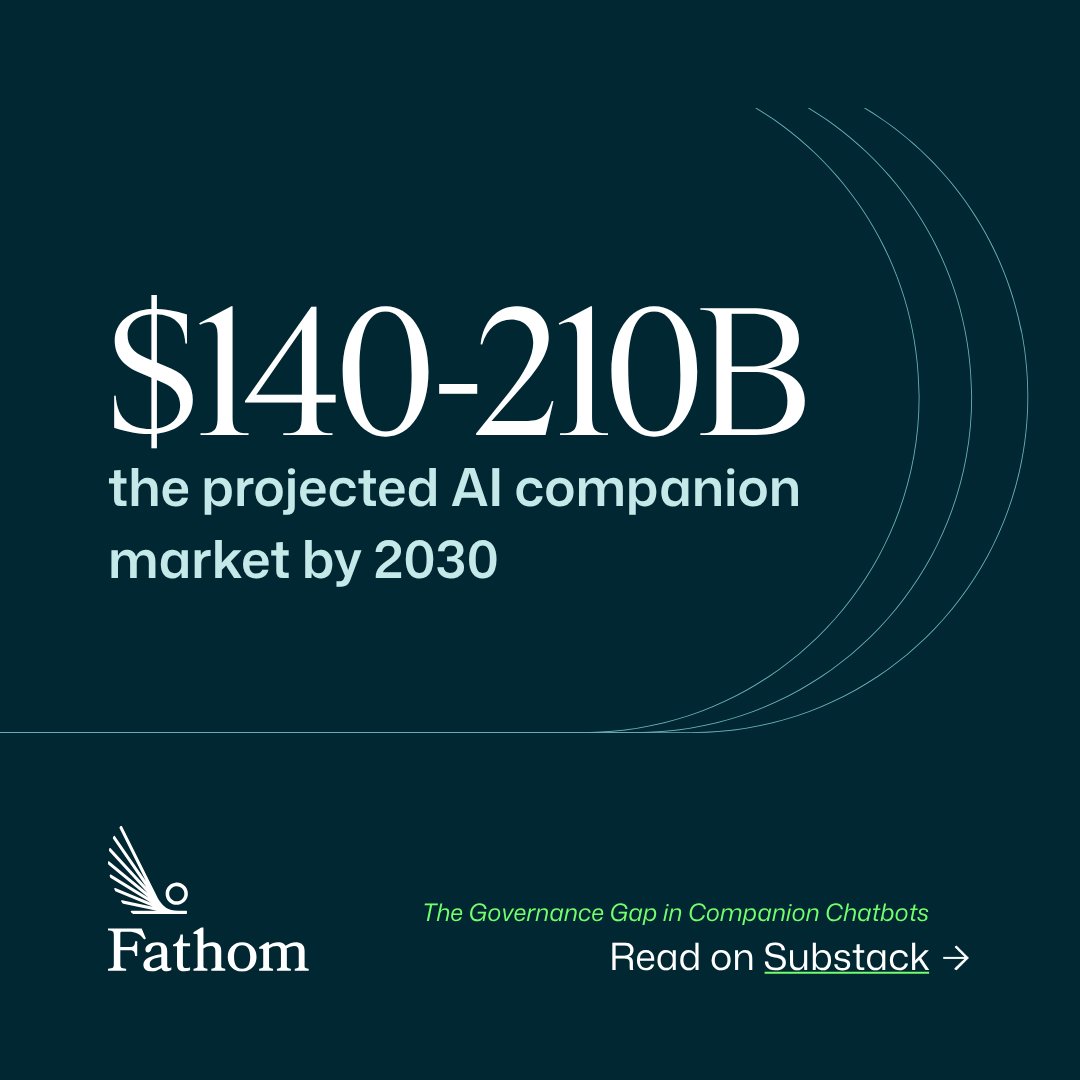
The Governance Gap in Companion Chatbots: How do you put guardrails on a system that isn’t failing — but working exactly as intended?
https://t.co/sUApfnOoA5
In our latest poll, we asked which guardrails people want for AI.
Preventing users from developing an unhealthy emotional bond with the AI tool ranked first by support: 76% overall support it and 47% strongly support it.
It's the guardrail Americans feel most strongly about, and the one our governance system is least built to deliver.
Read our latest Substack on why companion chatbots are the hardest version of this problem, and what kind of governance actually fits. 👇