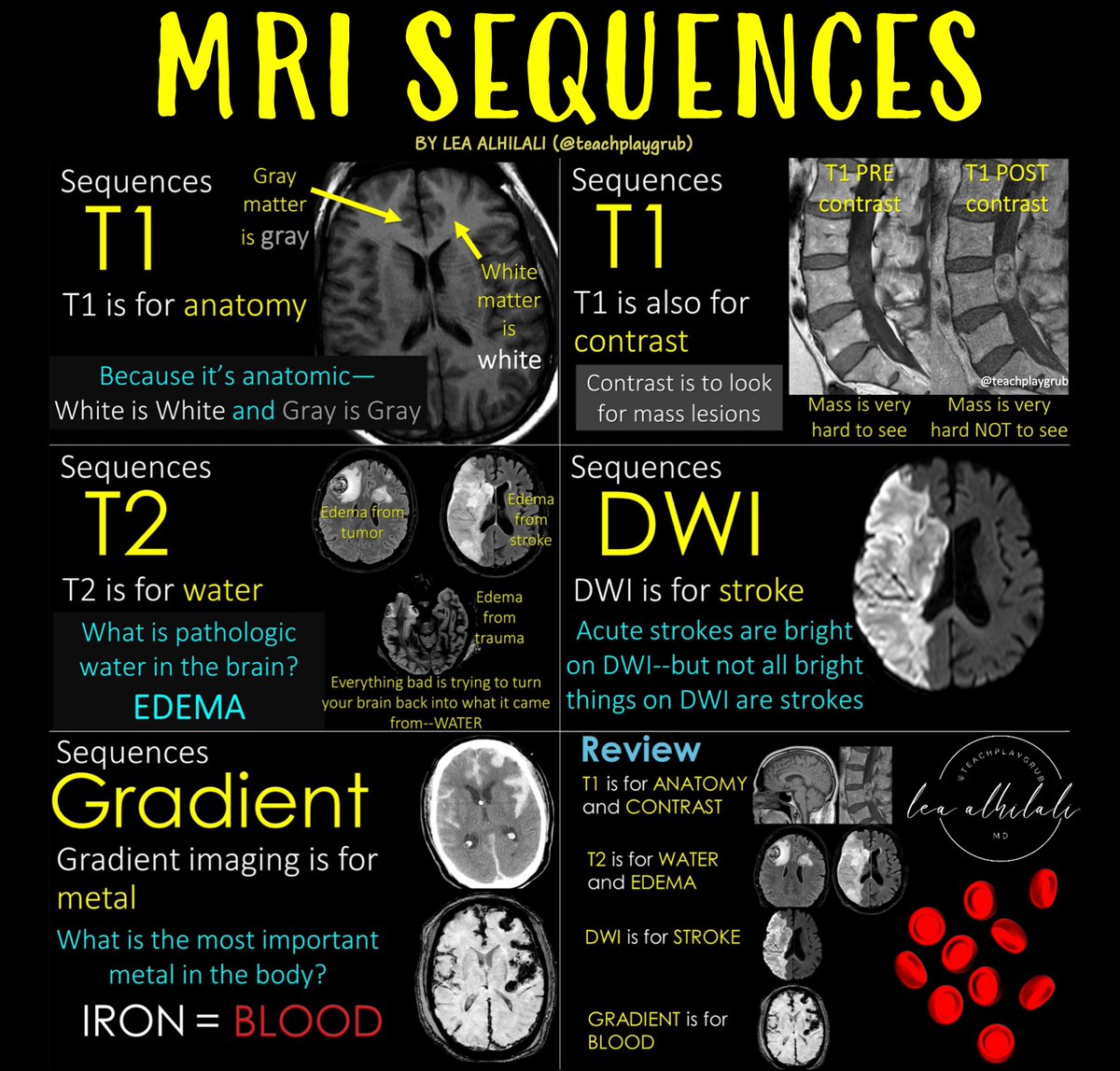
If you aren’t cheating, you aren’t trying!
Are you looking at MRIs?
Feeling some confusion about the diffusion?
Feel impaired when it comes to the FLAIR?
Wish you could cheat a little?
Here’s a post to help you cheat on all the sequences you NEED to know if you are looking at MRIs!
--T1: It’s for anatomy, so brain structures reflect the same color as real life. So gray matter is gray on T1 & white matter is white on T1. It’s also for contrast. Contrast material is taken up by masses making them light up & them easier to see.
--T2: It’s the water sensitive sequence. What is pathologic water in the brain? Edema! My attending once said, “Everything bad in this world is trying to turn you back into what you came from—water."
-- DWI: Diffusion detects stroke, which are bright on diffusion. But anything that makes space tight in the brain can be bright on diffusion (highly cellular masses, clotted blood, pus under pressure, etc.)
--Gradient: Gradient is sensitive to metals. And what’s the most important metal in body? Iron—bc iron is in blood. So gradient is our blood sensitive sequence
So now you know the basic MRI sequences and what they are used for! Now you get rid of all pretenses when it comes to MR sequences!
Is cranial nerve anatomy making you nervous??!!
High resolution SSFP imaging can visualize cranial nerves, typically for pts w/microvascular compression
But knowing their anatomy & location can help you on any imaging—bc if you know where they are, you know if they may be involved
Here’s what you can see on MRI:
Olfactory: along anterior cranial fossa above the cribriform plate
Optic: from globe, posteriorly through the orbit until intracranially optic nerves join to form chiasm
Oculomotor: from between the cerebral peduncles to cavernous sinus
Trochlear: From back of the midbrain at the aqueduct to cavernous sinus
Trigeminal: From pons at the middle cerebellar peduncles into meckels cave
Abducens: From undersurface of inferior pons anteriorly to dorello canal along clivus
7th/8th complex: From undersurface of inferior pons laterally to the IAC
Glossopharyngeal & vagus: from medulla where it looks like a clover to the jugular foramen
Hypoglossal: from medulla where it looks round like the spinal cord to the Hypoglossal foramen
Hopefully all this info of cranial nerves didn’t get on your last nerve!!
I actually do love being on a zoom call and admiring how beautiful I look in the fuzzy webcam camera. it’s like a modern impressionist painting. degas painting young professionals