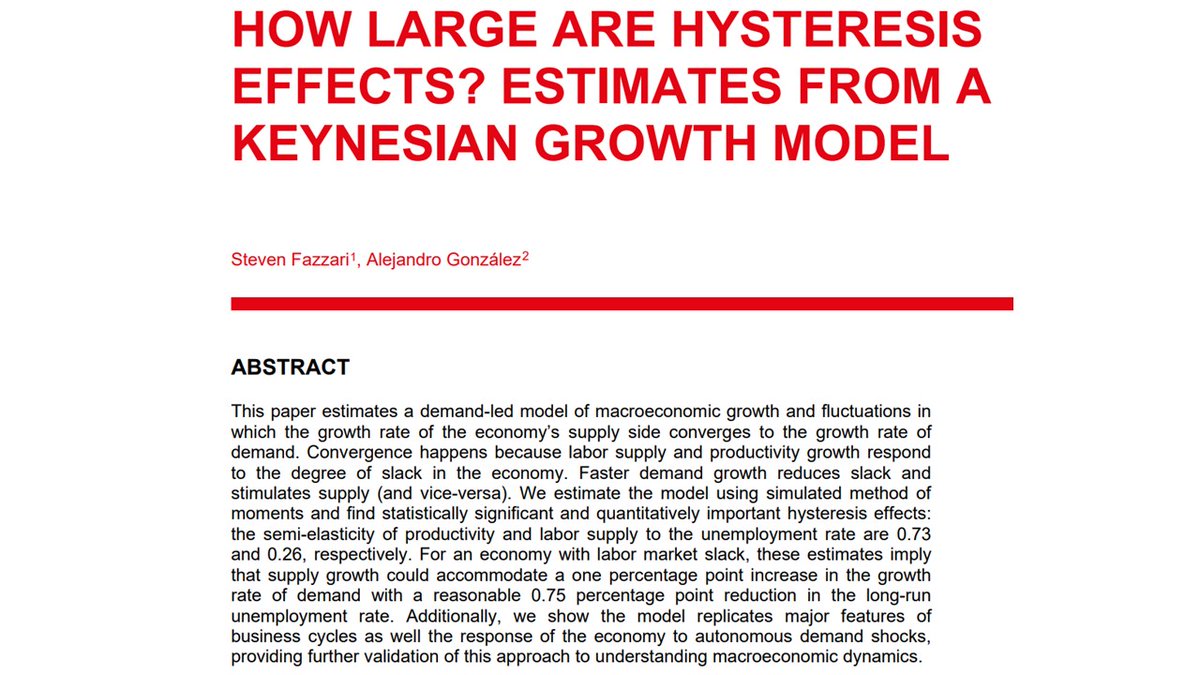
@AlejandroPh_C Glad to see my terrific PhD student on the job market. Insightful and impactful job market paper. Folks can learn a lot from Alejandro. I sure have!
See our April 2023 hysteresis paper and the Cambridge Journal 2020 paper for models and econometric evidence consistent with this recent history. Both linked here: https://t.co/MWzCrQG2D0 3/3
Recent US macro data are consistent with the concept of demand-led growth with accommodating supply as described in our evolving research. Nice article by @vtg2 on Politico on the economy liberals hoped for: 1/3
"With higher incomes, people would be able to spend more, which would fuel the economy ... It could also yield higher productivity, as companies invested in technology to better meet demand.
Higher wages, higher growth, higher productivity. " 2/3
New paper from my long-lasting project with @BCynamon and Daniel Cooper that develops and implements a comprehensive measure of American household economic well-being. Barry's tweet summarizes some key takeaways.
Thanks for the shout out. Minor cringe when I see "excess saving" or "saving glut." There is no "saving" without corresponding expenditure defined as something besides consumption. To me, "excess saving" means deficient demand. Data updated through 2020: https://t.co/uJO2PDH35G.
🚨 New Working Paper Alert 🚨
Can higher demand growth stimulate productivity growth and labor supply growth? If so, by how much?
In this new paper co-authored with @FazzariSteven, we show that the answer is 'Yes, a lot'.
Link and short thread below!
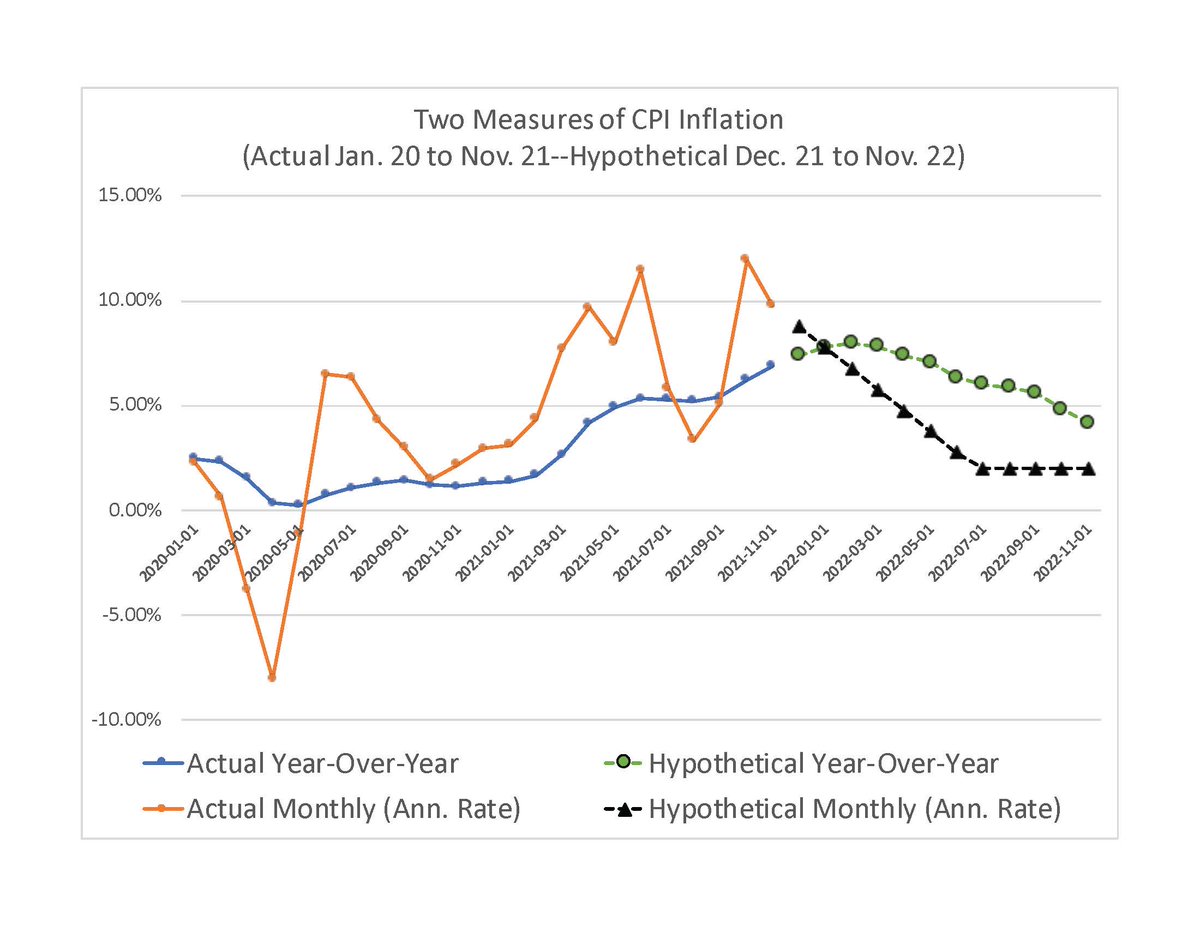
Year over year (Y/Y) measures can be misleading. If monthly CPI inflation were to fall one percentage point (annual rate) every month starting in 12/21 until it hit 2%, Y/Y measure would still keep rising through 3/22 and stay above 5% through 9/22.
@JWMason1 Important conversation. A good understanding of macroeconomics starts with a good understanding of basic accounting: spending creates income / not spending destroys income.
Nice work by @SGechert and friends reminded me of an old obscure paper. Seems like I had it pretty much right in 1998! Maybe 21st century social media will make "Capital Income Taxes and Economic Performance" more popular. https://t.co/MWzCrQFuNs (at the bottom)
@SGechert@DomiEhrenberger@RevEconDyn Congrats Sebastian et al. Great work on an important topic. My results for the elast. of sub: basically zero (Levy mid 1990s); 0.25 (J Pub Econ, 1999); about 0.50 (J Bus & Econ Stats, 2011). I probably believe 1999 results most. Thrilled with the 0.3 consensus here.
Hurray! Together with great coauthors @DomiEhrenberger, Tomas + Zuzana we finally got it published: Our #metaanalysis on the elasticity of substitution b/w capital and labor, a.k.a. the “Death to the Cobb-Douglas production function” made it to the @RevEconDyn. Thread:
Very important. Yes, the US unemployment rate fell to low levels before COVID. But the US economy never came close to recovering its pre-Great Recession trend. Also, it never came close to matching pre-Great Recessions "potential" output forecasts.
I think this point is well understood by anyone who actually paid attention. Who disputes is just pushing tired ideology & needs 2 be called out 4 it. Also see https://t.co/R1xAHGshwc. The article on the (zero) "Trump effect" by Born et al. is just out online in @PolicyStudiesTF
Important observations from EPI on state/local funds in the ARP. Look at figure A. Much of what state/local governments need is the result of anemic growth prior to the pandemic.
https://t.co/RSqL7kF2pf
I make a related point in my Jan. 19 INET article.
Hey #EconTwitter! I’ve got some research to share. My professor @FazzariSteven and I compared unemployment inequities during the Covid and Great recessions for groups based on gender, race, age and educ.
Covid is different and women/less educated are getting hit hard. /1
The federal rescue bill passed the House. Biden will sign it. Good! Here are my thoughts about the package from almost 2 months ago:
https://t.co/7PMJHUoABi