Xinhua: "China's outstanding external debt came in at 2.4121 trillion U.S. dollars at the end of March 2026, up 83.3 billion U.S. dollars, or 4%, from the end of 2025."
That's a rapid increase (15% annualized), but with its huge trade surplus and at least $5-6 billion held by the PBoC, the CIC and state banks, China's external debt is very manageable.
https://t.co/TWl9xuTEDB
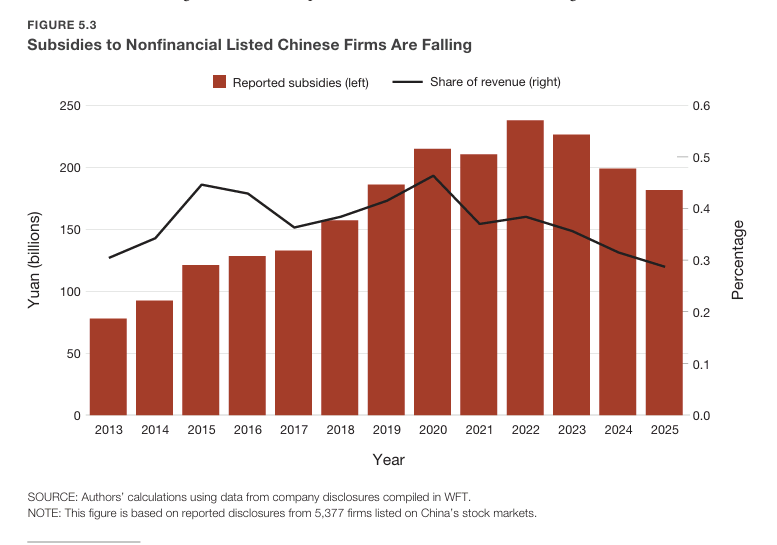
FT: "China’s premier Li Qiang attributed his country’s competitiveness to technological innovation as he dismissed international complaints over state subsidies. “The key to the competitiveness of Chinese products is not, as some people claim, that it relies on government subsidies,” he said, adding that “the Chinese government is not that wealthy, nor can it afford them”."
This is not the first time this argument has been made. I attended a presentation two weeks ago by a Chinese economist who advanced a similar claim. He supported it, however, by defining "subsidies" so narrowly that they could effectively be dismissed.
He measured subsidies mainly as direct outlays by the central government to manufacturers that are explicitly listed in the "subsidy" accounts of corporate financial statements. In doing so, he ignored credit and interest-rate subsidies, equity support, currency undervaluation, restrictions on labor mobility, government overspending on logistics and transportation infrastructure, environmental costs, and nearly every other policy or mechanism that helps explain China's unusually low household share of GDP.
But this way of thinking misunderstands the nature of subsidies. The most important subsidies are often not direct and explicit fiscal transfers. They are instead implemented in the way income, costs, and risks are distributed throughout the economy. It is mainly the distribution of income from one sector of the economy to another, in other words, that explains large, persistent trade surpluses.
This is why discussions about competitiveness should begin not with transfers that are specifically identified as subsidies but rather with the economic system as a whole. Trade imbaances are systemic. They cannot be explained solely by looking at whether particular companies receive direct government grants or tax breaks.
It is not just coincidence, for example, that countries with large and persistent trade surpluses are far more likely to be countries in which the household share of GDP is relatively low than countries that are especially innovative technologically. The United States, after all, remains arguably the most technologically innovative economy in the world, and yet it has run trade deficits for decades.
China, by contrast, has run large trade surpluses for decades, even though its emergence as a leading technological innovator occurred mostly in the past ten to fifteen years. If technological sophistication automatically translated into trade surpluses, the relationship between innovation and trade balances would look very different.
The claim that technological efficiency necessarily leads to large trade surpluses has never been true. What is true is that in a well-functioning economy, higher productivity should raise household income and therefore increase household welfare. More efficient production should generate higher wages, higher consumption, and stronger domestic demand.
Put differently, if technological efficiency allows a country to export more, it should also allow its households to import more. Rising productivity should increase both a country's capacity to produce and export and its capacity to consume and import. But in China, it is mostly the former that we see.
This is why the distinction between efficiency and competitiveness is so important. Efficiency means producing more output with fewer resources. Competitiveness, by contrast, refers to the ability to expand production and market share regardless of profitability. While greater efficiency can certainly improve competitiveness, it can also be enhanced by transferring costs away from producers and onto households.
What is more, if China's manufacturing competitiveness is indeed based primarily on technological efficiency rather than on direct and indirect subsidies, it should be possible to reverse many of the transfers from households to producers without undermining China's manufacturing success.
China could, in other words, engineer significantly higher wages, a more robust social safety net, higher interest rates, and a substantially stronger currency. These policies would raise household income and increase consumption. If competitiveness really reflected superior technology and productivity, Chinese manufacturers should remain highly competitive even after households received a much larger share of the benefits generated by economic growth.
In that case, not only would the welfare of Chinese households rise in line with China's manufacturing efficiency, but the rest of the world would also benefit from a corresponding increase in Chinese imports. The fact that China has struggled to do this, despite many years of promises to boost consumption, suggests that direct and indirect subsidies play a much larger role in China's competitiveness than many are willing to acknowledge.
Perhaps the clearest evidence lies in China's debt dynamics. China has experienced one of the fastest increases in debt ever recorded for a major economy. Yet with much of that debt representing either direct or contingent government liabilities, and with China simultaneously maintaining one of the lowest household consumption shares in modern history, it is difficult to argue that the debt has primarily been used to support household spending.
Instead, the evidence suggests that debt has been used directly and indirectly to support production and investment. More importantly, the persistent rise in the debt-to-GDP ratio implies that much of this investment has been economically inefficient. If investment were consistently generating sufficient economic returns, debt would not be able to rise so rapidly for so long relative to GDP.
None of this means that Chinese technological achievements are unimportant. On the contrary, China's advances in manufacturing, engineering, batteries, telecommunications, electric vehicles, and many other sectors are real, but this does not explain why Chinese manufacturing is so competitive across the board. Instead, this view reflects a widespread confusion between efficiency and competitiveness, and one that we have seen many times before in modern history, most obviously in the intense disagreements over the sources of Japan’s trade surpluses in the 1980s.
The bigger problem, as I see it, is that there is no meaningful agreement between China and its major trading partners on the real causes of global trade imbalances. The former views China's surpluses primarily as the result of technological success and market competitiveness, while the latter mostly views them as the result of policies that systematically suppress domestic consumption and subsidize production, either directly or indirectly.
History – again, most obviously, the history of the intense disagreements over the sources of Japan’s trade surpluses in the 1980s – suggests that when major economies cannot agree on the causes of persistent trade imbalances, they won't agree on the solutions. And if trade conflicts are ultimately resolved without a shared understanding of the underlying problem, the adjustment process is likely to be more costly than anyone initially expected.
The most important question is not whether today's trade tensions will eventually be resolved. They will be. More important is how the costs of adjustment will be distributed among China, the United States, Europe, Japan, India, and the rest of the world. That is a question we should probably approach with some trepidation.
https://t.co/o6ru3fJk8z
🇨🇳 #China to Step Up Fiscal Support to Boost AI Consumption - Statement
➡ China will ramp up fiscal support to spur AI consumption while advancing broader measures including smart product rollouts, e-commerce integration and service upgrades, according to a statement.
➡ Authorities will coordinate existing funding channels to expand AI adoption in consumer markets, implement policies to promote purchases of digital and smart products.
➡ Encourage local subsidies under trade-in programs for next-generation intelligent devices.
➡ Provide consumer loan interest subsidies to support AI‑related purchases, expand tailored financial products and services for AI consumption, and leverage a national AI industry investment fund to drive adoption.
➡ Plans to promote rollout of next-generation AI devices such as smartphones, computers, smart home systems and wearable technologies, alongside humanoid and service robots for households and elderly care.
➡ Deepens AI integration in e-commerce, logistics and retail, supporting smart stores, digital human livestreaming, intelligent customer services and automated delivery pilots.
➡ Calls for expanding AI applications across services including tourism, education and healthcare, while improving infrastructure, standards and safety governance.
*Link: https://t.co/AdOSXk4qLn
China is in a Balance Sheet recession the likes the world has never seen, ex-post its housing bust.
It will take more than a decade to recover from it. Meanwhile, incoming data confirm the shock month by month and despite it having already been „rightsized“ by the CCP. The latest?
Retail sales declined 0.6% last month from a year ago, posting a worse-than-forecast drop that was their first fall since the reopening from Covid lockdowns in late 2022.
Home prices fell at a quicker pace in May and fixed-asset investment shrank a deeper-than-expected 4.1% in the first five months from a year ago, according to data released by the National Bureau of Statistics on Tuesday.
What a remarkable outcome: the world's largest ever oil supply disruption failed to create a major energy crisis.
The IEA said 2026 shock was worst than 1973, 1979 and 2022 together. And yet, the cost of oil, natural gas, electricity and coal never surpassed the previous peaks.
A must read (or must listen): https://t.co/2uGt1XhA8V . A dystopian but unfortunately surprising convincing of what could happen if Europe does not catch up on AI. It moved my prior. (and it is, despite the gloomy conclusions) a fun read.
CHINA ELIMINATES 12,000 ‘OBSOLETE’ UNIVERSITY DEGREES IN PUSH TO PREPARE FOR THE AI ERA
CHINESE UNIVERSITIES SCRAP 12,000 DEGREE PROGRAMS AS AI RESHAPES JOB MARKET DEMANDS
🚨🇨🇳🏭📈🚨
New @RANDCorporation report on China's techno-industrial policies under Xi! With @JonathonPSine and Benjamin Lenain. We detail the evolution, goals, and instruments. Lots of charts and summary tables! Please enjoy.
https://t.co/dev9o5Nn0v
1/6
Financial Times: "A company-level OECD analysis of government subsidies across 15 key industrial sectors found that nearly 60 per cent of Chinese firms’ global market share gains since 2005 could be attributed to subsidies."
https://t.co/o2mcZeaagi
The EU is set to join Pax Silica, the US-led initiative to secure supply chains (and counter China) for AI chips & critical minerals. After weeks of debate and US reassurances, EU ambassadors are expected to approve the move on Wednesday.
https://t.co/IQZnIf7wfF