@TheOperaGeek Ah yes, women - upon hitting puberty - suddenly know the recipe to every culinary creation, ever, in exact proportion, and can eyeball that shit with total accuracy, and to fail to do so is a failure of our feminity.
Got it.
I literally cannot roll my eyes hard enough.
@magsnichols@NorthernWhisper @amor_fatti That is such a load of bullcrap, your privilege is showing. I never would have chosen to be emotionally abused by a narcissist who should have loved me on my bingo card of life just to learn some esoteric lessons. There's enough hatred in this world, we don't need it from family
Celebrating #Endwalker’s 3-year anniversary with a sweepstakes!
➡️ Visit https://t.co/iTD32NDv1d
🔔 Follow, repost, or view various #FFXIV pages
🎁 Chance to win Endwalker-themed prizes!
For full terms and conditions, please see the official rules at https://t.co/KzsfISoxzJ.
@TheOperaGeek Why do we have another whole generation of man babies who are completely incompetent to do any adulting? I'm so appreciative of having a partner who is actually a PARTNER in life, rather than another child to raise.
@WholesomeMeme I do! And I usually assign one of them as 'in charge' while we're gone (usually the one that's the dumbest but least likely to get into mischief).
@BurningTruth82@chisoltd@BookerGWash IDEA, the act that authorizes special education and related services, is a federal law that was established in 1975 and reauthorized in 2004. Individual states interpret this law into their own educational regulations, such as what constitutes eligibility or supports.
Foxes were once humans’ best friends, study says...
In an ancient grave in what’s now northwestern Argentina, a person was buried with a canine companion, but this animal friend wasn’t a dog, according to new research. Burial held skeleton of a type of canid that may have once competed with dogs for human affection: a fox.
Archaeologists uncovered near-complete Dusicyon avus (large extinct fox species) skeleton buried alongside a human at Cañada Seca, a site in northern Patagonia, in 1991. There were no cut marks on the bones, so fox hadn’t been eaten, said Dr. Ophélie Lebrasseur, a researcher with Wellcome Trust Palaeogenomics and Bio-Archaeology Research Network at University of Oxford’s School of Archaeology, UK.
An in-depth analysis of ancient DNA and radiocarbon dating confirmed fox’s species and age, and examination of collagen in fox’s remains revealed that it ate same food that this group of humans did. Along with skeleton’s placement in the grave, animal’s diet suggested that fox was tame and may have been kept as a pet, scientists reported in journal Royal Society Open Science.
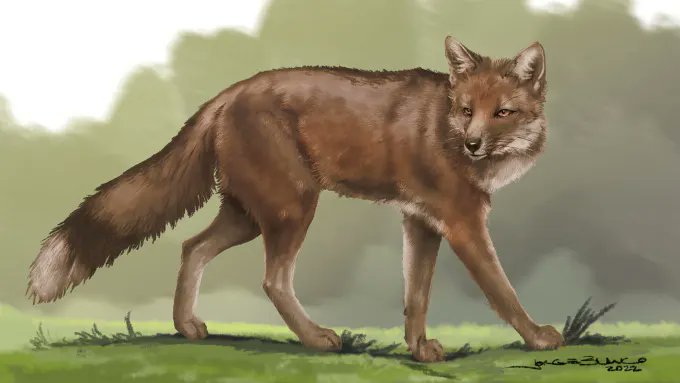
The discovery adds to a growing body of evidence from burial sites on other continents indicating that individual foxes were tamed by humans and shared a connection based on companionship. D. avus lived from Pleistocene Epoch (around 2.6 million to 11,700 years ago) into Holocene, becoming extinct about 500 years ago. It was roughly size of a modern German shepherd but far less bulky, weighing up to 15kg.
“In general, Dusicyon avus has a carnivorous kind of diet,” said Lebrasseur, who co-led the study with Dr. Cinthia Abbona, a researcher with Argentina’s National Scientific and Technical Research Council. But when the scientists tested the fox skeleton from the burial, they found that its diet was less carnivorous than expected and more similar to diets of humans. That suggests either the community was feeding it, or it was around the community and feeding on the kitchen refuse,” Lebrasseur told CNN. It would suggest that there’s a closer relationship and integration of the canid within society.
Notion of foxes as pets in South America aligns with evidence from other fox burials in Europe and Asia, said Dr. Aurora Grandal-d’Anglade, paleobiologist at Universidade da Coruña in Spain. Grandal-d’Anglade, who was not involved in new study, previously described Bronze Age graves in Iberian Peninsula that included dozens of dogs and four foxes buried alongside people. Researchers found that the foxes had been arranged much like the dogs were, suggesting that they, too, were companions for humans.
“There is no reason why foxes could not be domesticated,” Grandal-d’Anglade told CNN in an email. “We know that humans in many completely different societies often keep domestic animals (not only canids, but monkeys, birds, reptiles) simply as companion animals. When viewed in this light, more and more sites appear where foxes seem to have played the role of pet animals.”
Finding D. avus in a human grave was surprising for another reason while species was once widespread across southern South America, it was previously unknown in this part of Patagonia. Hunter-gatherers who lived in the region typically stayed within a range of about 70km, so they likely encountered the friendly fox within that range. “Dusicyon avus must have been part of nearby vicinity, to be able to be integrated within community,” Lebrasseur said.
- Subscribe for Detailed Post -
📷 : An artist’s reconstruction depicts the extinct fox species Dusicyon avus, which scientists believe may have been domesticated 1500 years ago by hunter-gatherers in what’s now Patagonia in Argentina.
#archaeohistories
@TheOperaGeek@StreamToEndMS Is Wagner your special strike team? I'd like to think Ludwig just unleashes him as Ride of the Valkyries blasts and just hundreds of death swans fly across the battlefield with Wagner dropping parts of an orchestra on the enemy.
@TheOperaGeek@TheJFreakinC Who's going to tell them Easter eggs are a secret pagan holdover that the early Christian church added to make their religion more palatable to converts?