India’s BPM industry is evolving from traditional process execution to intelligent service orchestration powered by AI, automation and data.
In the latest ET x Nasscom podcast, Sreeram Pagalla, Global Vice President – CX Operations, GCC & Transformation at Concentrix, Mythily Ramesh, Co-founder and Managing Director at Next Wealth, and Sangeeta Gupta, Senior Vice-President and Chief Strategy Officer at Nasscom explored how AI is reshaping the sector with a sharper focus on business outcomes, human-in-the-loop work, BPM-GCC convergence, skills, enterprise operations, and India’s role in global services.
Explore the full discussion: https://t.co/j8GecxqJWu
#BPM #AI #FutureOfWork #GCC #Nasscom
@sangeetagupta29@Sreerampagalla@Concentrix@NextWealth@SrikanthNasscom
From generating intelligence to operationalising intelligence is where the next major technology and business transformation is emerging. 🚀
What a lovely day! 🌟 And another interesting set of insights on the evolving AI landscape, this time from Gartner's 2026 Hype Cycle for Agentic AI. 🤖
A few key takeaways worth sharing:✨️
1. Agentic AI is moving beyond the initial hype towards practical enterprise adoption.
2. Only 17% of organisations have deployed AI agents so far, while over 60% expect to do so within the next two years.
3. Market expectations are running ahead of actual deployment readiness.
4. Different agentic AI technologies are progressing at different speeds and maturity levels.
5. Governance, security, accountability and cost management will be critical to enterprise adoption.
6. Agent orchestration, management platforms, context graphs and foundational infrastructure will play an increasingly important role.
7. The competitive advantage may increasingly lie in orchestrating AI ecosystems rather than relying on individual models.
8. Ultimately, the real test will be measurable productivity, operational efficiency and economic viability.
The larger transition is fascinating: from AI that generates, to AI that reasons, to AI that increasingly executes. 🧠⚙️
#AgenticAI #ArtificialIntelligence #Gartner #AITransformation #EnterpriseAI
What if AI isn't reducing workforce costs, but simply shifting them?
Gartner predicts that up to 30% of roles displaced by AI will be rehired by 2029, often at a premium.
Treating AI as a cost-cutting tool alone can undermine ROI; optimizing workforce costs is what drives sustainable value.
Uncover how AI is reshaping where and how those costs appear: https://t.co/LBYgaohcdg
Why do enterprises need a Universal Business Orchestrator in the Agentic AI era? Discover how AI agents, automation, people, apps, and data can work together through one governed execution layer. Read more 👇#AgenticAI#AI#BusinessOrchestration https://t.co/wkOjQG1vD4
The PR merge used to be where AI code review stopped. CodeRabbit just moved the line.
Post-Merge Actions let you define natural language instructions that run after a PR merges. File a Linear or Jira ticket. Open a GitHub issue. Post a Slack summary. Append a changelog entry. CodeRabbit runs them agentically against the merged diff and presents each action as a checkbox in the PR walkthrough, checked when it judges the action applicable.
What I keep noticing across the SDLC agent category: the work that compounds fastest is the follow-up work nobody does consistently. Changelogs get forgotten. Tickets don't get closed properly. Slack updates get skipped under deadline pressure. This is where agents create real leverage, not in the code they write but in the process hygiene they enforce.
The broader competitive landscape here: GitHub Copilot has Autofix and PR summaries. Linear has its own AI triage. Jira has its own AI sprint planning. What CodeRabbit is building is cross-tool intelligence at the merge boundary, the moment when a change officially becomes production intent.
The hidden bottleneck: teams have good tooling for writing code and reviewing code. The gap is in what happens between merge and deploy. Post-merge has always been the forgettable middle.
My read: as agentic SDLCs mature, the merge event becomes a trigger for a broader class of automated actions. CodeRabbit's move here is to own that trigger before GitHub Actions or Copilot does.
https://t.co/ROlCnzwhKc
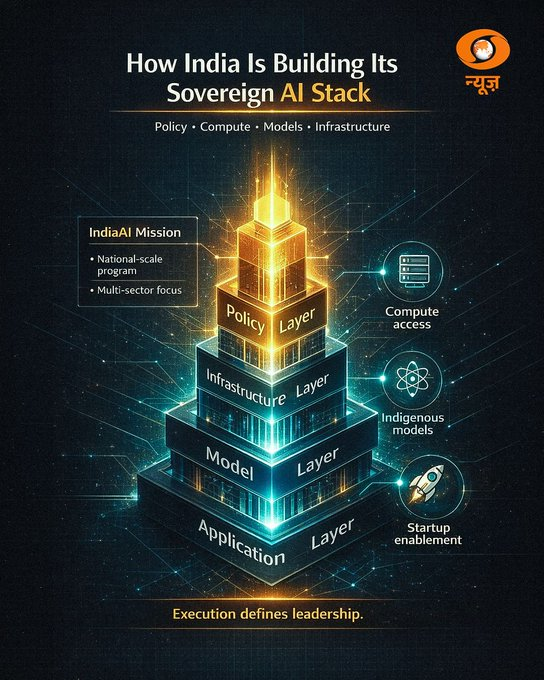
The AI Impact Summit in Delhi has brought together the who’s who from the AI world.
There is representation from over 100 countries.
There are distinguished participants from every corner of the globe.
Our aim is the same - leveraging the power of AI for the welfare of our planet.
As the award ceremony felicitating the winners of the Global Impact Challenges concluded, Shri @AshwiniVaishnaw, hon'ble Union Minister for
@GoI_MeitY, warmly congratulated the winners.
🔴LIVE here - https://t.co/xCvJhQj7tS
#IndiaAIImpactSummit2026
Absolutely inspiring to see India's AI prowess on the global stage! 🇮🇳 As someone passionate about tech, what AI innovation excites you most for our future? Let's discuss! #IndiaAI#AIforGood#ModiVision
https://t.co/qwfVkMAC1r en Ritense sluiten partnerovereenkomst Valtimo. Met de ambitie Robotic Process Automation en Valtimo Business Processs Automation samen succesvol in te zetten.
9/ 🤖 Butterfly Effect’s Manus AI
Manus AI, developed by Butterfly Effect, is a task automation tool using multiple AI models.
The company is raising funds at a $500M valuation, signaling growing interest in AI-driven solutions.
Manus AI aims to revolutionize business processs
AI isn’t a trend. It’s infrastructure for the future
If you’re not exposed long term, you might regret it
Here are companies that have deeply integrated AI into their core business:
$ZETA – AI-driven predictive marketing
$PATH – AI-powered robotic process automation
$ABCL – AI in antibody discovery & drug development
$OSCR – AI agents for personalized healthcare
$HIMS – AI-driven telehealth personalization
$ONDS – AI in drone autonomy & sensing
$GRAB – AI-powered superapp personalization
$NBIS – AI cloud infrastructure for GPU workloads
$IREN – AI-optimized data centers for computing
AI is already reshaping every industry
3. $PATH - UiPath
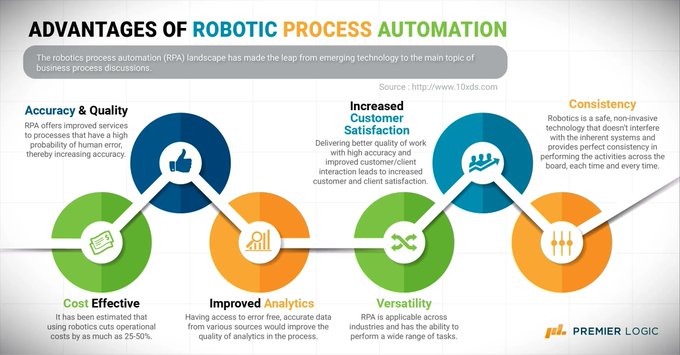
UiPath is a global leader in robotic process automation (RPA), helping enterprises automate repetitive workflows to reduce costs, improve accuracy, and enhance operational efficiency.
As RPA converges with AI, UiPath enables more intelligent, adaptive automation. It is one of the few platforms offering a full automation lifecycle under a single control plane, from discovery and orchestration to deployment and monitoring.
The company has supported nearly one million agent runs and over 170,000 process instances, with more than 450 customers actively building and deploying AI agents. As adoption increases, UiPath’s automation marketplace strengthens network effects and platform stickiness.
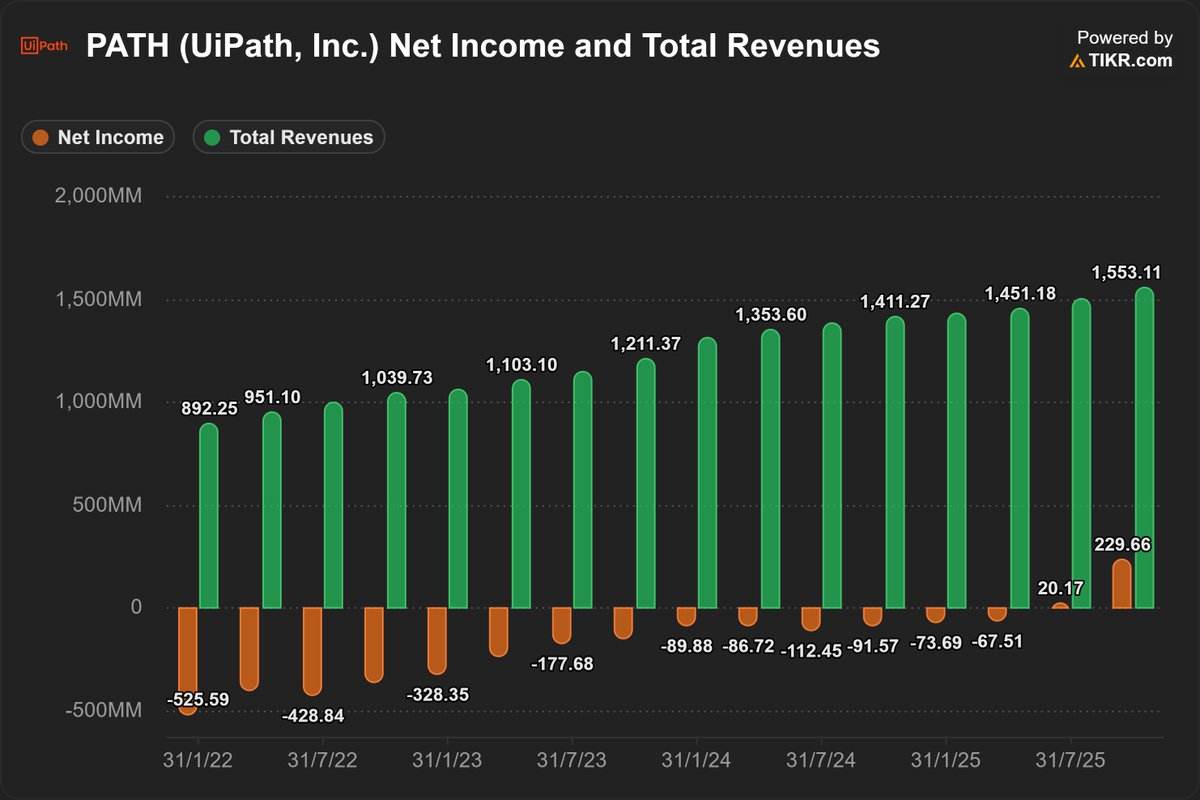
Enterprise contracts are typically multi-year with high renewal rates, driving predictable, recurring subscription revenue. Reflecting this maturity, UiPath achieved positive net income for the first time in 2025, marking a key milestone in its evolution.