Say hi to FeatherFlow 👋
🔍 Get your MVP built in days, not months
⏩ Find your first customer or impress investors
💫 Enjoy post-launch support to keep improving
Learn more and book your call: https://t.co/Q28xJPoh43
We built PureClaim for Artheon Medical, a US medical company. It reads their insurance letters with AI.
Before building the product, we tested the AI on their real letters. Once that worked, we built everything else around it.
More and more clients send us long briefs written with AI.
We ask AI to shorten it to the main points. Then we get on a call and ask about the goal.
We rarely let clients write the requirements. They give us the goal, and we turn it into requirements.
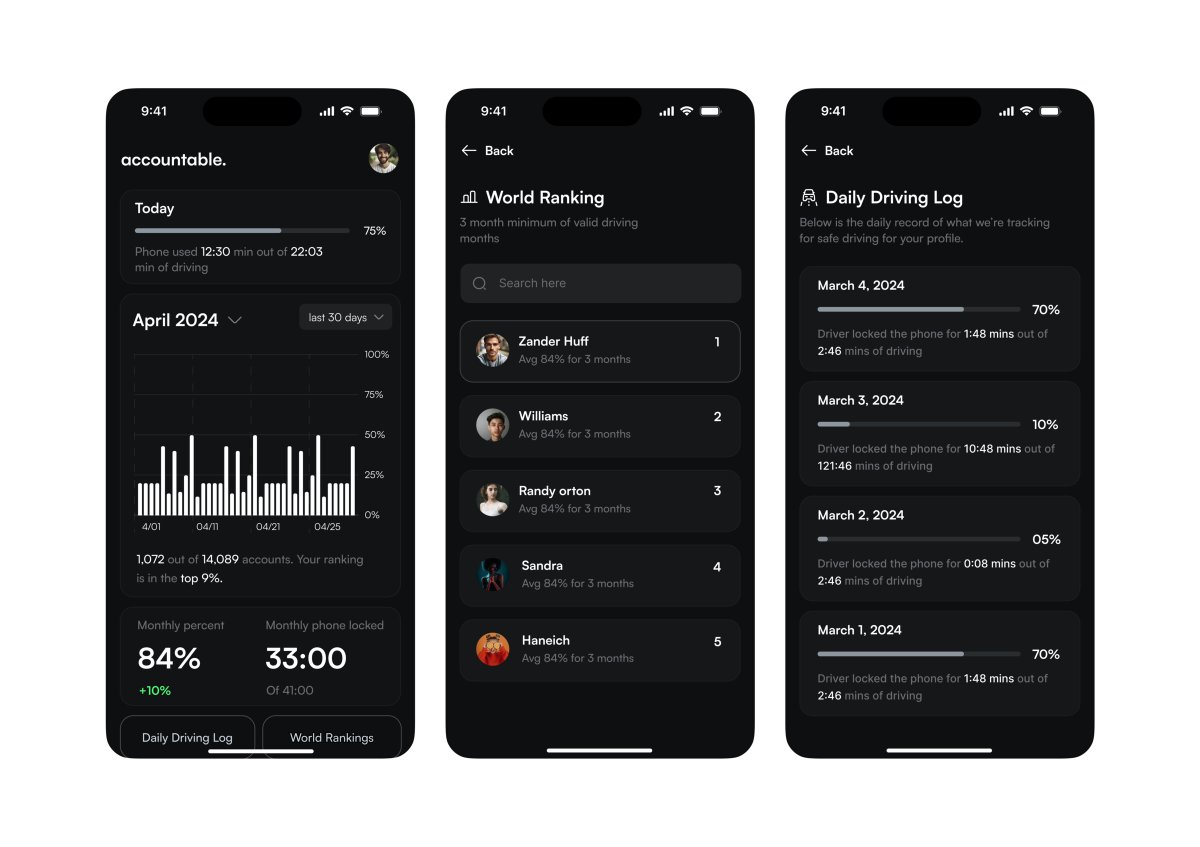
Three screens from Accountable, an app that rewards teens for safe driving.
The hardest part was making sure it only tracks you in your own car. A small Bluetooth beacon in the car solves that.
Claude reviews every code change before it is merged. Then an engineer signs off on it.
QA bots click through the app. Our testers still test the whole app by hand before a release.
The product decisions stay with our team.
We built PureClaim's document flow in six steps.
Every file is checked before the AI reads it, and every result is checked again after. If the main AI service fails, a second provider takes over.
Meet @JanuBuilds and his agency, FeatherFlow - showing you exactly how he got his agency to $76k+ last month.
Without sending 1000's of connection requests on LI.
Just genuine conversations, continuous improvement, consistency + one secret formula..
https://t.co/kLHDLflRkN
We built EduSync in 35 days, from concept to working prototype (no design).
Students move step by step, from quizzes to full prompts. Teachers get AI insights, kept simple so the dashboard stays clean.
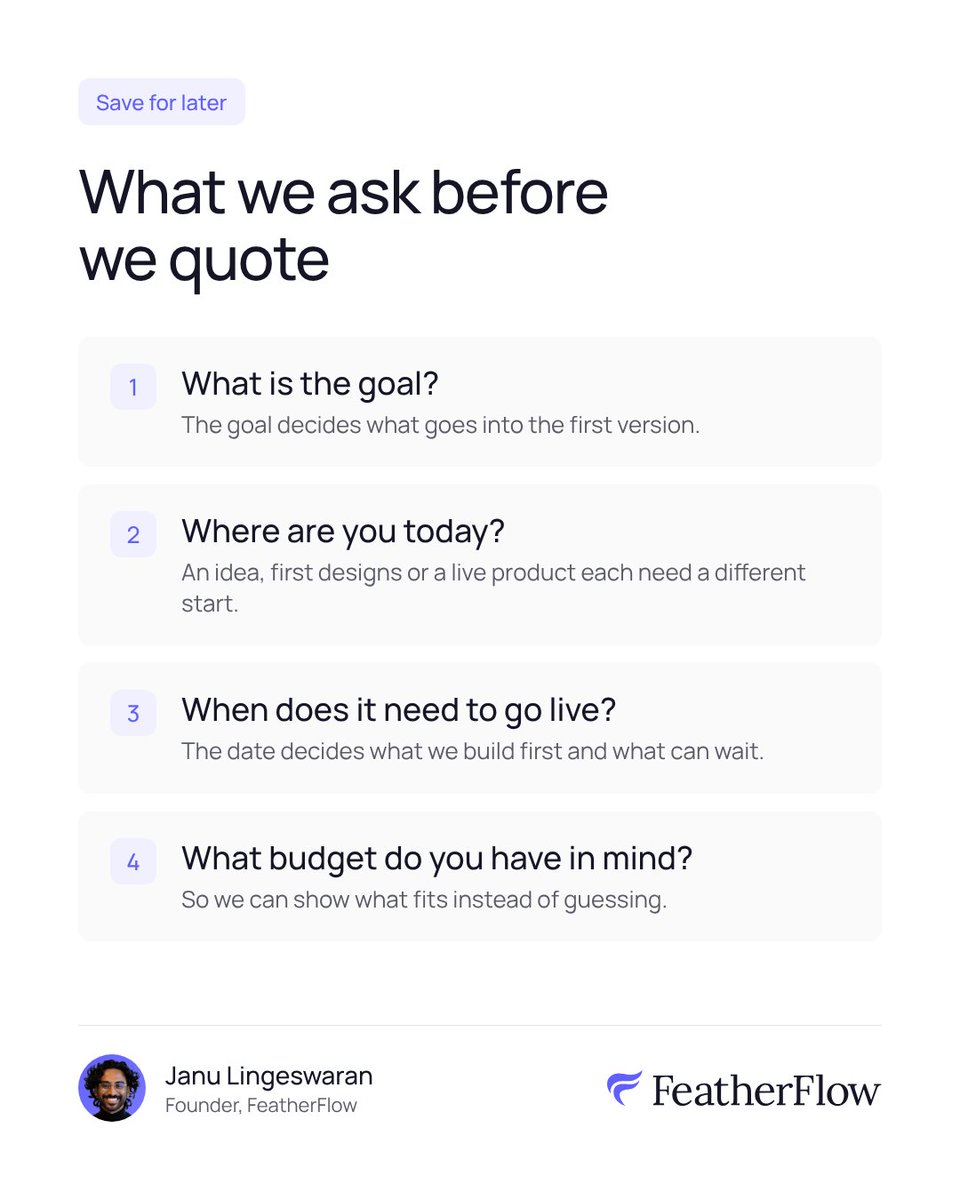
Two quotes for the same product can be very far apart. Often one studio asked questions first and the other didn't.
Before we quote, we ask:
What is the goal?
Where are you today?
When does it need to go live?
What budget do you have in mind?
So when you get two quotes, ask which one actually asked about your business.
We built the Ntree editor from simple blocks with a live preview.
There are complex rules underneath, but editing a page should feel as easy as any link-in-bio tool.
Doing a live session with @JasonDigital today at 11am ET (4pm here in Germany)
We're talking about how to build AI apps quickly without spending a fortune.
Drop by if you're around 🫶, there's Q&A at the end:
https://t.co/IvQbblWYwX
🚨 FeatherFlow is hiring a Lead Engineer! 🚨
We are looking for a senior engineer with 6+ years of experience to own the technical side of our client projects.
Fully remote, from anywhere. TypeScript/Next.js, Python and Claude Code every day.
We design and build AI and SaaS products for ambitious companies.
Apply here -> https://t.co/g0a9irFMm6
Do NOT DM me. You'll be disqualified immediately.
Pls repost to reach more people.
"We usually don't just trust people. You earned it."
A client in New York said that to us on a call.
They're a media company building an interactive streaming platform. When we started, it hadn't launched yet, and their engineer had already built a lot of features
The problem was that it was hard to use and hard to understand. Nobody on the team was really thinking about what it's like for someone who just sits down to watch or produce a show
We changed the order of things, restructured parts of the product and moved features to where a viewer would actually look for them. On the same call, they said design and how we handled scaling the video were two of the things they valued most
Thank you for trusting us with this 🫶
AI helps engineers build faster than ever. But someone still has to decide what's worth building, what to leave out, how onboarding should work and what happens in the edge cases. If nobody does that, you just ship the wrong thing faster
If you have a strong engineering team but nobody owning the product side, I'd be happy to talk. We've done this for companies in New York, Washington DC, Florida and North Carolina.
Marc Lou's most famous product just fell 98%.
$126,000/month → $2,000/month.
Everyone is saying: "never bet your whole life on a single product."
But I think that's the completly wrong takeaway. What actually happened is way more interesting, and it explains why he's still making $1M a year.
Here's the full story & what I'd do as a product strategist with ShipFast tomorrow if it were mine:
—
The numbers for ShipFast:
2023: $0/mo
2024: $126,000/mo
2025: $25,000/mo
2026: $2,000/mo
$1.27M all-time. One product. Solo. Impressive af!
One take could be: he got distracted. He launched TrustMRR, DataFast, Ship or Die, and let his golden goose starve. I thought the same first.
That's partly true but maybe 30% of the story imo. The other 70% was baked in from day one.
—
1. One-time purchases have no floor.
ShipFast never had MRR. Every month it had to find brand-new buyers. That gives you a predictable shape: launch wave, long tail fed by Marc's audience, then decay. No subscribers to cushion the fall.
2. The peak was a spike
A viral YouTube feature pushed ShipFast from ~$50k to ~$135k a month for a couple of months. A big part of the "crash" on that chart is just hype normalizing.
3. AI ate the category.
In 2023, a Next.js boilerplate saved you weeks of auth, Stripe and landing page setup.
In 2026, Cursor or Claude Code does that in an afternoon. Cheaper kits flooded the market.
The moat was speed. Speed got commoditized.
(I think boilerplates are more useful than ever, but the market is the market)
—
Now the 30% that IS on Marc:
Marc doesn't just market ShipFast. Marc IS ShipFast's marketing. Every tweet, every launch video, even the revenue ticker in his bio.
The moment he started tweeting about TrustMRR instead, ShipFast lost its only engine.
—
But here's something we have to give to @marclou:
It WORKED!!
He saw the decline coming and built the replacements BEFORE ShipFast flatlined. TrustMRR now earns more than 10x what ShipFast does. He still made over $1M in 2025 while his most famous product basically died.
I see ShipFast as a big W. It did its job: it built the audience that built everything else.
—
What I'd do with ShipFast tomorrow:
Not sell it. At small-SaaS multiples it's worth less than one good month of his portfolio.
Instead:
→ Make it free
→ Preinstall DataFast analytics and TrustMRR verification
→ Bundle it into Ship or Die
It costs him ~$2k/month. In return, every founder who starts a project with ShipFast walks straight into his subscription products.
A dying one-time product becomes the front door to his recurring revenue.