cPTSD recovery ❤️🩹 Personal thoughts on mental health & strength training w/a touch of science 🏋🏾🏋🏻
Recovering from trauma is hero's work. We can heal.
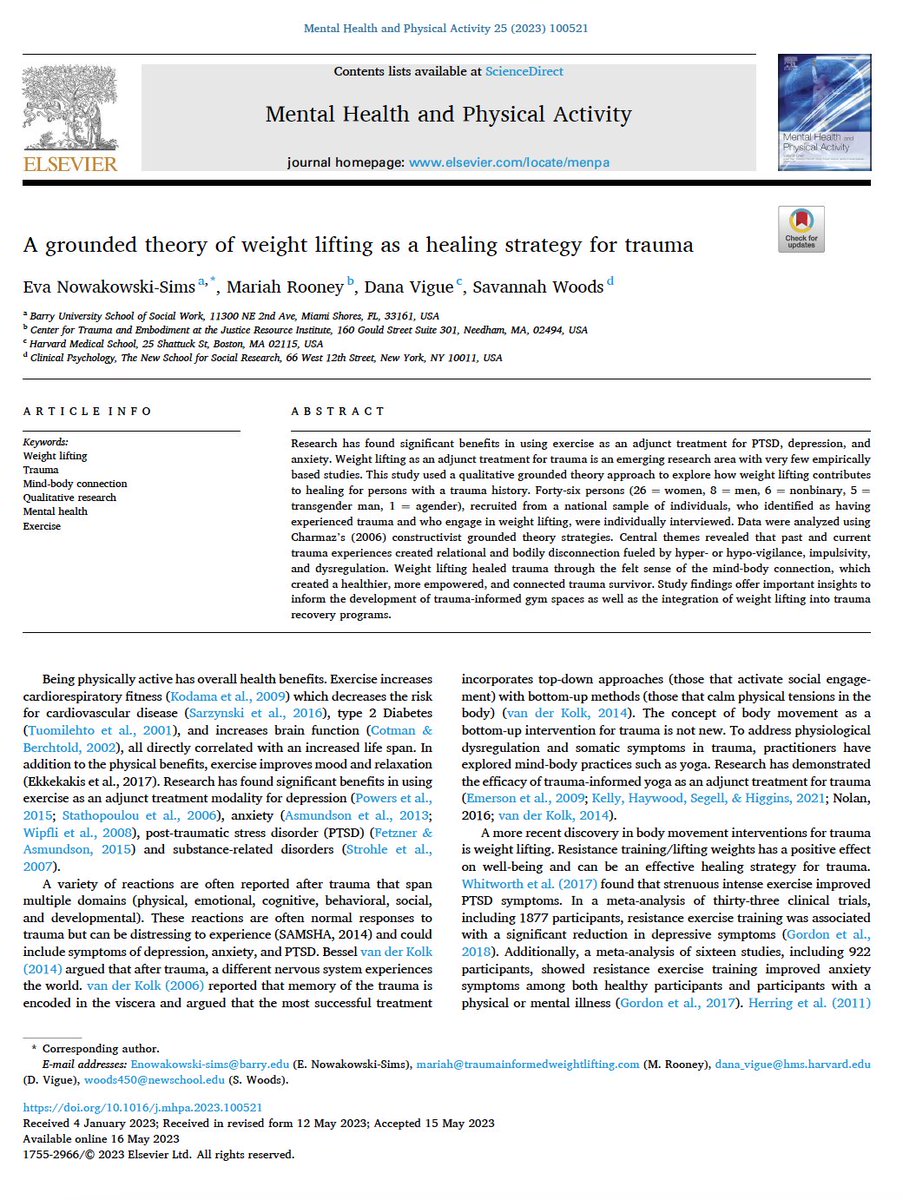
This article helped change my life. I started lifting weights to help combat extreme anxiety, but found it also helped build a sense of self-worth I never possessed from childhood. 🧵/1 #traumarecovery#featsofstrength
We reduce stigma by helping ppl understand what's actually happening. Here are the scientific facts. Here's what Trauma & SUD do to the brain & behavior. Here are lived experiences. Here are the real ppl doing the real work to heal & recover. Understanding ≠ oversimplification.
Fear & anxiety feel like threats to our existence. With shame, our existence is the very problem.
Fear asks us to retreat for protection; shame prefers we erase ourselves.
We don't fix shame w/fear exposure, we heal it by treating ourselves with care, with self-compassion.
@TraumaHealing23 Great point. Maybe not exactly the same, but part of my healing was allowing myself to both hate my parents' actions and care for the parts of them that were good. Emotions don't have to follow a logic of mutual exclusion.
When propped up by shame, fears are so damn hard to work through.
But with a base of self-compassion, fears are far less paralyzing, it almost feels like it is a cheat code.
Fear & anxiety feel like threats to our existence. With shame, our existence is the very problem.
Fear asks us to retreat for protection; shame prefers we erase ourselves.
We don't fix shame w/fear exposure, we heal it by treating ourselves with care, with self-compassion.
@StevenCHayes I have a question:
"What are the signs that an avoidance behavior is being driven more by shame than by fear?"
I'd love some nuance in how these may feel different in the body & clarification on how fear-exposure may not help w/ shame-driven avoidance. 🙏
For everyone working a recovery:
Just know, grief is a sign of self-compassion working.
Its the natural effect of unburdening our needless self-blame.
Grief is a sign of growth. ❤️🩹
#cptsd#recovery
@TraumaHealing23 Been trying to see the grieving process as a sacred activity - to honor immense loss.
Humans have always treated loss with great care & a creative push to make meaning through ritual, music, dance, movement.
No different for survivors, I'd bet. ❤️🩹
For everyone working a recovery:
Just know, grief is a sign of self-compassion working.
Its the natural effect of unburdening our needless self-blame.
Grief is a sign of growth. ❤️🩹
#cptsd#recovery
@TweetATherapist Don't forget the extreme internalization of capitalist values; you can be born with those capacities and not grind & grift your life away.
Writing, reading, walking, talking, laughing, lifting, dancing, doodling, creating, cooking, playing, running, eating, napping, sleeping – all are part of my recovery repertoire.
So much of recovery is meaning-making rooted in our values & the actions we take to express them.
I'm a verbal guy, & words are super important to how I think & process & express myself-- which made it even more important that my trauma recovery blueprint incorporate tools like somatic hacks, visualization, art, & music.
Recovery necessarily requires stretching.
@FU_joehudson I only learned to cry in a way that healed once I learned I was allowed to be kind to myself, using self-compassion to offset trauma-driven shame.
Previously I only cried as an expression of despair or rage. No all crying was the same for me.
@TraumaHealing23 I'm definitely in the grieving / mind-blown era of recovery!
I wouldn't have guessed, but using self-compassion to undue life-long shame allows us to see more clearly how painful the past really was. But this is the path to real recovery!
@Gothikangel@BeTraumaFree I truly think the compassion gap survivors feel with "normies" is mostly a comprehension gap in what trauma is and what it does to a person.
Sure, some folks are jerks, but I think a lot more just don't know. I'm thankful for every survivor who puts our experience into words!
@MarkTonerX Learning about cognitive diffusion was big for me, to separate thoughts from facts.
An emotionally powerful thought - like "I'm a failure" - will feel *a lot* like a real-world fact, but it ain't!
Emotional force isn't truth in these cases, its probably shame.
@TweetATherapist Hard to know how neglect fits in this rubric - I guess cold and icy?
Feeling invisible & lost doesn't have a clear temperature component to me, but I appreciate the opportunity to think about it. 🙏
@BeTraumaFree Reminds me of how I hesitate to start something new if I think I'll be bad at it. I do a ton of research to not feel dumb & thus make the bar of entry really high for myself. Maybe not the same for you, but I now remind myself to just be curious and play around w/o expectations.
@dininx3 So true! Attempts at false equivalence (migraines = headaches, trauma = adversity) reveals how naive folks are about far more serious matters.
Physical injuries often fit cultural expectations about what "legitimate" suffering looks like.
Childhood abuse & complex trauma challenge people's assumptions about "loving" families, personal responsibility & fairness of the world.
Survivors are met w/questions, not compassion.