Official account of the Federal Reserve’s payments improvement initiative, offering the latest in news, perspectives and our vision for a collaborative future.
Heightened trust, accumulated financial resources, and reduced social support can increase scams vulnerability among older adults. Since these factors cannot be easily changed, awareness and proactive intervention is essential. Learn how financial institutions can better protect this age group from significant scam losses: https://t.co/y3RDQMh2gs
Fraud incidents should be the beginning of the learning process, not the end. Post-incident reviews can transform fraud events into fuel for better defenses — sharper training, smarter controls, stronger detection. Explore how you can learn more from fraud events: https://t.co/LlkJyg4rAw
Financial institutions are looking for tools to improve their fraud mitigation. The Fed's Ryan Evans explores this challenge and how institutions need more timely signals to spot emerging trends. Watch the full video: https://t.co/3DVUIbPUpU
Federal Reserve Financial Services (FRFS) is excited to announce the launch of our new Fraud Mitigation Resource Center, your one-stop destination for FRFS fraud mitigation tools, insights, education and resources designed to complement existing fraud mitigation efforts and help inform approaches to identifying and managing evolving fraud risks. Start exploring: https://t.co/zZQXo9Zgp0
High-net worth individuals aren't just targeted for their wealth. Investment managers, trusted advisors, family office staff... each relationship is a potential entry point for criminals.
In our latest article, we break down the risk factors that make wealthy individuals uniquely vulnerable to scams — and what financial institutions can do to help prevent customer losses: https://t.co/TG7kXvltDD
When generative AI is guided by strong context instructions and grounded in both internal policy knowledge bases and shared industry language provided by the FraudClassifier(SM) and ScamClassifier(SM) models, it can be a reliable partner. Learn more about how fraud analysts can better utilize generative AI: https://t.co/hJcaTNLxKb
Explore scam survivor stories to learn how financial institutions can provide support to victims – helping them manage financial loss and prevent future fraud: https://t.co/q38tBaWb1F
Generative AI can be useful in classifying fraud and scams but adding context and a strong knowledge base can help provide better results. Learn how fraud analysts can use generative AI in practice: https://t.co/o20K0Ua2Ft
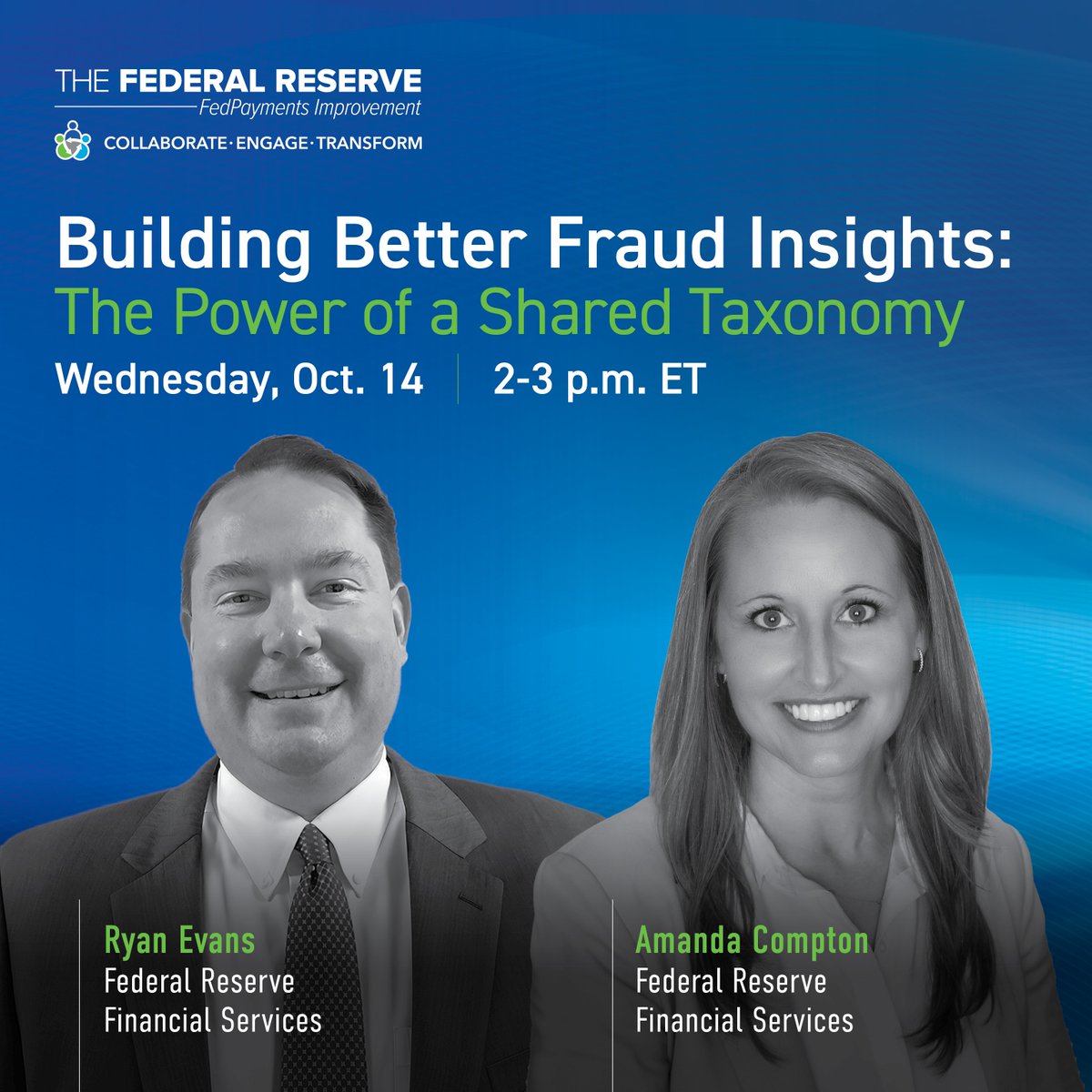
Consistent fraud classification offers a powerful way to strengthen information sharing and improve collaboration across the industry. Learn more from Federal Reserve subject matter experts at our Oct. 14 webinar: https://t.co/K4ZsEmHBPN
Join us on Oct. 14 at 2-3 p.m. ET to learn how a shared fraud taxonomy such as the FraudClassifier(SM) model, can help you gain insight into how fraud is impacting your organization and the ecosystem as a whole. Register today: https://t.co/K4ZsEmHBPN
Scams take more than money – they erode customer trust and confidence. Learn how victims can move forward and protect themselves after a scam, with the help of their financial institution. Read more: https://t.co/khYrxB9ulU
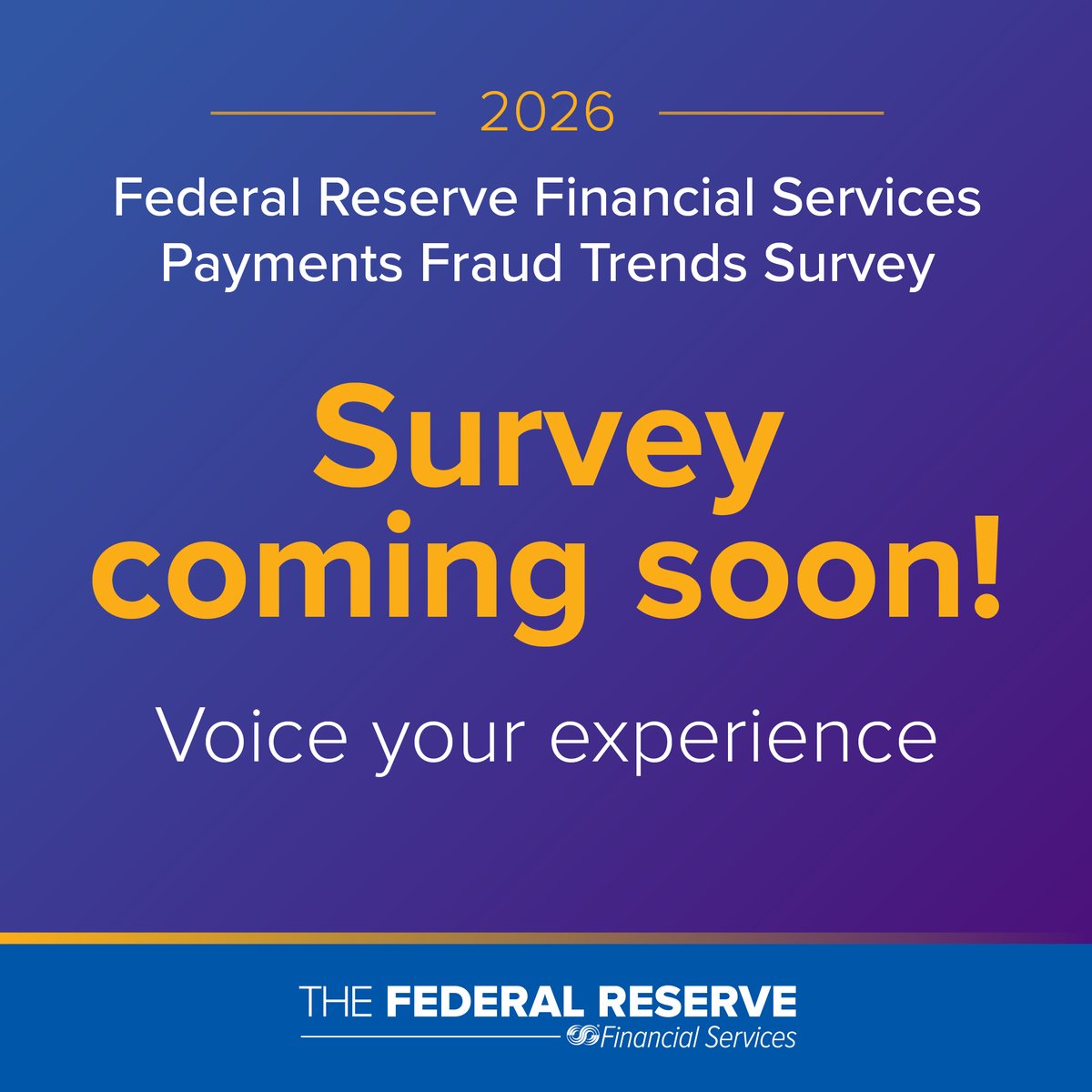
The Federal Reserve is committed to helping reduce fraud risk and advancing the safety and security of the payment system. To help enhance the view of the current industry fraud landscape, we want to hear about your organization’s fraud related experiences and challenges.
By sharing your voice, the 2026 FRFS Payments Fraud Trends Survey will help us identify fraud related experiences and challenges. In turn, ensuring future education, tools and resources reflect the needs and priorities of the payments industry.
Respond now: https://t.co/eILDRtBdiX
Life milestones like retirement, purchasing a new home, or becoming independent bring excitement—but they can also create moments of heightened scam risk.
Our latest article in the Understanding Scam Risk Across Customer Segments series dives into:
• How criminals exploit these transitions
• What financial institutions can do to better safeguard their customers
Read more: https://t.co/EVLtXVJDZJ
Coming soon: Join the effort to shape an industry view of the fraud landscape by completing our 2026 Federal Reserve Financial Services Payments Fraud Trends Survey. We want to hear about your organization’s fraud related experiences.
By understanding how account takeover fraud happens and the challenges in addressing it, financial institutions can better protect their customers, preserve trust and reduce the costs stemming from these attacks. Find out more: https://t.co/Je8OioPnyR
Anyone can be a victim of financial crime. Some victims are randomly selected, but others are personally targeted with criminals taking the time to test and refine their tactics. Follow us as we explore various groups that are targeted and what financial institutions can do about it, with our new series — Understanding Scam Risk Across Customer Segments. Be sure to like and follow so you can see all the articles in the series. https://t.co/Y6bHviLY5J
Great news! New fraud mitigation resources are here.
Initially launched earlier this year, the Account Takeover Fraud Mitigation Toolkit has a fresh installment of content that explores prevention and detection through realistic scenarios, interactive quizzes, training videos and downloadable resources. Two new learning modules are available for you to explore: https://t.co/i19kgs8Rkn
New fraud mitigation resources now available. The Federal Reserve is continuing to provide educational resources to help financial institutions combat payments fraud.
Education is an important defense against fraud and an effective way to protect your customers. Learn more about the new updates to our account takeover fraud toolkit: https://t.co/i19kgs8Rkn
Just Released! Explore new content in our Account Takeover Fraud Mitigation Toolkit.
Educate yourself and your staff on how to better identify and combat this type of fraud in an ever-changing landscape: https://t.co/YoTs1wgmDI