The Federalist Society for Law and Public Policy Studies is a group of conservatives and libertarians interested in the current state of the legal order.
Hon. Kyle Duncan’s message for students navigating today’s campus climate during the Federalist Society’s recent webinar “Shouted Down: When Protest Becomes Censorship:”
“Stick up for yourself, if you’re at a school that disrespects you because you're a quote on quote conservative or you believe in something about something… demand in a respectful way to be treated the same as everybody else. You belong there, you deserve to be there, you don’t deserve to be shunned or shouted down, or ostracized certainly not by the professors and the administration.”
Watch the full discussion:
https://t.co/lXmrHQ61ZN
Don’t forget to register for the 2026 Alabama Chapters Conference!
Join us September 10–11 in Huntsville, Alabama, for two days of engaging panels, meaningful discussions, and opportunities to connect with members from across the state.
Register:
https://t.co/FN5rTUeHee
Loudoun County, Virginia has become one of the nation's most prominent battlegrounds over parental rights, curriculum, student privacy, and gender identity policies in public schools. As debates over the role of parents in education continue nationwide, Loudoun offers a window into the broader legal and policy questions at stake.
Join us TODAY at 12:30 PM for a discussion focusing on Loudoun County as a case study exploring the tension between parents and educators in public schools.
Featuring: Tyson Langhofer (@LanghoferTyson), Ian Prior (@iandprior), and Roger Severino (@RogerSeverino_)
Watch:
https://t.co/ODWrXPgMC2
Must Watch: Justice Clarence Thomas shares with the @HooverInst how being educated by Catholic nuns in segregated Georgia—and the lessons they instilled in him—shaped his childhood:
“On the other hand, you had the nuns that would constantly say that ‘God gave you these talents, and you have these God-given talents, and it’s sinful for you not to use them.’”
My father’s confirmation hearings were 40 years ago! I share some memories about that summer and some thoughts about what has changed in @NRO.
https://t.co/Iuik1zdnqS
Register for the 2026 North Carolina Chapters Conference!
Join us October 2 for a day of engaging conversations on the Supreme Court, election law, education, separation of powers, and more!
Register:
https://t.co/hPYLAktofa
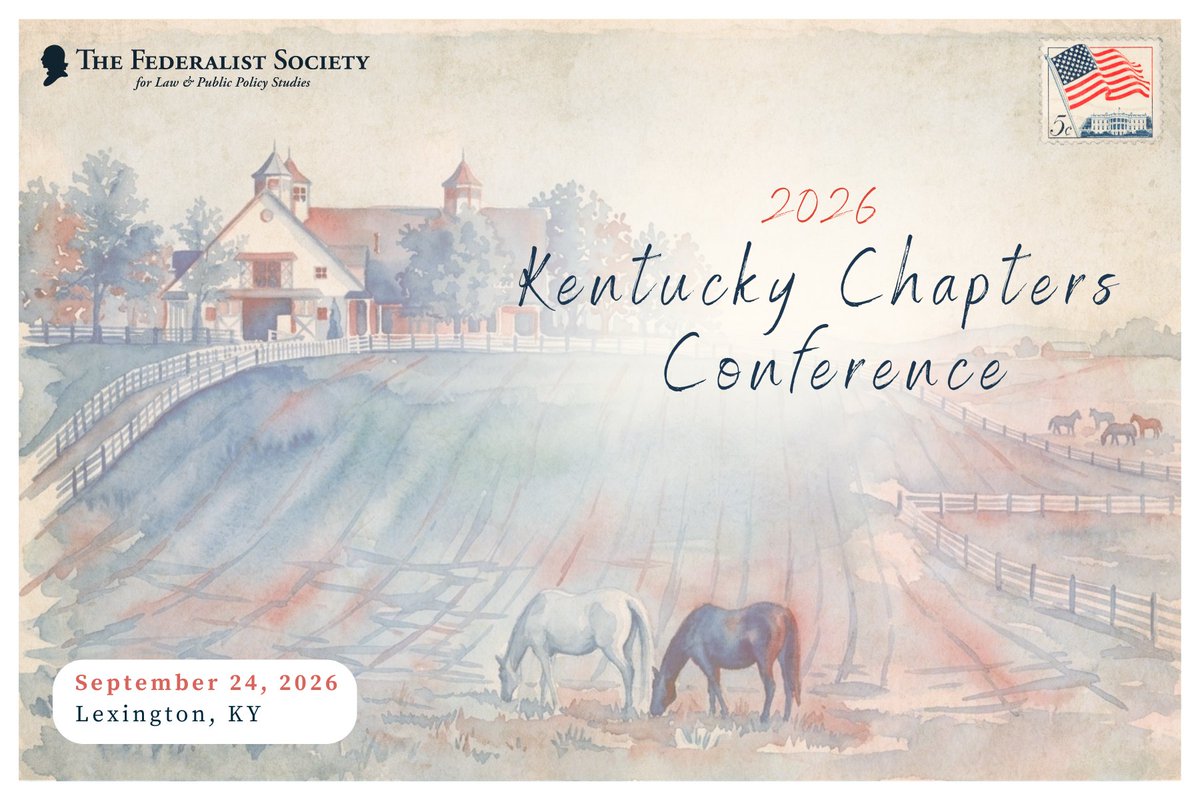
Mark your calendars for September 24! Registration is now open for the 2026 Kentucky Chapters Conference!
Join us in Lexington for a full day of meaningful conversation and engaging programming!
Register today!
https://t.co/4LVHdnCEEw
As more states legalize physician-assisted suicide, questions continue to arise about how those laws intersect with federal Medicare rules and end-of-life care. A recent CMS request for information on "medical aid in dying" and hospice services has renewed debate over the legal, regulatory, and ethical boundaries between palliative care and practices intended to hasten death.
Join us TODAY at 1:00 PM for a discussion with Alexander Raikin (@AlexanderRaikin), Dr. Jeffrey Singer (@dr4liberty), and Dan Troy on the evolving legal landscape surrounding assisted suicide in the United States.
Watch:
https://t.co/5HEryDtZMF
The Faster Labor Contracts Act would dramatically reshape first-contract negotiations by imposing strict bargaining deadlines and, if no agreement is reached, requiring mediation followed by binding arbitration. Supporters see it as a way to prevent stalled negotiations, while critics argue it would upend the nation's longstanding system of voluntary collective bargaining.
Join us TODAY at 12:00 PM for a discussion with Thomas Beck, Prof. Sharon Block, G. Roger King, Daniel Kishi (@DanielMKishi), and Alex MacDonald on what the bill could mean for employers, unions, and the future of labor law.
Watch:
https://t.co/IyifaDj8u5
O.H. Skinner, Executive Director of @for_consumers, on how state polarization is raising concerns about the extraterritorial reach of state laws:
"You're seeing polarization at the state level more and more in our country, and you're seeing a response to unexpected losses of federal authority by the left is to push ever greater on trying to accomplish ideological goals through extraterritorial laws."
During today's FedSoc webinar, Michael Williams, Solicitor General of West Virginia, discusses extraterritorial laws that threaten state sovereignty:
" So fundamentally, what we are concerned about in these cases — be it Suncor in the tort space, or the New York Superfund context, or the more traditional statutory regulatory space — is that all of them ignore the fundamental right to equal state sovereignty. And so we really are worried about a situation in which states are allowed to lash out against one another through these sorts of retaliatory mechanisms, or just create an economic balkanization that we don't think was ever contemplated by our constitutional structure."
HAPPENING IN AN HOUR: Prof. Michael Greve, Prof. Daniel Rodriguez, O.H. Skinner, Michael Williams, and Hon. Jennifer Perkins (@jenperkinsaz) will be discussing the constitutional issues at the heart of Suncor Energy v. Boulder County.
Watch:
https://t.co/mhjeoGUZQ5
On August 7, 1782, General George Washington created the Badge of Military Merit—the nation's first military decoration to recognize service based on merit rather than rank.
More than 150 years later, the award was revived as the Purple Heart Medal. Today, it honors members of the U.S. Armed Forces who are wounded or killed in service to their country, carrying forward Washington's vision of recognizing courage and sacrifice.
Music: https://t.co/NreEBM1SIb
Ahead of July 4th, the Federalist Society welcomed Supreme Court Justice Neil Gorsuch to the Inaugural Family Fest at Mount Vernon. He and co-author Janie Nitze read from their new picture book, Heroes of 1776: The Story of the Declaration of Independence, and participated in the evening’s festivities.
How far can states go in regulating conduct beyond their borders? In Suncor Energy v. Boulder County, the Supreme Court will consider whether state-law climate lawsuits raise broader constitutional questions about federalism, state sovereignty, and the proper allocation of authority among Congress, the courts, and the states.
Join us tomorrow at 12:00 PM for a discussion with Prof. Michael Greve, Prof. Daniel Rodriguez, O.H. Skinner, Michael Williams, and Hon. Jennifer Perkins (@jenperkinsaz) on the constitutional issues at the heart of the case.
Watch:
https://t.co/y4N11Px2xH
The National Labor Relations Board has long shaped labor policy through case-by-case adjudication rather than formal rulemaking. But recent Board vacancies, growing calls for rulemaking, and the Sixth Circuit's decision in Brown Forman v. NLRB have raised new questions about whether that approach can continue—and whether the Board should take a different path.
Join us TODAY at 12:00 PM for a discussion with Prof. Samuel Estreicher, Brian Hayes, Marvin Kaplan, and Alex MacDonald on the future of NLRB policymaking and what a shift toward rulemaking could mean for employers, unions, and workers.
Watch:
https://t.co/vpF6NUvqc9
More than four years after the Bruen decision, states continue testing the boundaries of the Supreme Court’s Second Amendment jurisprudence.
"When will the states stop passing Bruen response bills, trying to unfairly limit Second Amendment activity?" Earlier today, Michael Williams, General Counsel of @AmSuppressor, explained why he expects these legal battles to continue to persist. "I don't see it stopping for a while, and I don't see courts stopping it until the actual bad conduct stops.”
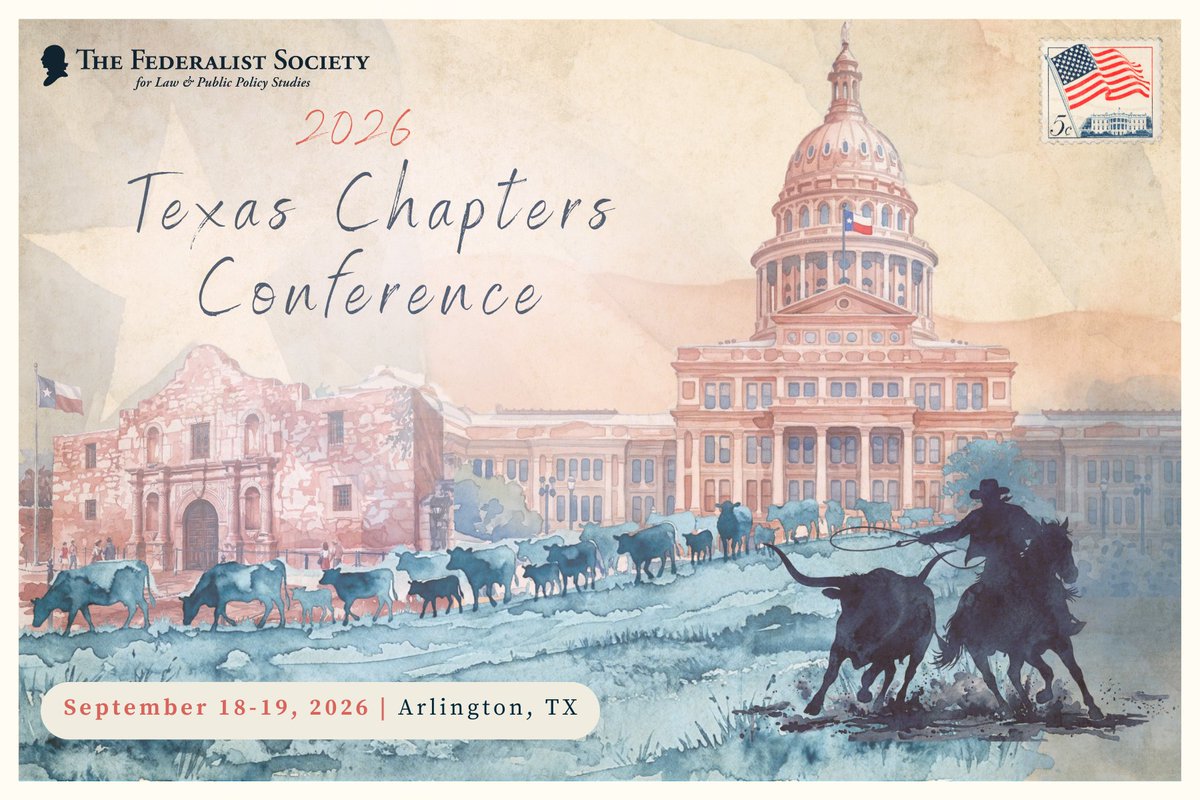
Join the Texas Lawyer Chapters for the 2026 Texas Chapters Conference!
This year’s conference will be especially meaningful as we celebrate America 250 and Texas 150. Join us September 18–19 for engaging discussions, thoughtful programming, and opportunities to connect with members from across the state!
Register:
https://t.co/vfZRIjPRxe
Michael Williams, General Counsel of @AmSuppressor, discusses how lower courts have addressed challenges to bans on AR-15s and other commonly owned firearms following Bruen and why the Supreme Court’s intervention could reshape Second Amendment jurisprudence:
"Since Bruen, obviously, we've seen these cases across the country... These laws banning AR-15s were upheld at the 7th Circuit, the 1st Circuit, the 4th Circuit, and only recently have we started to see some shifting... A couple weeks ago, we saw the 3rd Circuit strike down New Jersey's ban on AR-15s... I think it's exciting that the Supreme Court has finally taken us up."
Prof. Haley Proctor, Associate Professor of Law, Notre Dame Law School, on the future of firearm-related litigation following Wolford v. Lopez and U.S. v. Hemani:
"So what this tells us, I think, is that we're entering an era of normalized Second Amendment litigation… So what I think we get out of Hemani and Wolford is the message that the Bruen test is here to stay."