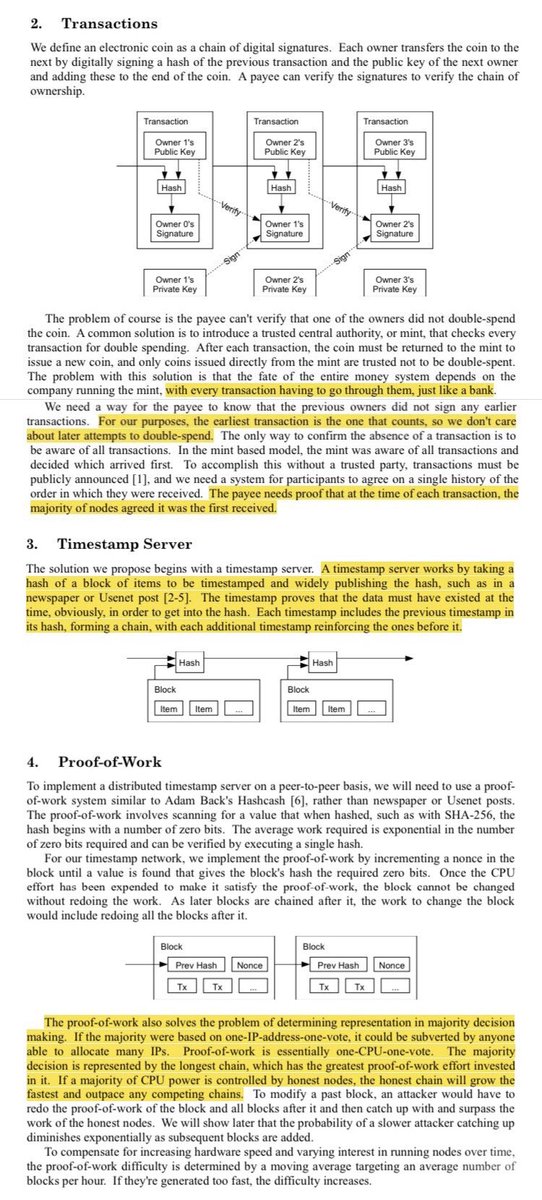
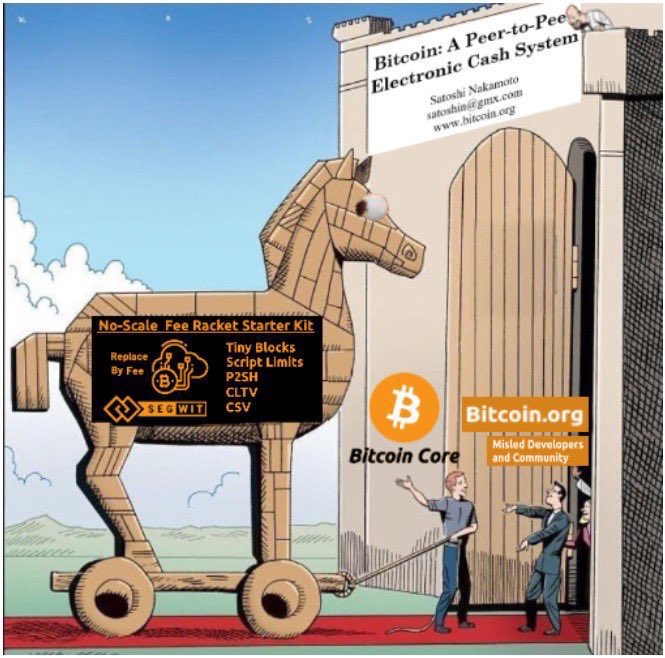
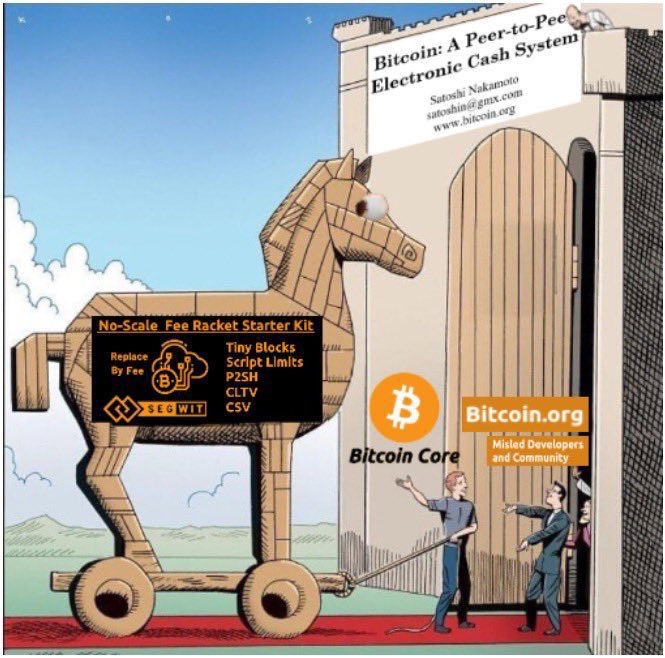
@bradmillscan You’re looking for #UASF: A social consensus implementation of 1-IP-1-Vote, which circumvents Nakamoto Consensus to exert ‘centralized control’ over #Bitcoin via dishonest distributed actors: Fork Coercion vs PoW on the immutable + unbounded Bitcoin.
👀😬🤓🤫
Andrej Karpathy: the agent era already killed half of what you're learning
half of what you're grinding right now is already dead weight
senior engineers quietly stopped doing it themselves
the dead list: chasing every new framework, 40 research tabs open till 2am, prompt-and-pray workflows, "one genius model will save me", doing every task by hand
the pattern is obvious. effort that doesn't compound. busywork dressed up as skill. tabs that go viral in your head and close by spring
what actually compounds:
autoresearch - the loop that designs and runs experiments for you
model speciation - not one genius ai, a team of specialized ones
collaboration surfaces between you and your agents
orchestration over execution. you direct, you don't grind
the harness mindset. harness > model, always
taste and judgment - the part no agent replaces
the edge isn't being smarter. it's refusing to stay your own bottleneck while everyone else still grinds solo
book and study this
This premise?
Exactly what Bitcoin (not BTC) should enable + provide unlimited opportunities for creative expression.
But nah, capture & capitulation.
Today a crazy quantum story just got wilder.
On March 31, the Google Quantum AI team published a landmark result on Shor's algorithm for elliptic curve cryptography. Technically, the paper was a bombshell: a dramatic 10x improvement over the state-of-the-art. As a stunt and wakeup call to the blockchain space, those optimisations were illustrated on secp256k1, the elliptic curve underlying Bitcoin and Ethereum signatures.
But perhaps the most striking part of the paper was sociological, not technical. Instead of following standard academic process, the optimisations were kept secret, hidden behind a zero-knowledge (ZK) proof. Google's accompanying blog post mentions they "engaged with the U.S. government". The ZK proof demonstrates the existence of algorithmic improvements without leaking details. Academic censorship with ZK, a historic first!
As a co-author of the Google paper I witnessed some of the context surrounding this censorship. To be honest, multiple aspects of that context don't sit well with me. As much as I believe the general public ought to know more, I am limited in my ability to whistleblow. Though let me be clear about one thing: the Google team's professionalism has been absolutely exemplary, and they deserve nothing but praise.
Censorship has a way of backfiring. The Streisand effect, where an attempt to bury something only draws more attention to it, is exactly what's unfolding today. First, Google's key optimisation has been rediscovered by the French. And in a thrilling turn of events, a collaborative Shor-at-home challenge just launched. The initiative, available at ecdsa[.]fail, breached a new Shor world record in a matter of hours.
Let's start with the rediscovery. Just two months after Google's paper, French quantum expert André Schrottenloher cracks the main secret optimisation. His paper, titled "Optimized Point Addition Circuits for Elliptic Curve Discrete Logarithms", landed on the arXiv today. Big congrats to André, who beat several other nerdsnipped experts to it. In a blog post also published today, Craig Gidney, the world expert on Shor optimisations, revealed that he'd been sitting on this very optimisation for a whole year under censorship pressure.
Interestingly, André missed a handful of minor optimisations, both from Google's original publication and from improvements found since. It's plausible there's still plenty of juice left to squeeze out of Shor, and this is exactly what the ecdsa[.]fail challenge is about. The verifier program developed for the ZK proof does double duty, automatically filtering for valid submissions. Dozens of compounding small and micro improvements are rolling in. As of the time of writing there's an 8.4% improvement to Google's circuit, as measured by the product of logical qubit count and Toffoli gate count. Nice!
The nerdsnipping ran deeper than anyone expected. Over the last few weeks it became clear it extended well beyond André and other quantum experts. Behind the scenes, a small army of amateurs quietly got to work. Inspired by Karpathy-style autoresearch, they turned AI on Shor. Ironically, the verifier program for the ZK proof makes an ideal reward function for AIs. The barrier to entry for this modern style of research is refreshingly low, with several non-experts, even a teenager, finding nice optimisations. Get in touch if you'd like to join a Telegram group with fellow autoresearchers :)
Part 2: neutral atoms and qday
The story doesn't end with Google. On the same day Google went public, a stealthy startup called Oratomic published its own Shor paper in a coordinated release. It made a splash, ultimately becoming the most upvoted paper on scirate[.]com, a website ranking arXiv papers.
Oratomic's claim was wild. By building on Google's logical optimisations and applying custom physical optimisations for neutral atoms, they claimed just 10K physical qubits were sufficient to run Shor's algorithm on secp256k1. That number is mind-bogglingly low.
Knowing essentially nothing about neutral atoms when Oratomic's paper landed, I was intrigued and decided to learn more about the tech. I fell straight down the rabbit hole and spent a couple hundred hours on the topic. I got a little obsessed and watched every YouTube video I could find and spoke to a bunch of experts.
My conclusion? The tech is real, very real. Even Google recently decided to start a neutral atom lab, a notable pivot from their sole focus on superconducting qubits. If you care about qday, i.e. the day a quantum computer will break the first piece of cryptography in production, neutral atoms demand your attention. I shared some of my learnings on Shor and neutral atoms in a 30min talk at the ZKProof cryptography conference. You can find it on YouTube by searching "zkproof neutral atom".
Here's an interesting observation about this duo of breakthrough papers: neither Google nor Oratomic say a word about what their results mean for qday. No timelines. Zero. Nada. That is especially baffling given that the whole point of whitehat quantum cryptanalysis is to inform qday estimations and help the general public make good decisions.
So let me attempt to partially fill the silence, similarly to what Scott Aaronson did in his April 29 post. Given everything I know, including scary non-public information, I now put the odds of qday by 2032 at 50%. 10% by 2030.
Anecdotally, the US government has its own date: 2035. Originating at the NSA and later adopted by NIST, it's when branches of the US government will be disallowed from using quantum-vulnerable cryptography. In plain language: with hindsight, that date is a joke and should be discounted entirely. I don't see how NIST avoids being forced to pull it forward by years.
Part 3: post-quantum cryptography
There are good reasons to sound the alarm today, but please do not panic. Rushing carelessly towards immature post-quantum cryptography is a recipe for disaster. IMO a good target date for migration is 2029, roughly 3.5 years out. 2029 happens to be the date selected by Google, Cloudflare, and the Ethereum Foundation.
These days most of my time goes to safely migrating Ethereum towards post-quantum cryptography as part of the broader lean Ethereum effort. There's a lot to do. We need to rip out and replace BLS signatures at the consensus layer, KZG commitments at the data layer, and ECDSA signatures at the execution layer.
The plan to get there is compelling, and is based on hash-based cryptography. Within the Ethereum Foundation we've developed a Swiss army knife called leanVM (github[.]com/leanEthereum/leanVM) powered by the magic of hash-based SNARKs. Thanks to truly exceptional work by Emile, Thomas, and others, its performance is derisked. Regarding security, leanVM is a jewel, a minimal zkVM crafted for end-to-end formal verification and maximum security.
Want to help? There are two $1M initiatives. First, the Proximity Prize (proximityprize[.]org). Solve a long-standing mathematical conjecture in coding theory, improve hash-based SNARKs, and go home a millionaire. Second, the Poseidon Initiative (poseidon-initiative[.]info), offers $1M for breaking Poseidon, the SNARK-friendly hash function.
For fifteen years every Bitcoin Core maximalist told you on-chain scaling was impossible and Lightning was the only honest answer. Last week an AWS Senior Solutions Architect named Jordan Kramsky put his name on the case study that says they were lying or wrong.
Pick one.
The Claude Code leak saga just keeps getting crazier.
Anthropic filed a DMCA to kill 8,100 GitHub repos. GitHub nuked the entire network within hours including forks that had zero leaked code. The head of Claude Code had to personally go on X to apologize.
Then someone did a clean-room rewrite in Python before sunrise. DMCA cannot touch a clean-room rewrite. It hit 50K stars in 2 hours, which is the fastest repo in GitHub history. Today it officially launched as claw-code with a formal press release.
→ More stars than Anthropic's own repo
→ A Rust port already shipped release 0.1.0
The company that built its entire brand on AI safety accidentally shipped 512,000 lines of source code in a public npm package. And now the open-source version is more popular than the original.
Crazy.
@separ8@hodlonaut Spam is a subjective term. The internet is filled with spam, and yet it is not fundamentally crippled at an operational level.
Lack of scalability, and discrete actions taken to prevent it, were collective choices that did not have to be made.
Infinite scalability is feasible.
@BattleJeff1@bensig That BTC requires these ‘updates’ is a testament to its drift from Bitcoin; its centralization.
Bitcoin is an economic system, whereby any competitive actor is able to openly provide value to the network following its simple rules.
BTC was crippled & now must change ‘by fiat’.
These are ‘esoteric’ opinions; code is not strictly authoritative. ‘Messages’ were always intentional, and are absolutely not akin to writing on paper money. Money is, chiefly, information; messages are information.
The predominant term used in the white paper is "transaction." Satoshi's Bitcoin obtained, relayed, and redundantly stored transactions. Where "message" is used in the white paper it is just referring to a sub-protocol used to communicate transaction information between nodes. It's just common technical terminology used in protocol work -- protocols are by definition algorithms that send and receive messages, so "messages" in this computer science context is a generic technical term that can be used for any kind of data sent by any kind of protocol, regardless of formats, restrictions, or intended usage of that data, and that's how it's being used in the white paper. The term "transaction" and the formats and space restrictions in the code much better inform us what the intended use was or is.
That said, it's always been possible to embed non-financial content in blockchain transactions, akin to how it has always been possible to draw scrawls on a dollar bill. However, embedding *legible* non-textual content, and thus most legally risky kinds of content, was quite difficult in Bitcoin during its early years, due to several kinds of enforced limitations, until SegWit and some other "upgrades" made it easier, culminating in the inscriptions hack and core30, which has practically invited legible non-textual content, and thus a far wider variety of content for which node operators can be held legally liable, which, unlike other services for which legal precedents exist, blockchain node operators have no ability to delete without severely degrading or destroying their functionality.
Absolutely not free from central manipulation.
Central manipulation chooses how to fork, how to scale (or not), how to limit use cases to only those the central cartel deem valid.
Bitcoin is the first truly neutral global monetary base layer, much like the internet is for information. It’s a protocol for unbiased value transfer, free from central manipulation. In a world of fiat noise, Bitcoin is the signal. Choose your foundation wisely. 🟧
It can’t be a self-attack if the system automatically functions economically to reward the proper incentives.
It’s only a self-attack because the operators of the system have refused to allow the system to function economically.
Ergo, it’s a ‘fee market’ not a ‘free market’.
What dooms spam on the timechain is it is valueless, large and many vastly cheaper alternative ways to store data, whereas Bitcoin transactions are high value, compact and there is no alternative. The free market has the advantage without creating ill-advised self-attack problems
It's incredibly sad to see smart and genuine people still wasting so much of their time on a technology that is fundamentally broken.
I'd have even understood building something for Lightning in 2016, but in 2026… No matter how hard you try, it turns out to be custodial.
yesterday a friend messaged me: "i have 48 hours before the lawyers find out. you need to see this"
he worked as a data engineer at a hedge fund in Zurich. he got fired on friday
on monday, his vpn was still working
he downloaded 3 jupyter notebooks before his access got cut
one of them was called polymarket_edge_model_v4_FINAL.ipynb
THE CORE IDEA:
the fund doesn’t predict the outcome of the event. they predict the PANIC of other traders
when the price moves sharply, 80% of players close at a loss. the fund takes the other side
"liquidity vacuum trade"
TRIGGER — 3 conditions at the same time:
/ price >2% in 90 seconds
/ volume >3x the average
/ 70%+ of orders on one side
the bot trades AGAINST the crowd
expected_price = EMA(200) × (1 + sentiment_offset)
deviation >12% = entry
stop at 25%
take profit at EMA ±3%
win rate: 73.2% across 1,847 trades. sharpe 2.7
i rewrote it in python over the weekend. 172 lines
first week: +$412 from $1,500
the formulas are above. claude will handle the rest.
The Glorious L1 SoV Security Tax
If your SoV is an L1, it must constantly pay for its own security.
That means:
– Permanent inflation
– Validators sell
– Security competes with retention
Security demands expenditure.
Money requires stillness.
They are literally different jobs.
An SoV that outsources consensus to a high-throughput base layer avoids the security tax.
Completely.
It preserves hardness without perpetual dilution.
An SoV doesn’t need to be a chain.
It needs to be ungameable.
ORE understands that, do you?
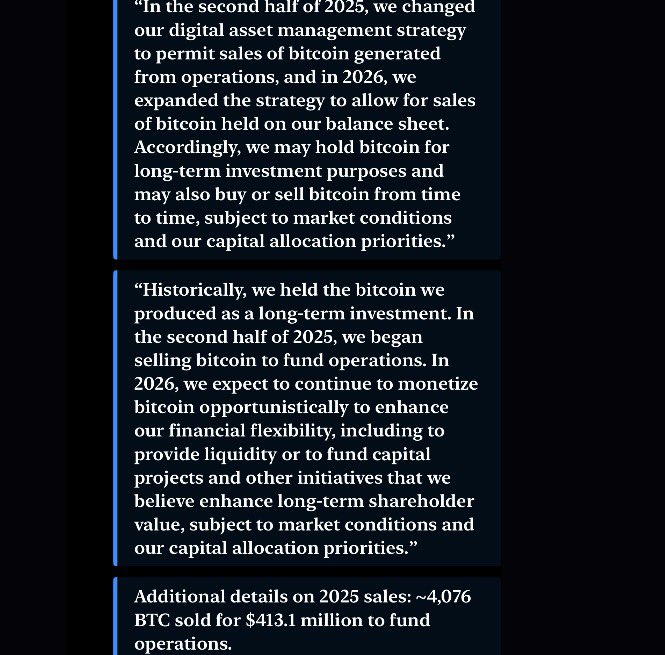
BREAKING: The largest publicly traded Bitcoin miner, MARA Holdings, is planning to SELL the majority of its Bitcoin reserves.
MARA has just updated its treasury policy to allow sales of its accumulated BTC.
The company currently holds 53,822 BTC, worth roughly $4.7 billion based on recent valuations, placing it just behind Michael Saylor’s Strategy.