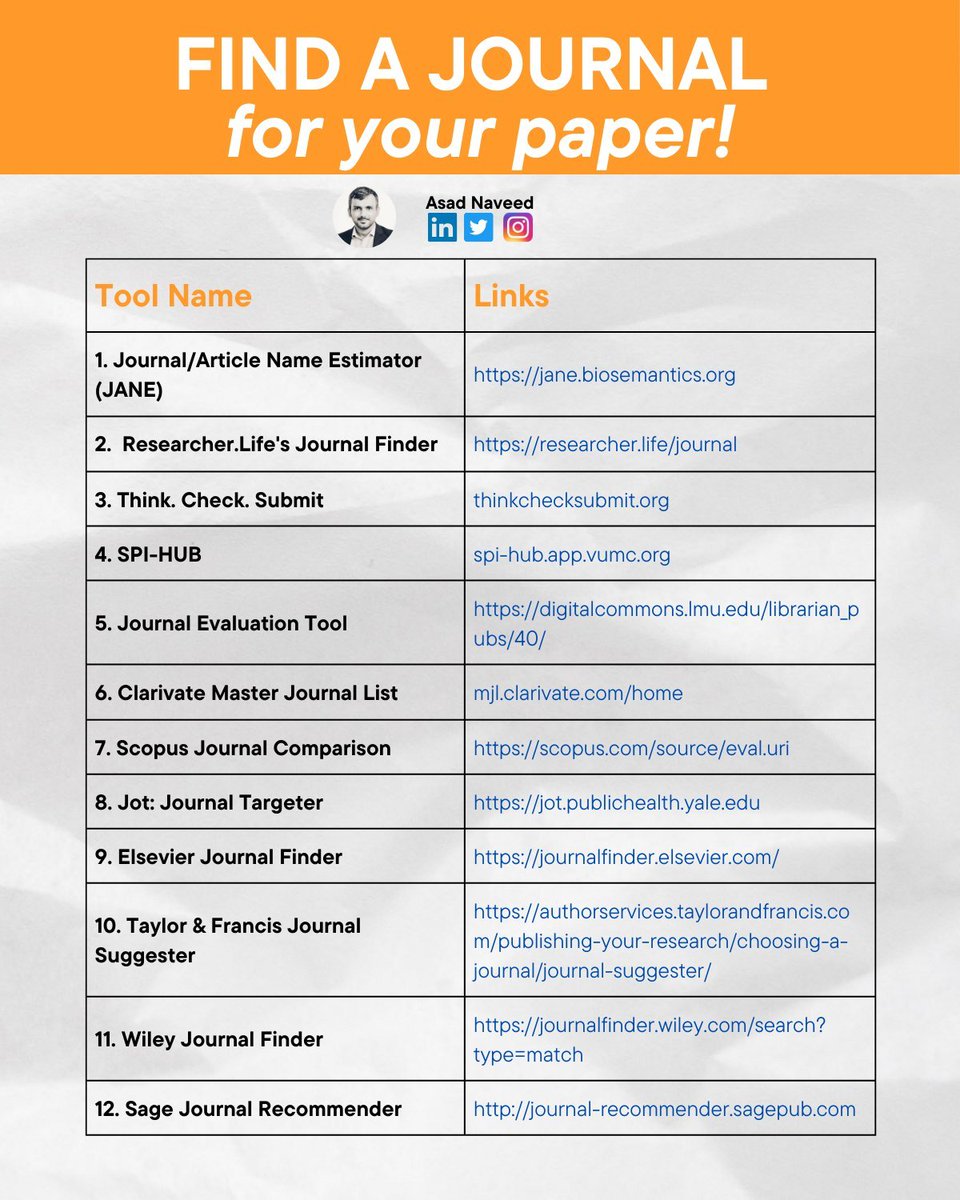
10 RESEARCH WEBSITES THAT PHDS DO NOT WANT YOU TO FIND.
Bookmark this. Academia is gatekept by paywalls and you should not be paying.
1. https://t.co/X3NB1B5G0J
The largest open library on earth. Almost any textbook your professor assigned is here for free.
2. https://t.co/6PrA4Hu4py
The search engine for academic papers. Sort by citations to find the most influential research.
3. https://t.co/Dkd9aUkaPM
AI powered paper search built by the Allen Institute. Highlights every citation in context.
4. https://t.co/eDeHsCfyHJ
Plug in one paper, see every related study mapped as a graph. Reveals what experts actually read together.
5. https://t.co/5qJJorB7ny
An AI research assistant. Ask any question and get a structured table of papers with key findings.
6. https://t.co/XnSZ9WPRR1
Aggregates the conclusions of thousands of papers into one answer. Stops cherry picking.
7. https://t.co/wyQIVMApM3
The Spotify of papers. Recommends new research based on what you have already read.
8. https://t.co/LkdILeVnhD
Visualizes citation chains. Shows how an idea spread across decades of research.
9. https://t.co/1bu5BC44jU
Tells you which papers support, contradict, or mention any claim. Saves hours of fact checking.
10. https://t.co/7krhcpFEED
200 million open access papers in one searchable index. The world's largest free academic archive.
Most students pay $40,000 to access what these sites already make free.
The Neuroscience of Word Meaning by Professor David Kemmerer
Discover how our brains represent word meanings, linking perception, action, emotion, and abstract cognition.
https://t.co/tEeZS6bH6R
#psychology#cognition
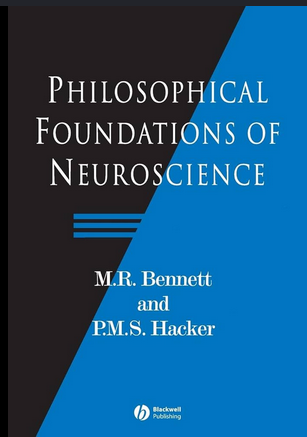
If you want to think and speak seriously about minds, brains, and computers, one book you ought to read is
Philosophical Foundations of Neuroscience, by Max Bennett and Peter Hacker
"If you're not failing, you're not pushing boundaries."
Hear medicine laureate Elizabeth Blackburn speak about the valuable lessons we can learn from failure.
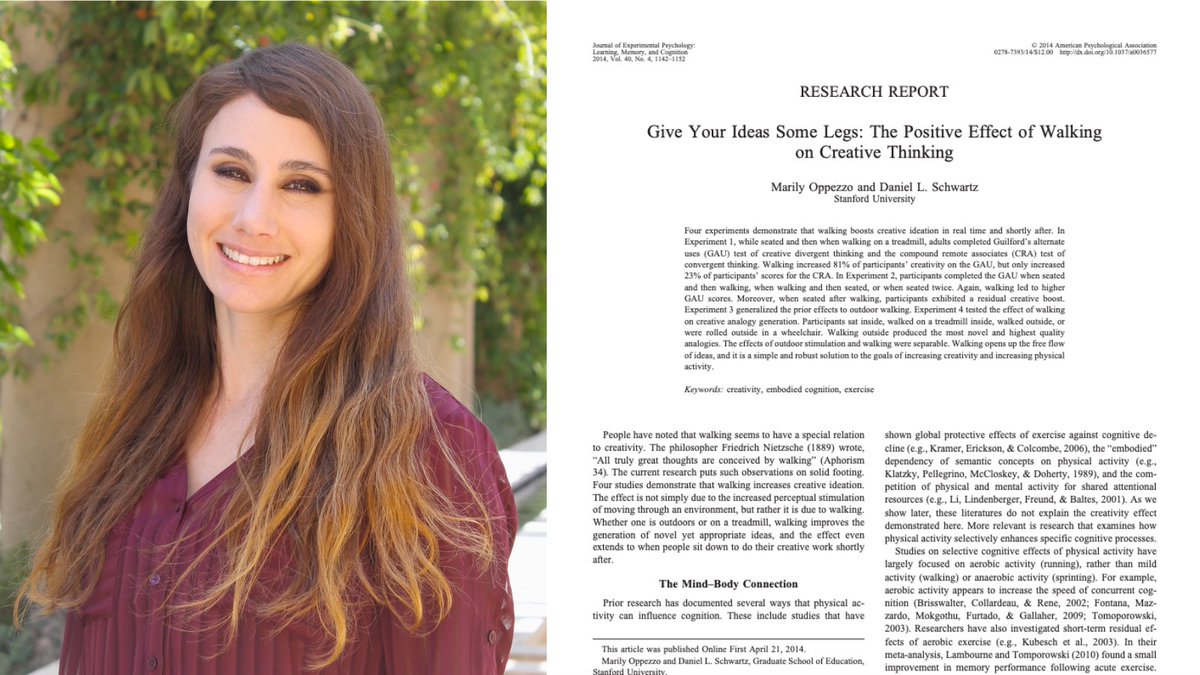
A Stanford psychologist spent 4 years proving that the simple act of walking generates 60% more creative ideas than sitting, and the experiment she designed to kill every alternative explanation is one of the most decisive findings in modern psychology.
Her name is Marily Oppezzo.
She got the idea for the study while walking with her advisor at Stanford to discuss her thesis topic, and the paper she eventually published in the Journal of Experimental Psychology in 2014 is sharp enough that it should have ended the seated meeting on the day it came out.
She ran 4 experiments on 176 people. Same person tested twice. Once sitting, once walking. The creativity tasks were the standard ones psychologists have used for decades to measure how good a brain is at generating novel useful ideas.
The result was almost too clean to publish.
81% of participants in the first experiment produced more creative ideas while walking than while sitting. In the second experiment, 88%. In the third, 100%. Every single person walked into a more creative version of themselves.
On average, people generated 60% more novel useful ideas the moment their legs started moving.
The skeptical question is the obvious one. Maybe it was the fresh air. Maybe it was the scenery passing by. Maybe it was the change of environment doing the work, not the walking itself.
Oppezzo killed every one of those explanations with one experimental decision.
She put people on a treadmill facing a blank wall. No scenery. No fresh air. No environmental change. Just legs moving in place while staring at white drywall. The 60% boost held.
Then she ran the experiment that closed the case completely. She took participants outside in two conditions. Half of them walked through a Stanford courtyard. The other half were pushed through the exact same courtyard in a wheelchair. Same outdoor stimulation. Same scenery passing at the same speed. The only difference was whether the legs were moving.
The walkers produced dramatically more novel high-quality ideas than the wheelchair group. The outdoors did almost nothing on its own. The walking did everything.
This is the part of the study that hit hardest when I read it the first time.
She also tested the opposite kind of thinking. Convergent thinking. The kind where there is one right answer and you have to narrow down to it.
Word puzzles where 3 words share a hidden fourth word that connects them. The seated participants did slightly better on these. Walkers got slightly worse.
Walking is not a general intelligence enhancer. It does one specific thing. It opens up the divergent search inside your brain. The part that generates options. The part that produces unexpected connections. The part that takes a problem and finds five ways into it instead of one.
When you need to converge on the single right answer, sit down. When you need to find the answer in the first place, get up.
The mechanism is now well understood. Walking selectively activates what neuroscientists call the default mode network, the system inside your brain that runs when you are not consciously focused on anything. The DMN is where mind-wandering happens. Where memories cross-reference each other. Where ideas that have been sitting in separate folders inside your head finally bump into each other.
When you sit at a desk and force yourself to concentrate, you suppress the DMN. When you walk at a natural pace, the executive part of your brain gets just busy enough handling the walking that the DMN comes online and starts doing the work that focus was blocking.
The most useful finding in the entire paper is the one almost nobody quotes.
The boost did not turn off the moment people stopped walking. Participants who walked first and then sat back down stayed elevated. Their next round of seated creativity work was still significantly better than people who had been sitting the whole time. The rest lingered for at least several minutes after the legs stopped moving.
You do not need to do creative work while walking. You need to walk before the creative work. The brain holds the state.
The history of this is the part that should haunt anyone who still does meetings in chairs.
Charles Darwin built a gravel loop behind his house in Kent called the Sandwalk and walked it 3 times a day for the rest of his life. The theory of evolution was developed one lap at a time on that path.
Nietzsche walked up to 10 hours a day during the years he wrote his most important books and openly said the work was conceived on his feet.
Beethoven composed for the morning and walked for 5 hours every afternoon with a pencil in his pocket for when something landed.
Kahneman said the best thinking of his Nobel Prize-winning career happened on leisurely walks with Amos Tversky. Steve Jobs refused to take important conversations sitting down. He held them on foot.
Every one of them was using the system Oppezzo would not measure until 2014. They just did not know what to call it.
The question worth sitting with is the one almost nobody asks.
Every meeting you have ever attended sitting around a table was a meeting held at a fraction of the brain power that was actually available to the people in the room. Every brainstorm that got stuck inside a conference room. Every problem you tried to solve at a desk and gave up on. Every idea you could not quite get to.
The intervention is the easiest one in modern science. No supplement. No app. No subscription. No training program. Just a pair of legs and 15 minutes.
The Stanford lab proved it. The philosophers knew it. The neuroscience explains it.
And almost everyone reading this is still trying to think their way out of problems sitting completely still.
mathematics is not just symbols.
it is language for compressing structure.
> numbers
> sets
> functions
> spaces
> limits
> transformations
we understand them by building mental bridges between ideas.
how we understand mathematics by jacek woźny
looks at how mathematical meaning forms through conceptual integration.
the important idea:
math is not only calculation.
it is metaphor, abstraction, language, and mental modeling working together.
> a line becomes a function.
> a function becomes a machine.
> a space becomes a set of possibilities.
> a proof becomes a path through logic.
most people struggle with math because they only see notation.
real understanding begins when symbols turn into concepts you can move around in your head.
INSTEAD OF WATCHING AN HOUR OF NETFLIX TONIGHT.
This 1 hour Stanford lecture by Joel Peterson will teach you more about negotiation and getting what you want than most people learn in years.
Bookmark it and give it an hour, no matter what.
¿Cómo habitamos los espacios digitales en nuestra #CasaAbiertaAlTiempo? 🏠✨
El Decálogo de ética para la IA en la UAM establece 10 principios clave para nuestra comunidad:
✅ Dignidad y derechos humanos: Procurar que los contenidos de IA no vulneren la integridad de las personas ni el prestigio institucional.
✅ Diversidad, igualdad y solidaridad: Garantizar la inclusión y reducir brechas de desigualdad cognitiva y social.
✅ Cultura de paz: Utilizar la IA para erradicar discursos de odio, violencia y desinformación.
✅ Honradez y responsabilidad: Declarar siempre la autoría y supervisar todo contenido generado por IA.
✅ Vocación de servicio a la sociedad: Orientar la tecnología hacia el bien común y la solución de problemas sostenibles.
✅ Sostenibilidad: Mantener una conciencia crítica sobre el impacto ambiental y energético de estos sistemas.
✅ Legalidad y seguridad: Actuar bajo la normatividad vigente y mitigar riesgos para los usuarios.
✅ Imparcialidad: Auditar y salvaguardar los procesos de interacción con cualquier sistema de IA.
✅ Transparencia y rendición de cuentas: Asegurar que el uso de la IA sea trazable, explicativo y justificable.
✅ Protección de datos y propiedad intelectual: Respetar rigurosamente la privacidad y los derechos de autor.
Construyamos juntos un futuro digital inclusivo y responsable.
👇 ¡Descarga el folleto y compártelo!
https://t.co/HAba1eQKUH
#UAM #ComunidadUAM #IAÉtica #EducaciónSuperior #CulturaDePaz
Hay un riesgo real de que el actual sistema educativo este erosionando habilidades como lectura, investigación y pensamiento crítico
La obsolescencia de los sistemas educativos tradicionales ante la IA crea un debate que debe ir más alla de como prohibirla
https://t.co/ymjBbdNB0T
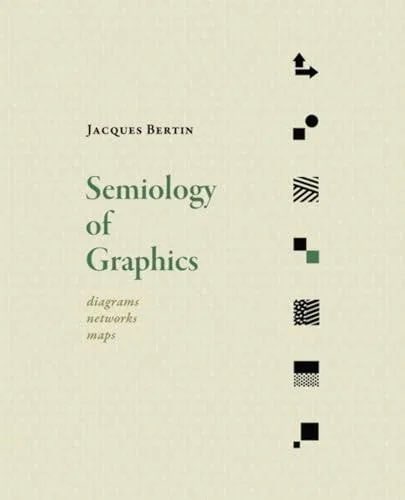
for those of you interesting in mastering the art of quantitative communication
once you are done with Tufte, you may advance to Bertin
billions of dollars have been reallocated based on the lessons of this text
Earlier this year I was getting frustrated with Claude's charts, fed this book to claude and had it generate a Tufte skill. Instantly got simpler/more beautiful visualizations.
https://t.co/lfXwyQfmQG
New Cambridge Element, Psychological Network Analyses & Directed Acyclic Graphs Tutorial for Developmental & Educational Science, by Xin Tang @Xin_Tang_Finn, Jindong Zhang, Yuyang Zhang & Hye Rin Lee! Free access available until 27 May at
https://t.co/S4kQfX8EQz
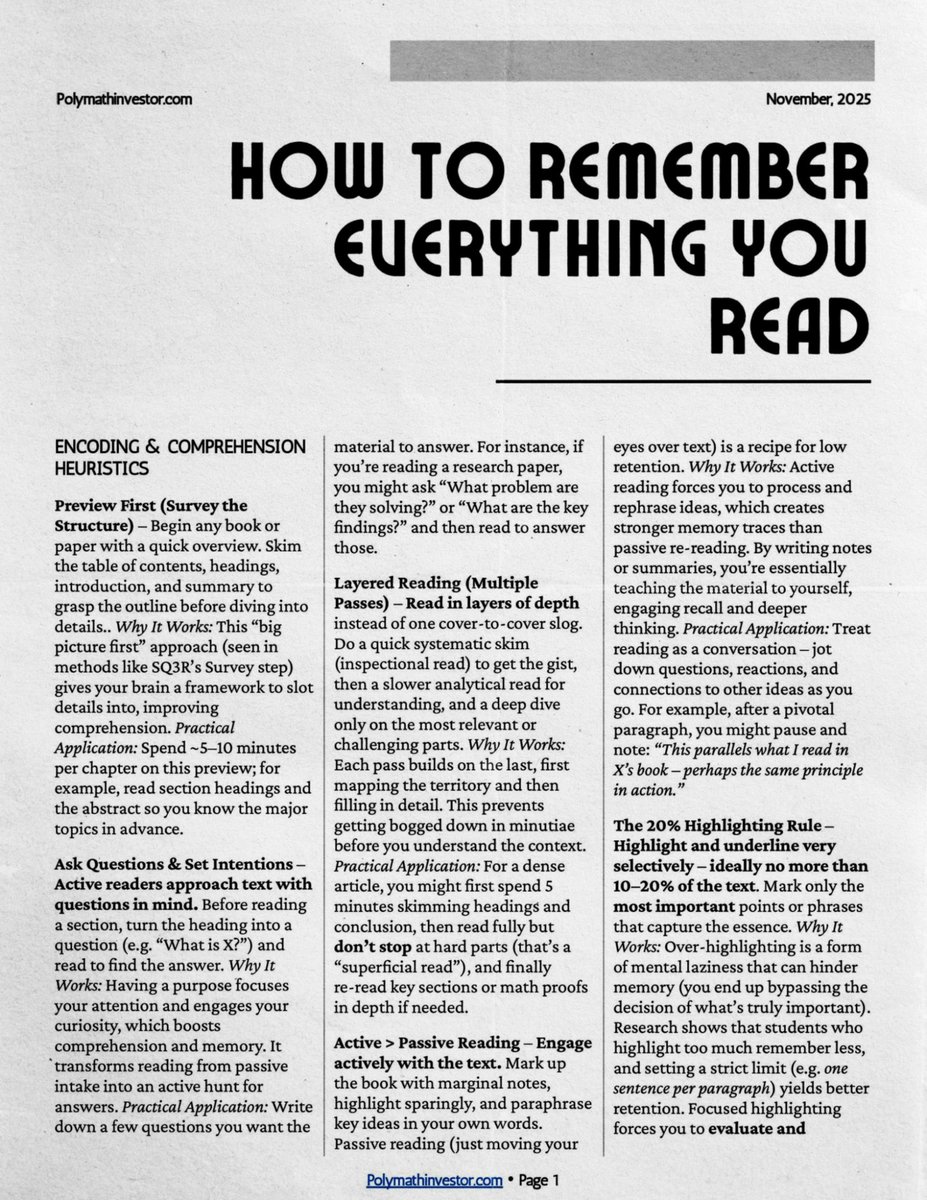
A few months back, I published this guide on how to remember everything you read.
Re-sharing it here for anyone who finds these protocols useful.
(1/11)
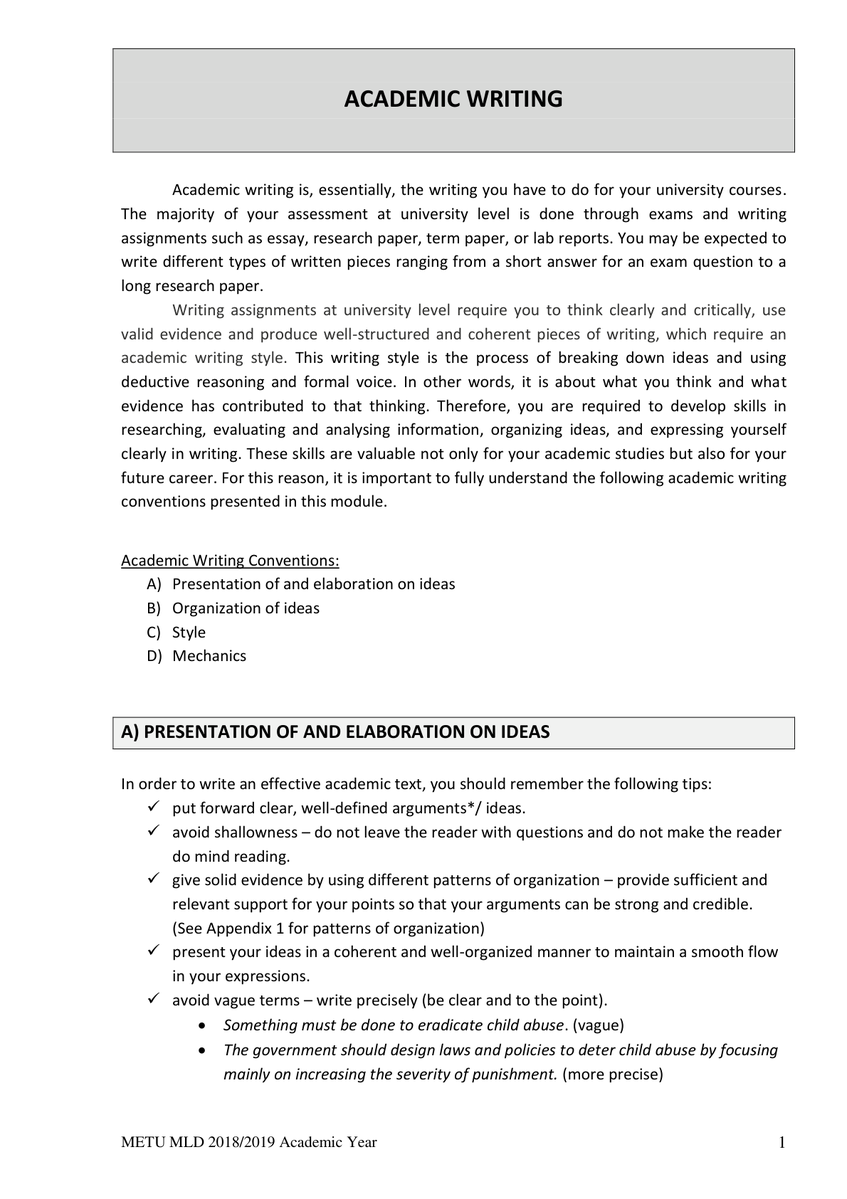
Here's a 123-page free academic writing guide
Download the guide by clicking the link below
Follow Silvi on LinkedIn for more free resources on academic writing.
https://t.co/q0saZRvru8