Happy to have visited the @SABIC_Europe site in Geleen, The Netherlands, with @J_Raynaud_PhD and Vincent Monteil. A nice closure to a great year of collaboration between SABIC and @cp2m_lab.
Karl Ziegler - Early Career of a Scientist
Angew. Chem., Int. Ed. https://t.co/tiGD8GHMtt
Angew. Chem. https://t.co/xGnL0nIGJD
Nobel Laureate Karl Ziegler’s early career was overshadowed by the political circumstances of the Nazi era. Born in 1998 he succeeded in his chemistry studies @Chemie_UMR in record time: He received his PhD at age 22 and his habilitation at age 25. After a short stint at the Univ. of Frankfurt he had from 1926 onwards non-permanent positions at the Univ. of Heidelberg. As Karl Ziegler opposed the Nazi ideology and party he was—despite his excellent chemical reputation—refused full professorships at various German universities (Heidelberg, Frankfurt, Karlsruhe, Würzburg, and Göttingen) in 1936 he finally received a call to the @UniHalle, and in 1943 he was offered the Directorship at the Kaiser Wilhelm Institute for Coal Research, today the https://t.co/vz1LSsqmf0 MPI for Coal Research. There, in 1953, he and his talented coworkers discovered the room-temperature/low-pressure #polymerization of #ethylene for which he received together with Giulio Natta @polimi in 1963 the https://t.co/Hvv9GSv5Vc #NobelPrize for Chemistry. More about the early career of Karl Ziegler can be read in a captivation article by Christoph Kießling just published in @angew_chem.
52ème Colloque national du GFP
🗓️du 20 au 22 nov 2024 à Paris, campus des Cordeliers
Thématiques:
-Polymères et Environnement (GDR DUMBIO)
-Polymères et Santé
-Polymères et Energie
-Matériaux Fonctionnels
-Physique des Polymères (GDR ISM)
https://t.co/F569BFLiwY
I had a great time in the @ICCLyon2024 yesterday. The venue is gorgeous, and the amount of different topics to explore was impressive. The new works on polyolefin chemical recycling were very elucidating and informative.
Next week @AliouiSamy and I will be representing the @cp2m_lab in the BlueSky-Incorep 2023! I am looking forward to meet different researchers on the field of polyolefin catalysis and sharing our experiences!
Very excited to be in the @exxonmobil European R&D Days next week in Brussels! This will be a great opportunity for exchange of ideas with other academics and the industry!
PhD students, don't worry. Technologies, trends, and even whole fields come and go. A PhD makes you an expert in a field but, more importantly, teaches you how to become an expert. Once you know that you can learn anything, you can adapt to major disruptions in your field.
With so many inspiring posters shared during #RSCPoster 2023, it was hard for our judges to pick their favourites, but we now have the final results! Discover all the winners 👉https://t.co/qk83p0bjEM
@EdGardner_ @EmilyPentzer @ABesika@AthinaAnastasa1@RoySocChem@CelesteBrady_ Mr. Gardner, good morning! By any chance is the RSC providing certificates for the webinars? It would be of great help to me because it will help me to complete the last credits I need in my doctoral school 😀
That concludes #RSCPoster 2023! Thank you for getting involved – we loved connecting with you all and seeing your amazing posters. The winners for each category will be announced soon. In the meantime, explore our #RSCPoster journal collection - https://t.co/BenG8IRR0v
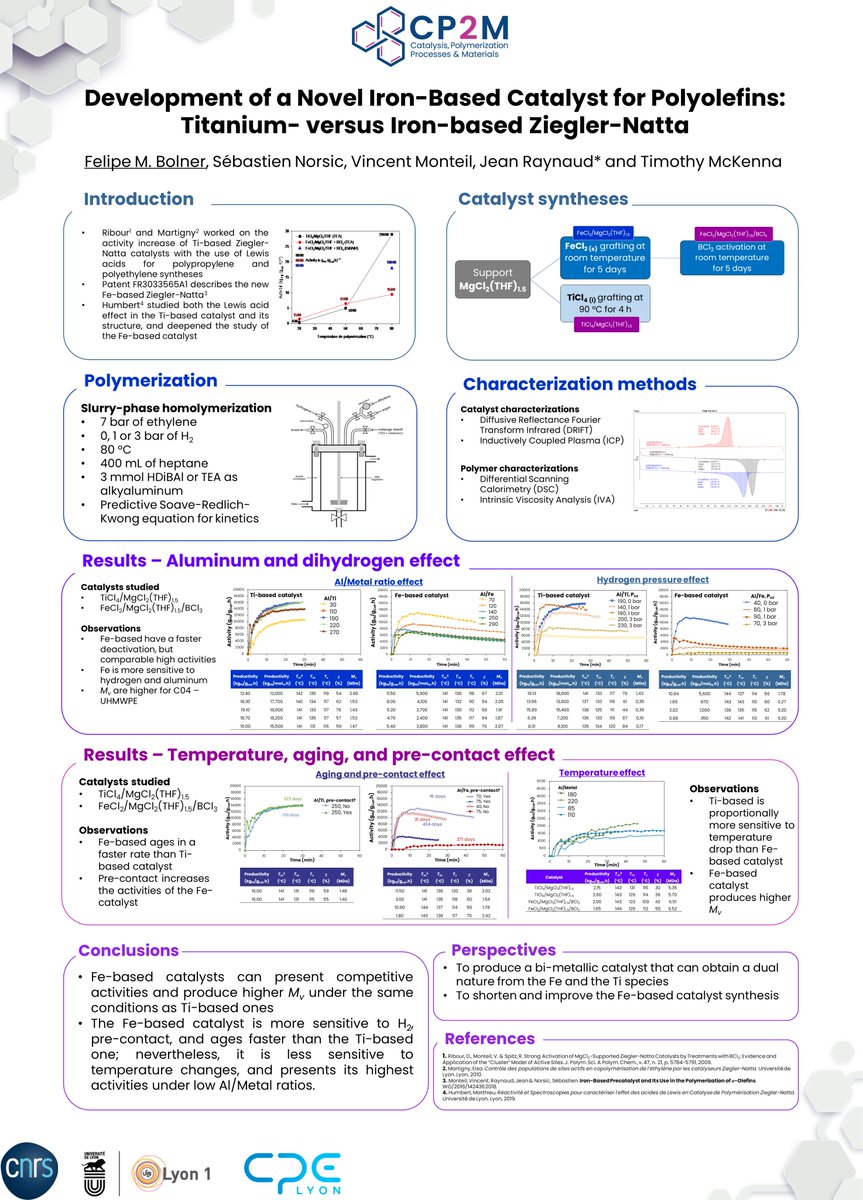
@DrEllisCrawford @J_Raynaud_PhD@timothy_mckenna@cp2m_lab the mechanism of polymerization is the same as the Ti-based Ziegler-Natta catalyst because we obtained ultra-high molecular weight (UHMWPE) using the Fe-based catalyst. Linear PE resins - LLDPE, HDPE - require a coordination polymerization mechanism. I hope it was helpful! (3/3)
It is my pleasure to show you my work for the 2023 #RSCPoster about the comparison between the FeCl2-based Ziegler-Natta catalyst developed at the CP2M lab and the classic TiCl4/MgCl2 Ziegler-Natta on ethylene homopolymerization. #RSCCat#RSCMat#RSCEng
@DrEllisCrawford @J_Raynaud_PhD@timothy_mckenna@cp2m_lab a major change in activity, and after ICP-AES analysis we observe that all FeCl2 added to the system is supported in both methods. Nevertheless, the solvents we use have to be dry, since Ziegler-Natta catalysts are poisoned by water and oxygen gas. Finally, we believe that (2/3)
@EdGardner_@J_Raynaud_PhD@timothy_mckenna@cp2m_lab these options use complex ligands instead of simple structures such as ours, making these catalysts more expensive and difficult to synthesize. (2/2)
@EdGardner_@J_Raynaud_PhD@timothy_mckenna@cp2m_lab Thank you for your question! We wanted a greener metal alternative than titanium for ethylene coordination polymerization by using iron, an abundant and non-toxic option. It is reported in the literature many options of transition metals for olefin polymerization, however (1/2)