You can sign up for our daily newsletter @ https://t.co/VQgxJp8Ia1 (subscribe button under "get updates") on page 1.
Or lmk your email and Ill sign you up directly.
This is genuinely wild.
Cloudflare just dropped new Radar data showing that bots and AI traffic now account for 57.5% of all HTML webpage requests on their network.
Humans are down to 42.5%.
For context, Cloudflare handles around 20% of the entire internet. So this is not a small sample size.
Their CEO said the agentic AI wave has flipped the script years ahead of their 2027 forecast. Crawlers, scrapers, autonomous agents. Hammering sites non stop.
Most of the visitors reading content and loading pages right now are machines.
This breaks a lot of things at once.
Ad models that priced eyeballs, SEO playbooks built around human reading patterns, site design and rate limits built for human behavior. All of it needs to be rewritten for machines first.
The internet just stopped being a human-first place.
We are the minority now.
Rubicon Organics Celebrates Double Win at the 2026 Grow Up Industry Awards
- 1964 Supply Co.™ awarded Brand of the Year
- Simply Bare™ Organics awarded Best Dry Flower for BC Organic Fruit Loopz
$ROMJ $ROMJF
https://t.co/86HfpmigmH
One of the few good recent Rogan podcasts (usually the ones where he shuts up and lets someone talk passionately for 2-3 hours).
This NASA astrophysicist / spokesperson was fantastic.
https://t.co/k3IgjSdttJ
BUSINESSES ARE NOW USING PREDICTION MARKETS TO HEDGE PROMOTIONS LOL
A BAR IN NYC HAD A PROMO IF THE KNICKS WIN, THEY COVER EVERYONE’S DRINKS FOR THE NIGHT
THE BAR PLACED A $5K HEDGE ON KALSHI THAT PAYS OUT IF THE KNICKS WIN
THE BAR WINS EITHER WAY
Most of fintwit is people pumping 100x P/S names that have run 1,300% in the last 6 months.
Still a ton of alpha for people who screen everything and only pick the best-in-class.
Some names have gigantic catalysts in front of them and are down heavily.
This market is incredibly inefficient. You dont need to chase the federal trade in order to find investment opportunities.
Scientists pulled one kind of bacteria out of a jar of kimchi, fed it to mice, and those mice pooped out twice as much plastic as the mice that didn't get it. That single experiment is behind every "eat kimchi to flush plastic from your body" headline going around this week.
The bacteria, a strain called CBA3656, sticks to nanoplastics. Those are plastic flecks so small they slip straight through your gut wall and end up lodged in your kidneys and brain. In a clean lab dish, the bacteria grabbed 87% of the plastic around it. Then the team ran it through conditions that copy a working human gut, the acid and the constant squeezing, and the grip dropped to 57%. A second kimchi strain they tried fell apart in the same test and held onto just 3%.
So the grabbing part holds up, and in those mice it did push more plastic out the other end. But two details keep this far from dinner advice. The mice were germ-free, raised with no gut bacteria of their own, nothing like the crowded gut you actually have. And the bacteria was purified and fed on its own, in amounts you'd never get from a few bites of cabbage. The team also tested just one type of plastic, the kind in foam cups and takeout boxes, so nobody knows yet whether it grabs the dozens of others you swallow every day.
The irony is almost funny. Kimchi is traditionally salted with sea salt, and sea salt is one of the most common ways plastic sneaks into food in the first place. When scientists checked salt brands from six continents, they found up to 1,674 plastic specks in a single kilogram, with the worst counts in Asian sea salts. Korean food researchers have even started swapping in pink salt to make kimchi, just to cut the plastic. So the same jar can be dropping plastic in while its bacteria carry a bit out.
Salt is also why "just eat more kimchi" falls apart. One cup of cabbage kimchi carries around 750 milligrams of sodium, more than a third of all the salt you're meant to get in a whole day. Korea eats more kimchi than anywhere on earth, and it also has one of the highest stomach cancer rates in the world, something researchers link partly to that heavy salt habit. Eating bowls of it to chase a result from sterile mice would buy you a guaranteed sodium problem for a plastic payoff no one has shown works in people.
Right now there is no proven way to pull microplastics back out of a living human body. This study is a promising first step toward one, built on bacteria people have safely eaten for centuries. But calling it a plastic detox skips every step between a purified strain in a sterile mouse and a tub of kimchi in your fridge.
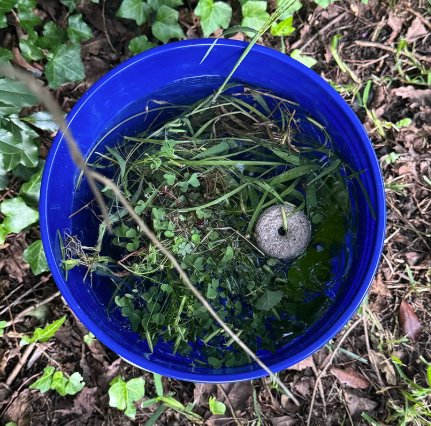
You can crash your yard's mosquito population without spraying a single chemical with a Mosquito Bucket of Doom.
Fill a 5-gallon bucket about two-thirds with water. Drop in a handful of grass clippings, leaves, or hay. Let it sit for a day, then drop in a Bti dunk (also called Bacillus thuringiensis israelensis, sold at any hardware store as "mosquito dunks," about $10 for six).
Mosquitoes are powerfully attracted to fermenting water and will lay their eggs in your bucket. Bti is a naturally occurring soil bacterium that produces a toxin that kills mosquito, blackfly, and fungus gnat larvae only.
This method doesn't harm bees, butterflies, fireflies, fish, frogs, birds, pets, or people. BTI dunks are EPA-approved for organic use and safe in animal water troughs and birdbaths.
One dunk lasts about 30 days. Top off the water as it evaporates. Cover with 1/2-in Mesh Hardware Cloth to prevent animals from getting trapped and put the bucket somewhere shady where pets and kids won't get into it.
The bucket becomes a mosquito magnet and a dead end. Compare that to fogging the entire yard with pyrethroids, which kills every insect in it, including the predators that eat mosquitoes.
Doug Tallamy's Homegrown National Park has been running the "Mosquito Bucket Challenge" since 2021. The more buckets in a neighborhood, the bigger the dent. One bucket per yard is a great start.