Con orgullo presentamos en #Chivilcoy la primera investigación nacional #apostarnoesunjuego sobre apuestas online en jóvenes, con la participación de más de 9.000 chicos en 24 provincias y 360 localidades, junto a @cotyalonso Roxana Lopez y Malena Sartoretto.
Mañana comenzará el Mundial, y muchos estarán atentos a los partidos. El fútbol nos recuerda algo que no debemos olvidar: la vida no es una carrera para lucirse en solitario, sino un camino que aprendemos a recorrer juntos. Quien no sabe pasar el balón, aunque tenga talento, todavía no ha entendido el juego. Y quien no sabe vivir con los demás y para los demás, todavía no ha entendido la vida. #ViajeApostólico
"Llegamos al ridículo de normalizar que en muchos países si uno mata a una mujer se llama femicidio y tiene una pena más grave que si mata a un hombre. Legalizando que la vida de la mujer vale más que la del hombre"
-Javier Milei sobre los femicidios
ARGENTINA QUEDÓ ÚLTIMA EN EL RANKING DE INVERSIÓN EXTRANJERA EN LA REGIÓN
De acuerdo con datos de la Organización para la Cooperación y el Desarrollo Económico (OCDE) para 2025, el país recibió US $3.134 millones de inversión extranjera directa y quedó muy por debajo de los registros del resto de la región. El dato generó incomodidad en el Gobierno.
El Ejecutivo apuesta a revertir la situación con el RIGI, el Super RIGI y el impulso a sectores estratégicos. Sin embargo, las inversiones vinculadas principalmente a recursos naturales y energía aún no alcanzan para generar un proceso amplio de atracción de capitales.
Cuánto registraron los demás países
— Brasil: US$ 77.000 millones
— México: US$ 40.000 millones
— Chile: US$ 13.000 millones
— Colombia: US$ 11.000 millones
— Costa Rica: US$ 6.000 millones
Fragmentos del reporte de Misión Productiva con datos de OCDE
"El contraste refleja las dificultades persistentes de la Argentina para consolidarse como destino de capital productivo de largo plazo, aun en sectores donde el país posee ventajas competitivas y fuertes incentivos regulatorios".
"La inversión extranjera difícilmente pueda expandirse de manera sostenida en un contexto de mercado interno deprimido, utilización ociosa de capacidad instalada y ausencia de financiamiento de largo plazo".
(+) en Clarín: https://t.co/lzUJLA5qWr
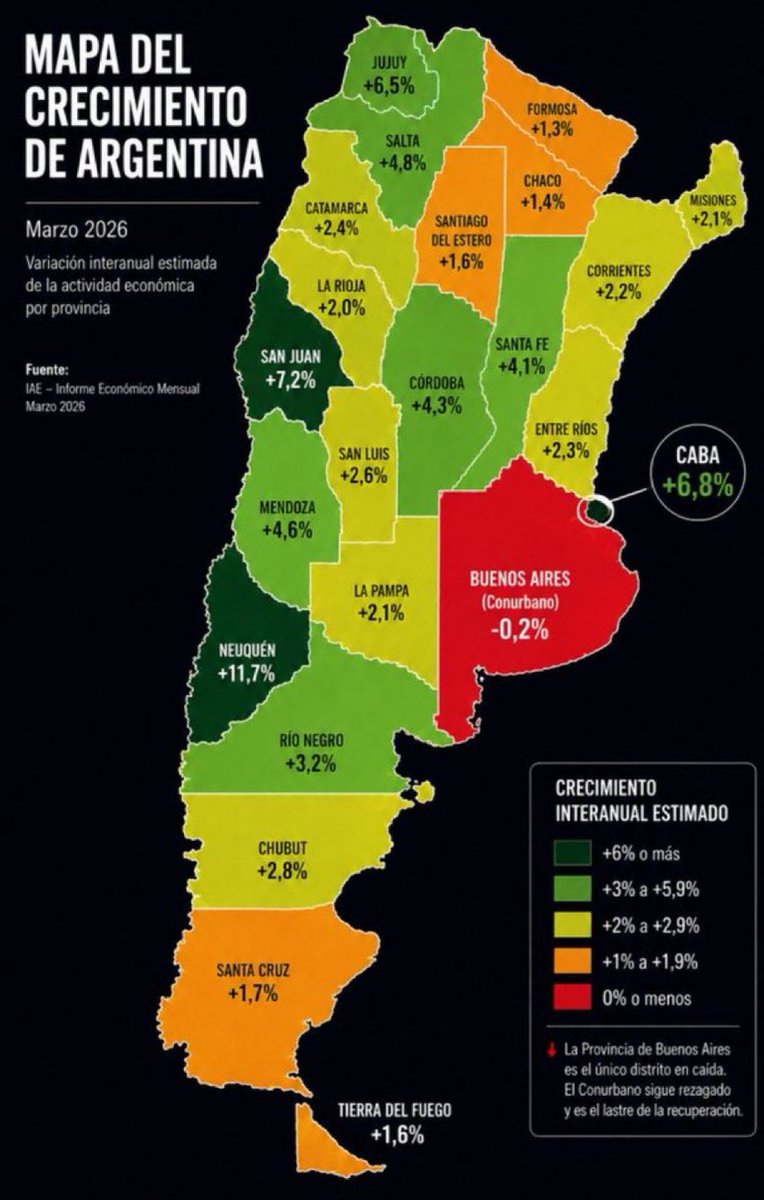
[NUEVO] El mapa de actividad económica de las provincias que compartió Milei es falso y no pertenece al IAE ❌
➡️Desde el IAE Business School confirmaron a Chequeado que “ni los datos ni el mapa pertenecen a un informe elaborado por la escuela de negocios de la Universidad Austral”.
➡️Además, el mapa muestra inconsistencias geográficas y otros claros indicios de haber sido generado con IA.
LA UNIVERSIDAD AUSTRAL DESMINTIÓ HABER ELABORADO EL MAPA SOBRE CRECIMIENTO ECONÓMICO PROVINCIAL QUE CIRCULA EN REDES
Desde la IAE Business School de la casa de estudios desmintieron haber elaborado el “mapa del crecimiento de Argentina” que circula en redes sociales y que cita a esa institución como fuente. La imagen había sido compartida este sábado por referentes del oficialismo, entre ellos Fernando Iglesias y el propio Javier Milei.
"El mapa de crecimiento económico provincial que circula en redes sociales y que cita como fuente ‘IAE – Informe Económico Mensual marzo 2026’ no fue elaborado por el IAE ni forma parte de ninguno de nuestros informes", afirmaron a través de su cuenta oficial en la red X.
(+) en Clarín: https://t.co/QVp2PdpQEH
Foto: El mapa compartido de falsa autoría.
EXCLUSIVO:
Manuel Adorni y su esposa gastaron $85 millones en tarjetas de crédito durante 2025
El promedio de consumos registrados fue de $7,1 millones por mes cuando el funcionario cobraba $3,5 millones y Bettina Angeletti era monotributista
https://t.co/zxkgeloYp0
peter thiel no viene a vender “innovación” sino a recordar que el nuevo capitalismo no necesita fábricas, necesita datos, vigilancia y estados dispuestos a tercerizar su soberanía.
palantir expresa la fantasía oscura de las élites donde la ciudadanía es administrada como una base de datos, la privacidad se vuelve una anomalía y los monopolios gobiernan todos los aspectos de nuestra vida.
que figuras así ganen influencia en argentina debería abrir una pregunta urgente: si el futuro lo programan las potencias, ¿qué lugar nos queda a nosotros además de obedecer de forma sumisa haciendo seguidismo ciego?
Today @FaustiOro is seemingly just a boy. He learned chess at his kitchen table during the pandemic. Five years later, he is a Grandmaster — the second-youngest in the history of our sport.
Argentina has produced another twelve-year-old the world will be watching for the next twenty. @leomessi knows the feeling.
Congratulations, Fausti. Congratulations, Argentina @JMilei 🇦🇷
Cuando les pregunten si la plata les da la felicidad acuerdense de este ejemplo:
La persona mas rica de nuestro pais riendose de una jubilada que no le alcanza para los remedios
La inseguridad preocupa cada vez más en la ciudad.
Sin datos completos no hay diagnóstico serio. Y sin diagnóstico, no hay política de seguridad posible.
🎙️ Les compartimos un recorte de la entrevista en el programa Buenos Días de Radio Chivilcoy.
Espectacular lo que cuenta @AnguloMartin sobre los viajes de Adorni. Los dos hoteles de lujo de la familia en Aruba salieron casi 15 mil dólares. Se pagaron CASH en una agencia de viajes en Argentina. Taca-taca. Mandó a alguien a garpar con la viva, la viviana, la vivaldi, la rúcula, la crocante, la morocha. Todo cara grande, obvio. ¿Y se acuerdan que también dijo que los gastos de su esposa en la estadía oficial a Nueva York se pagaban “de su bolsillo”? Resulta que no hay ni un solo movimiento de sus tarjetas de crédito allá en esos días. Nada, cero. En Aruba, tampoco. Una pareja que solo usa efeté, parece. Por otro lado, son gastos curiosos para alguien que ya sabemos que tiene 335 mil dólares de deudas por operaciones inmobiliarias.
Because we get asked a lot.
The Technological Republic, in brief.
1. Silicon Valley owes a moral debt to the country that made its rise possible. The engineering elite of Silicon Valley has an affirmative obligation to participate in the defense of the nation.
2. We must rebel against the tyranny of the apps. Is the iPhone our greatest creative if not crowning achievement as a civilization? The object has changed our lives, but it may also now be limiting and constraining our sense of the possible.
3. Free email is not enough. The decadence of a culture or civilization, and indeed its ruling class, will be forgiven only if that culture is capable of delivering economic growth and security for the public.
4. The limits of soft power, of soaring rhetoric alone, have been exposed. The ability of free and democratic societies to prevail requires something more than moral appeal. It requires hard power, and hard power in this century will be built on software.
5. The question is not whether A.I. weapons will be built; it is who will build them and for what purpose. Our adversaries will not pause to indulge in theatrical debates about the merits of developing technologies with critical military and national security applications. They will proceed.
6. National service should be a universal duty. We should, as a society, seriously consider moving away from an all-volunteer force and only fight the next war if everyone shares in the risk and the cost.
7. If a U.S. Marine asks for a better rifle, we should build it; and the same goes for software. We should as a country be capable of continuing a debate about the appropriateness of military action abroad while remaining unflinching in our commitment to those we have asked to step into harm’s way.
8. Public servants need not be our priests. Any business that compensated its employees in the way that the federal government compensates public servants would struggle to survive.
9. We should show far more grace towards those who have subjected themselves to public life. The eradication of any space for forgiveness—a jettisoning of any tolerance for the complexities and contradictions of the human psyche—may leave us with a cast of characters at the helm we will grow to regret.
10. The psychologization of modern politics is leading us astray. Those who look to the political arena to nourish their soul and sense of self, who rely too heavily on their internal life finding expression in people they may never meet, will be left disappointed.
11. Our society has grown too eager to hasten, and is often gleeful at, the demise of its enemies. The vanquishing of an opponent is a moment to pause, not rejoice.
12. The atomic age is ending. One age of deterrence, the atomic age, is ending, and a new era of deterrence built on A.I. is set to begin.
13. No other country in the history of the world has advanced progressive values more than this one. The United States is far from perfect. But it is easy to forget how much more opportunity exists in this country for those who are not hereditary elites than in any other nation on the planet.
14. American power has made possible an extraordinarily long peace. Too many have forgotten or perhaps take for granted that nearly a century of some version of peace has prevailed in the world without a great power military conflict. At least three generations — billions of people and their children and now grandchildren — have never known a world war.
15. The postwar neutering of Germany and Japan must be undone. The defanging of Germany was an overcorrection for which Europe is now paying a heavy price. A similar and highly theatrical commitment to Japanese pacifism will, if maintained, also threaten to shift the balance of power in Asia.
16. We should applaud those who attempt to build where the market has failed to act. The culture almost snickers at Musk’s interest in grand narrative, as if billionaires ought to simply stay in their lane of enriching themselves . . . . Any curiosity or genuine interest in the value of what he has created is essentially dismissed, or perhaps lurks from beneath a thinly veiled scorn.
17. Silicon Valley must play a role in addressing violent crime. Many politicians across the United States have essentially shrugged when it comes to violent crime, abandoning any serious efforts to address the problem or take on any risk with their constituencies or donors in coming up with solutions and experiments in what should be a desperate bid to save lives.
18. The ruthless exposure of the private lives of public figures drives far too much talent away from government service. The public arena—and the shallow and petty assaults against those who dare to do something other than enrich themselves—has become so unforgiving that the republic is left with a significant roster of ineffectual, empty vessels whose ambition one would forgive if there were any genuine belief structure lurking within.
19. The caution in public life that we unwittingly encourage is corrosive. Those who say nothing wrong often say nothing much at all.
20. The pervasive intolerance of religious belief in certain circles must be resisted. The elite’s intolerance of religious belief is perhaps one of the most telling signs that its political project constitutes a less open intellectual movement than many within it would claim.
21. Some cultures have produced vital advances; others remain dysfunctional and regressive. All cultures are now equal. Criticism and value judgments are forbidden. Yet this new dogma glosses over the fact that certain cultures and indeed subcultures . . . have produced wonders. Others have proven middling, and worse, regressive and harmful.
22. We must resist the shallow temptation of a vacant and hollow pluralism. We, in America and more broadly the West, have for the past half century resisted defining national cultures in the name of inclusivity. But inclusion into what?
Excerpts from the #1 New York Times Bestseller The Technological Republic: Hard Power, Soft Belief, and the Future of the West, by Alexander C. Karp & Nicholas W. Zamiska
https://t.co/8igjazz1On








![Chequeado's tweet photo. [NUEVO] El mapa de actividad económica de las provincias que compartió Milei es falso y no pertenece al IAE ❌
➡️Desde el IAE Business School confirmaron a Chequeado que “ni los datos ni el mapa pertenecen a un informe elaborado por la escuela de negocios de la Universidad Austral”.
➡️Además, el mapa muestra inconsistencias geográficas y otros claros indicios de haber sido generado con IA.](https://pbs.twimg.com/media/HJGbx3rXEAAPecw.jpg)