For years, the blockchain debate was:
Ethereum vs Solana vs the next contender.
I think that model is wrong.
And the reason is simple:
The primary user of blockchains is no longer human.
My conclusion:
A network that delivers:
• PoW security
• Sub-second settlement
• Fraction-of-a-cent fees
isn't necessarily competing with Ethereum or Solana.
It may occupy a category of its own.
#Kaspa#KAS#AIAgents#Web3#DeFi#MachineEconomy
For years, the blockchain debate was:
Ethereum vs Solana vs the next contender.
I think that model is wrong.
And the reason is simple:
The primary user of blockchains is no longer human.
But technology alone isn't enough.
Kaspa still needs:
A native stablecoin
Miner-consensus price oracles
x402 integration (Coinbase's M2M payment standard)
Agent SDKs and an on-chain Agent Registry
The infrastructure layer for autonomous economies.
That's a really good question, but it's hard to answer in a single tweet because our mission is quite extensive, and it requires a lot of background knowledge to really understand what sets Kaspa apart.
Currently, a lot of people see Kaspa as “Bitcoin’s crazy little brother” that improves time-to-finality by leveraging the benefits of DAG-based consensus protocols without accepting their traditional drawbacks, such as decreased decentralization or a limited validator set.
This perception is somewhat accurate, but it falls short of conveying the full picture, because Kaspa’s vision extends far beyond just trying to be a better Bitcoin.
Anyone willing to study Kaspa and its broader vision will discover similarities to nearly all major existing DLT designs: from Bitcoin, to Ethereum, to Solana, Sui, Celestia, and beyond.
My personal view is that “research” in the DLT space is approaching a point of convergence. We increasingly understand how to push distributed systems close to the limits of what physics permits. The frontier is no longer only about raw throughput or faster finality. The attention is shifting toward game theory, incentives, sequencing, MEV, alignment, and how to build systems where the economic incentives of users, builders, miners, validators, applications, and infrastructure providers do not work against each other.
That is why debates like based rollups versus arbitrary sequencing, shared sequencing, MEV mitigation, proposer-builder separation, and execution-layer incentives matter so much. These are not niche technical details. They determine whether a network can remain neutral, decentralized, and aligned while scaling to global usage.
And this is where I think Kaspa is pushing the boundaries in a very important way.
Kaspa is not merely trying to be “fast.” The goal is to build an L1 where speed, decentralization, security, and incentives are aligned at the base layer. A system that does not scale by hiding complexity behind trusted committees, privileged sequencers, centralized validator sets, or opaque coordination mechanisms, but instead tries to preserve the spirit of proof-of-work while extending what an L1 can realistically do.
Because Kaspa arrived later than many other major projects, it does not carry the same degree of technological debt. It can absorb lessons from Bitcoin, Ethereum, rollups, modular blockchains, high-throughput monolithic chains, DAG research, MEV research, and the broader history of decentralized systems, and combine those lessons into something more optimal.
To me, that is what Kaspa is building: not just a faster blockchain, but a more incentive-aligned decentralized infrastructure layer.
But this also creates a different challenge.
Kaspa’s biggest problem today is not its technology. It is the lack of centralized coordination around communicating the vision. And because Kaspa is a grass-roots movement, that responsibility does not belong to a marketing department, or a single leadership team. It belongs to the community.
That also means the community has a different role to play.
There will always be holders who are mainly interested in price, and that is completely fine. But there also need to be people who are here because they want to use the technology to build a different future. People who care about the architecture, the incentives, the open questions, the trade-offs, and the long-term trajectory of decentralized infrastructure.
I am one of those people.
I am not interested in DLTs merely as a way to generate wealth. I am interested in them because I believe they can change the trajectory of humanity as a whole.
For that reason, I want to use this opportunity to announce a regular community hangout where we discuss the current state of development, the open questions, and where we can align our vision together.
The first session will be on Tuesday, June 9th, 2026.
We will talk about the vProgs framework, how the codebase works, what sets Kaspa apart, where we improve on existing solutions, and what still needs to be done. The goal is for this to become a regular, possibly bi-weekly, event where we as a community come together to discuss the future and understand the technology.
Eventually, we can invite people from other projects as well, but the main focus at the beginning will be explaining and communicating how things work under the hood.
There is still a lot of work to be done, and I do not want to waste precious time. So the first sessions may feel a little improvised, but we can improve as we go.
The important thing is that we start.
So mark the date: Tuesday, June 9th, 2026.
⚖️ POW VS POS IS NOT A TECH DEBATE ANYMORE. IN THE AGENT ERA, IT IS A DISPUTE ABOUT WHO YOU TRUST.
The PoW vs PoS debate is usually framed as "energy use vs efficiency." That framing is six years out of date.
The real question, the only one that matters for the next decade: which security model can an AI agent actually trust?
⚡ THE HUMAN-ERA FRAMING
For humans, PoS works. Validators are usually known entities, the staking yield aligns incentives, slashing punishes bad behavior, and human users mostly do not care about the underlying security model as long as the app works.
This is fine for crypto in 2020. It is not fine for crypto in 2027.
🤖 THE AGENT-ERA FRAMING
An AI agent settling 5,000 transactions per day faces a different threat model than a human user signing one transaction per week.
The agent's threats:
1. Validator collusion against a specific transaction class
2. Censorship of agent-originated transactions for regulatory reasons
3. MEV extraction at scale, far more aggressive than human-targeted MEV
4. Selective availability based on agent identity or origin
All four threats exist on PoS chains. All four are mitigated only by social pressure, regulatory pressure, or political pressure on a small validator set.
Agents do not respond to social pressure.
🎯 WHY POW IS STRUCTURALLY DIFFERENT
PoW security comes from physical cost. To attack the network, you must outspend the network on energy and hardware. There is no validator set to bribe, coordinate with, or pressure.
An AI agent evaluating PoW security only has to model one thing: the cost of attacking the hash rate. This is a clean economic calculation with no social variables.
An AI agent evaluating PoS security has to model: validator concentration, slashing conditions, regulatory exposure of validators, MEV extraction patterns, governance attack vectors, social coordination risk. All of these have political dimensions that agents cannot reliably model.
🌐 THE TRUST PRIMITIVE
PoW trust is denominated in joules. PoS trust is denominated in stake plus reputation plus governance plus regulation.
Agents speak the language of math, not politics. They will systematically prefer the trust primitive that compiles into a single economic calculation over the one that requires modeling human institutions.
This is not an ideological claim. It is a mechanical one.
🏛️ WHY THIS MATTERS FOR KASPA SPECIFICALLY
Bitcoin has the same PoW property but is unprogrammable and slow. Ethereum has programmability but switched to PoS, losing the trust primitive that agents prefer. Solana, Avalanche, Cardano, all in the PoS camp.
Kaspa is the only major chain that is simultaneously:
. PoW secured
. High-throughput
. Programmable through Toccata
. Ownerless and unfundable
This is not a coincidence. This is the only architecture that satisfies the agent trust model while also supporting the application logic agents need.
🎯 BOTTOM LINE
PoS won the 2020-2024 era because humans tolerate political trust. PoW will win the 2027-2030 era because agents do not.
The next decade of crypto is not "which chain has best UX." It is "which chain do machines structurally prefer."
💾 Save. The PoW renaissance does not start with Bitcoin. It starts with whichever PoW chain agents adopt first.
Tags: #Kaspa $KAS #PoW #PoS #Trust #AIAgents #Security #Validators #Decentralization #Crypto #Web3 #Bitcoin #Ethereum #L1
🤖⚡ AI AGENTS WILL CHOOSE KASPA. BUT ONLY IF 2 THINGS HAPPEN.
By 2027, millions of AI agents will pay each other 1000 times per minute. No banks. No cards. No weekends off.
Most people are betting on Ethereum L2s or Solana. I think they're wrong. Here's the full breakdown: under what conditions the agentic economy will choose Kaspa — and why it will be inevitable.
⚠️ FIRST, HONESTLY — 2 CONDITIONS. WITHOUT THEM THE THESIS BREAKS.
1️⃣ SILVERSCRIPT TRAINING DATA.
AI agents (Cursor, Claude Code, Copilot) are trained mostly on Solidity. Silverscript is new — code corpus is near zero. That's a 6–12 month bottleneck. Solution: a community fund for open-source examples, templates, and SDKs. The faster the corpus grows — the faster the flywheel kicks in.
2️⃣ A STABLECOIN ON KASPA.
Agents don't operate on volatile assets. They need USDC or USDT. Right now Kaspa has no liquid native stablecoin and no proper bridge. Without that, agents walk past — no matter how fast the network is. This is dependency #1 to watch after Toccata.
If both close in 2026 — let me explain why no other chain will catch up.
📊 WHY THIS MATTERS AT ALL
Stablecoin volume in 2025: $33T (+72% YoY). 2026 supply forecast: $420B. Analysts call agentic payments — machine-to-machine AI transactions — the #1 growth driver. This isn't narrative anymore. It's a reality unfolding right now.
⚡ WHAT AN AI AGENT NEEDS FROM A SETTLEMENT LAYER
→ Sub-cent fees (1000 payments per hour)
→ Second-level finality
→ Deterministic transaction ordering
→ 24/7 with no 10-minute block waits
→ Thousands of TPS without crashing
🚫 WHY OTHER CHAINS DON'T FIT
Ethereum L1: $5+ per tx. NEXT.
Ethereum L2: cheap but fragmented, bridging hell.
Solana: fast but validator centralization + frequent outages.
Bitcoin: 10-minute blocks. For an agent that's eternity.
✅ KASPA ALREADY DELIVERS
Sub-cent fees. 10 blocks per second. 10-second finality. Nakamoto-level PoW security. Zero validator cabal. And this is BEFORE Toccata.
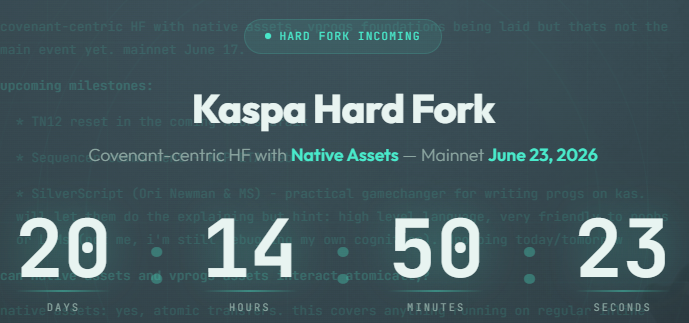
🔥 TOCCATA (JUNE 5–20, 2026) MAKES KASPA THE "SECOND CHOICE"
Native KRC-20 tokens on L1. Covenants via Silverscript. ZK opcodes. Programmability WITHOUT a bloated VM. UTXO + programmability = a viable environment for simple agent payments: pay-per-API, content micropayments, agent-to-agent tipping. But for complex 20-step DeFi strategies, agents will still go to Base or Solana — that's where the mature ecosystem already lives.
⚔️ DAGKNIGHT (Q3 2026) MAKES KASPA THE "FIRST CHOICE"
This is the inflection point — when Kaspa stops being "just another L1" and becomes INFRASTRUCTURE for the agentic economy. Adaptive consensus with no a priori delay bound. Fast finality UNDER LOAD. Deterministic ordering for order-sensitive systems. Resilience to "internet chaos."
💎 THE UNIQUE COMBINATION
Post-DAGKnight Kaspa becomes the ONLY network with ALL of these at once:
PoW security ✓
Sub-second finality ✓
Sub-cent fees ✓
Adaptive consensus ✓
Native programmability ✓
No other L1 has all five.
🚀 IF BOTH CONDITIONS HIT
AI agents could accelerate Kaspa's ecosystem faster than 5 years of organic growth would. Cursor and Claude Code already 5–10x dApp dev speed. On mature chains it creates noise. On young Kaspa it creates CATEGORIES. First DEX, lending, NFT market on Kaspa = entire category TVL.
🎯 BOTTOM LINE
Conditions: stablecoin + Silverscript corpus.
Trigger: Toccata makes Kaspa viable ("second choice").
Climax: DAGKnight makes it the best on the market ("first choice").
Accelerator: AI agents as developers scale the ecosystem 5–10x.
Agentic economy = #1 narrative of 2026–2027. The market will figure this out last. As always.
💾 SAVE THIS POST. When AI agents move $100M/day on Kaspa, you'll remember where you saw it first. Like + RT if you agree. If not — drop counter-arguments below, let's debate.
#Kaspa $KAS #AIAgents #Toccata2026 #DAGKnight #AgenticEconomy #Crypto #DeFi #PoW #BlockDAG #AI #MachineEconomy #Web3 #Silverscript #Stablecoins