Administradora pública, politóloga, docente y eterna estudiante de la gloriosa UdeC.
🔎 Estudios territoriales.
Con mucho que tejer, decir, luchar y aprender.
Saludamos a la @RedPolitologas en su 10° aniversario 💜
Una década visibilizando y potenciando el trabajo de las mujeres en la Ciencia Política latinoamericana y construyendo espacios académicos más diversos.
¡Felicitaciones por estos diez años! #NoSinMujeres
🎉 ¡Hoy cumplimos 10 años! 🎂
Una década construyendo redes, abriendo espacios y poniendo a las mujeres en el "centro" de la Ciencia Política.
Gracias infinitas a cada colega por sumar a esta comunidad. Esto es de todas. 💗
#NoSinMujeres#10AñosRedDePolitólogas#Somos1013
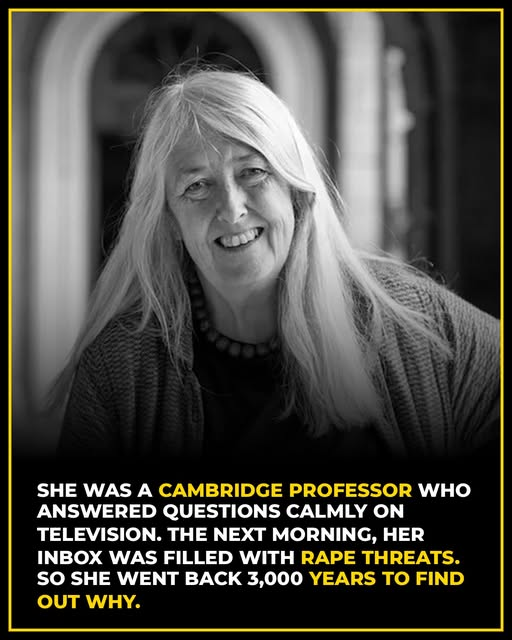
She was 57 years old.
White hair. No carefully managed image. No media training designed to make her more palatable. Just thirty years of accumulated knowledge and the calm, unhurried authority of a woman who had spent her life mastering her subject.
She sat on a BBC panel, answered questions about immigration and politics, cited evidence, made arguments — and then went home.
The next morning, her inbox looked like a crime scene.
Her name is Mary Beard — Cambridge professor, classicist, one of the most respected scholars of ancient Rome and Western civilisation alive. And the internet had decided that a woman speaking with quiet authority on television needed to be punished for it.
The messages were not criticism. They were not debate. They were rape threats. Death threats. Coordinated campaigns of personal destruction targeting her appearance, her age, her voice — anything that could be used to remind her that spaces like the one she had just occupied were not meant for her.
Most people would have gone quiet.
Mary Beard went further in.
She did what scholars do when they find a pattern that disturbs them: she followed it backward. Through decades. Through centuries. Through millennia. All the way back to some of the oldest texts in Western civilisation.
And she found it had always been there.
In Homer's Odyssey — one of the foundational works of Western literature, nearly three thousand years old — there is a scene that most readers pass over without registering its quiet violence. Penelope comes downstairs and asks the poet to sing a different song. Her own son, Telemachus, cuts her off. He orders her back to her room and tells her plainly: speech is the business of men.
She goes.
Mary Beard read that scene and recognized it immediately.
Not as ancient history. As a pattern.
In ancient Rome, women who dared to speak in public were not described as orators or thinkers. They were described as noise — disorderly sound, something that did not deserve to be called language or argument. Their voices were not speech. Their thoughts were not thoughts.
In the medieval world, women who claimed public authority were labeled as witches.
Elizabeth I — Queen of England, ruler of a nation — had to rhetorically reshape herself into something masculine just to be taken seriously as the leader of her own country.
The silencing of women who speak with authority was not invented by social media. It was not a modern pathology or a cultural accident. It was built deliberately, over centuries, into the very foundations of how Western civilisation defined who gets to speak, what authority sounds like, and who is allowed to take up space in public life.
Mary Beard had found something important.
In 2017, she published Women & Power: A Manifesto — short enough to read in an afternoon, substantial enough to reframe everything you thought you understood about why this keeps happening.
Her argument was precise and devastating.
The problem is not that women lack the ability to lead. The problem is that the model of leadership itself — the template for what public authority looks, sounds, and feels like — was built by men over centuries and has never been redesigned. When a woman enters public life and doesn't fit that template, she is not failing. The template was never built for her. It was built specifically to exclude her, and it has been doing exactly that, efficiently and continuously, for three thousand years.
The solution, Beard argued, is not to teach women to perform power the way men have always performed it. The solution is to dismantle and rebuild the very concept of what power is allowed to look like.
She kept teaching. She kept writing. She kept appearing on television — white-haired, unhurried, carrying her decades of authority without performing it, without packaging it for comfort, without apologizing for it.
The threats continued.
But other messages began arriving too. Letters from women and girls who had spent their entire lives feeling that every door was slightly too narrow, every table slightly too high, every room slightly reluctant to make space for them. Women who had spent years wondering what was wrong with them — why they couldn't quite fit, couldn't quite belong, couldn't quite be taken seriously no matter how much they knew or how hard they worked.
They read the book and understood, perhaps for the first time, that nothing had ever been wrong with them.
The room had been designed without them in mind.
That is not a personal failing.
That is a three-thousand-year-old architectural decision.
And one Cambridge professor with white hair and a calm voice — who refused to go quiet when the internet told her to — spent her career documenting it, naming it, and handing that knowledge to everyone who needed to hear it.
Telemachus told Penelope that speech was the business of men.
He was wrong then.
He is still wrong now.
And Mary Beard has three thousand years of evidence to prove it.
via The Inspireist
#FeministFriday #HERstory
Ojo!
Sólo en esta semana fueron detenidos:
- 8 carabineros en Atacama por falsificación
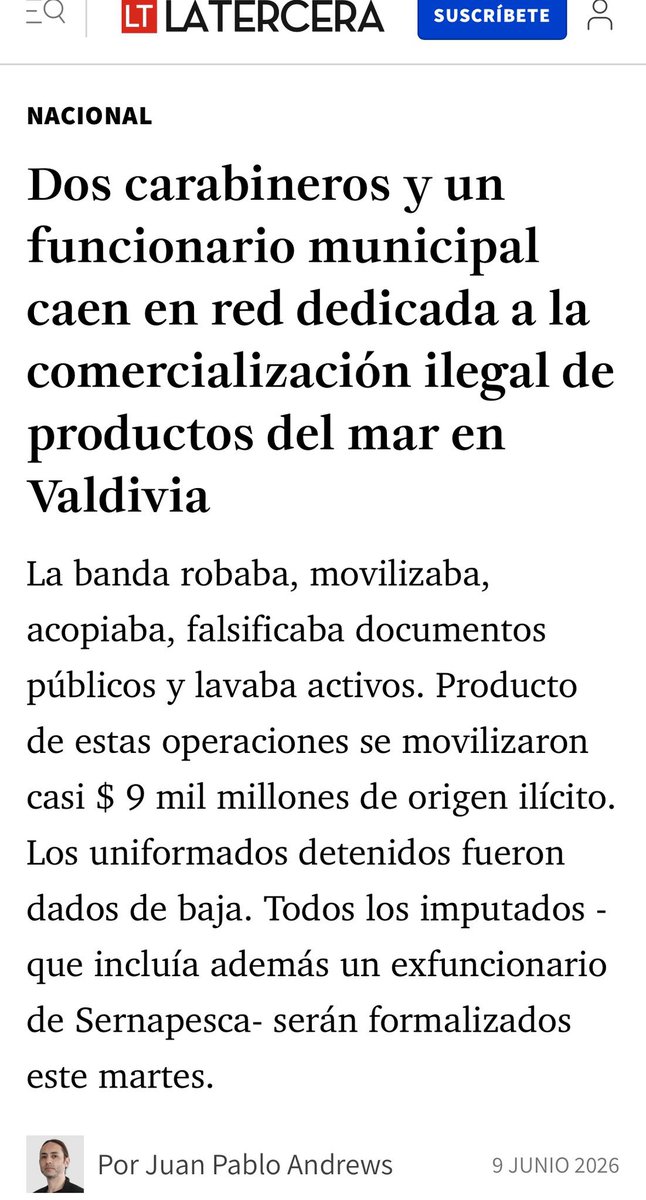
-2 carabineros en Valdivia por comercio ilegal productos del mar.
-5 gendarmes en Coquimbo por tráfico de drogas.
-6 carabineros en Talca por robos.
Ministro Arrau esto es de máxima prioridad!
“I shouldn't say this, but I'm going to say it because I truly believe it. If somebody vetoes me because I believe in democracy, because I believe in multilateralism, because I believe in women's rights, because I believe in human rights, I will be honored.”
— Michelle Bachelet
🔴 Chevesich mandó a Jorge Quiroz a Capuchinos en 2003: pasó dos noches en la cárcel
El ministro de Hacienda de Kast fue uno de los 22 procesados en una arista del caso Mop-Gate
🖊 @am_sanhueza
https://t.co/wiZsMIMf2E
🚨 AHORA | El CFA alerta que proyecto de ley misceláneo mantiene riesgos para las finanzas del Estado y podría deteriorar aún más las arcas públicas
https://t.co/gX6evaDu7m
🔴 La dura advertencia del CFA sobre la mega reforma de Kast: Identifica 11 riesgos fiscales y asegura que el proyecto presenta déficit “al menos hasta 2031”
https://t.co/Ttha2KSD1X
Esto no es cierto Ministro.
Existen diversos casos en que la ley permite levantar el secreto bancario sin orden del juez:
-operaciones sospechosas el banco las debe reportar a UAF
-saldos cuando se exceden las 1500 UF al mes. (Ley 21453)
- informar + 50 transferencias (ley 21713)
Interesantes declaraciones de Andrea Repetto sobre la megarreforma de Kast: “Es cara, con costos claros y beneficios inciertos” https://t.co/gjGL96pq5V a través de @el_pais
Si queremos combatir en serio el crimen organizado hay que flexibilizar el secreto bancario especialmente en la fase previa a cargo de la UAF.
En este caso, si no se le cae el teléfono a una mujer en el homicidio múltiple de Lampa, nunca nos enteramos de esto.
#Secretobancario
La FLACSO México lamenta el sensible fallecimiento del Dr. Raúl Pacheco-Vega entrañable profesor-investigador, colega, amigo y miembro muy querido de nuestra comunidad académica.
Expresamos nuestras más sentidas condolencias a sus familiares, amistades, colegas, estudiantado y a las comunidades académicas de las que formó parte.
Vivimos en un mundo pronatalista y antiinfancia. Se defiende una especie de embarazo obligatorio sin un cuidado serio de quienes ya han nacido, de los niños, sin una atención real a las mujeres y a sus familias. Buena entrevista a Donna Haraway en @el_pais https://t.co/Pmps7Krm7S
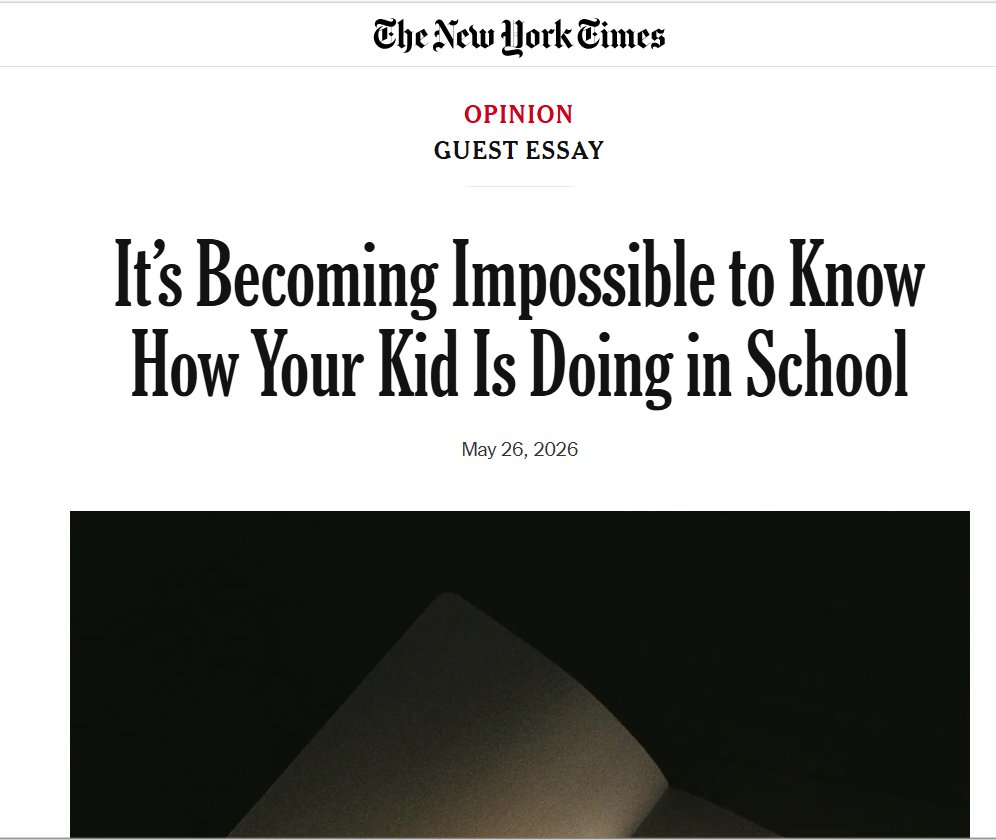
New York Times: si todos sacan buenas notas, las notas informan menos. Casi 9 de cada 10 padres en EE. UU. creen que sus hijos están en el nivel esperado o por encima en lectura y matemáticas. Pero en 8º grado (2º de la ESO), solo el 30% alcanza competencia en lectura y el 28% en matemáticas según NAEP.
Las notas se han vuelto una señal cada vez menos precisa: entre 2010 y 2022, la nota media de Institutos subió de forma significativa.
Opinion | What Your Kid’s Report Card Isn’t Telling You - The New York Times
https://t.co/mMYH7yAlxl https://t.co/YrJ9oWut5b
Artificial intelligences do not undergo experiences, do not possess a body, do not feel joy or pain, do not mature through relationships, and do not know from within what love, work, friendship or responsibility mean. Nor do they have a moral conscience, since they do not judge good and evil, grasp the ultimate meaning of situations, or bear responsibility for consequences. They may imitate or even simulate, but they do not understand what they produce, for they lack the affective, relational, and spiritual perspective through which human beings grow in wisdom. #MagnificaHumanitas
La natalidad desciende tan rápido que al paso que vamos, cuando algún día el congreso y el presidente se pongan de acuerdo en ley de sala cunas, ya no va a ser necesaria.