Applications are open for #CompNeuro, a live, intensive online course. Participants learn to combine modern #MachineLearning and causality frameworks with advanced modeling approaches to tackle real #neuroscience questions.
https://t.co/3tcT7w3Zlt
📆 Mark your calendars! Neuromatch and Climatematch Academy’s 2026 courses are coming!
Join us for some information sessions in January to learn more and get ready to apply in February ➡️ https://t.co/0hZYWuVBUR
#ComputationalScience#DeepLearning#ClimateScience#NeuroAI
📣 FREE WEBINAR
Join us for a workshop on packaging your software for sharing with David Edge from LeapFROGS.
Wednesday 10 Dec, 16:00 UTC
🤓 Learn more about what will be covered here: https://t.co/Bdr8kipPEc
➡️ Check in your time zone and register: https://t.co/baern4B7FT
The mainstream view of AI for science says AI will rapidly accelerate science, and that we're on track to cure cancer, double the human lifespan, colonize space, and achieve a century of progress in the next decade.
In a new AI Snake Oil essay, @random_walker and I argue that AI's impact could be precisely the opposite: AI could slow rather than hasten science.
The production-progress paradox
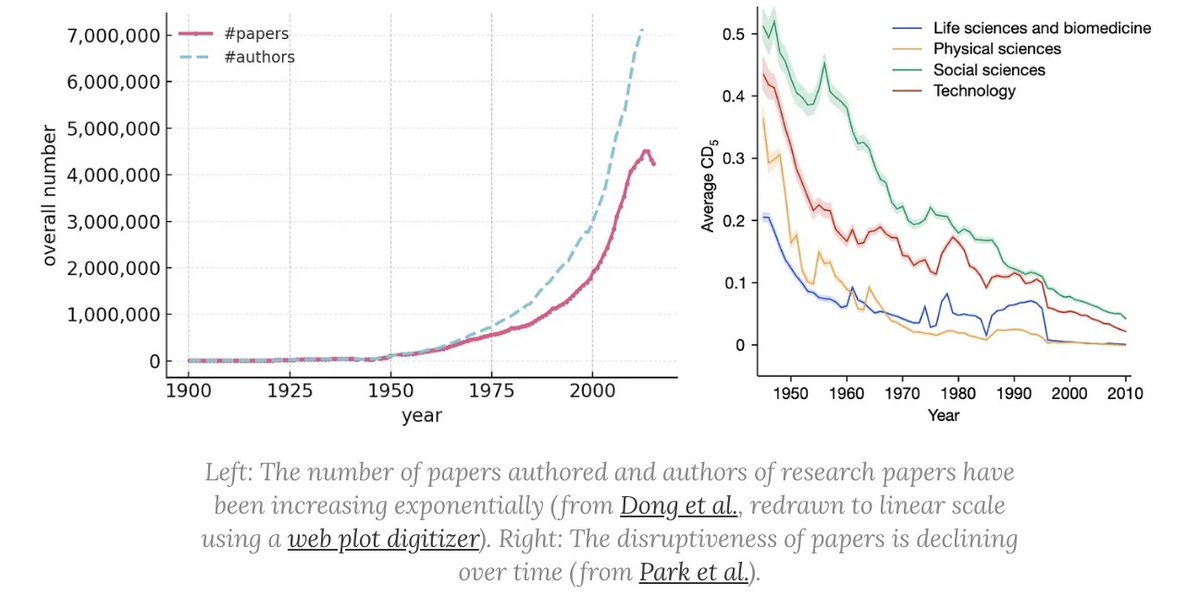
Scientific papers have increased 500-fold since 1900, with funding and researchers growing exponentially. Yet genuine progress—measured by disruptive discoveries, new scientific terminology, Nobel-worthy breakthroughs, and research productivity—has remained constant or declined. Multiple metascience studies confirm this troubling disconnect between production and progress.
AI could worsen this by making it even easier to chase productivity metrics while homogenizing research approaches.
Science is not ready for software, let alone AI
Scientists are notoriously poor software engineers, lacking basic practices like testing and version control. Papers rarely share code, and when they do, it's often error-riddled. AI has already led to widespread errors across 600+ papers in 30 fields, with many COVID-19 diagnosis papers proving clinically useless. Science needs to catch up to 50 years of software engineering—fast.
AI might prolong the reliance on flawed theories
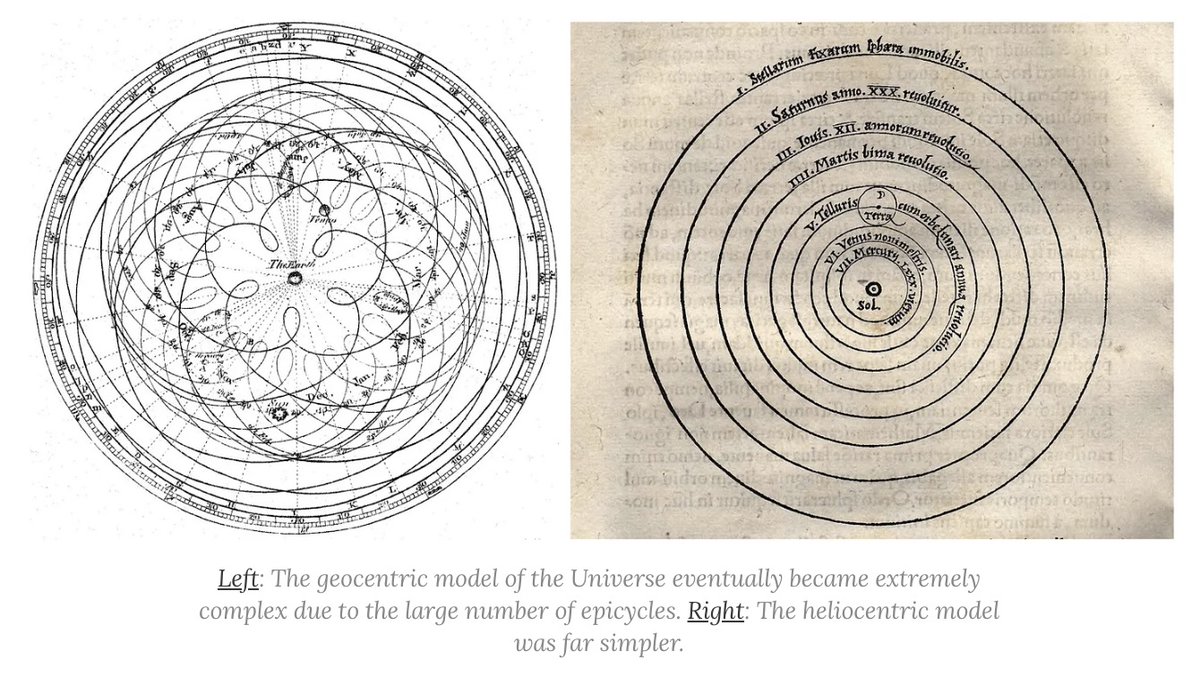
AI excels at prediction without understanding, like adding epicycles to the geocentric model (which improved predictive accuracy) rather than discovering heliocentrism.
Scientific progress requires theoretical advances, not just predictive accuracy. AI might trap fields in intellectual ruts by making flawed theories more useful without revealing their fundamental errors.
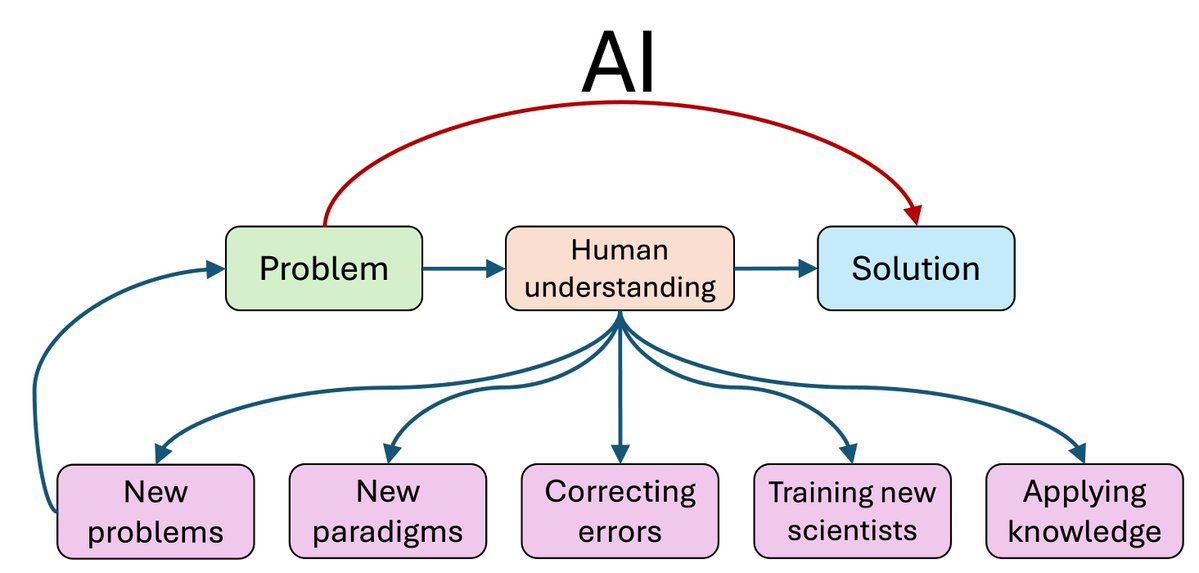
Human understanding remains essential
Science isn't just about finding solutions—it's about building human understanding. AI risks short-circuiting this process, like using a forklift at the gym. Evidence shows AI-adopting papers focus on known problems rather than generating new ones.
Implications for the future of science
Individual researchers should develop software skills and avoid using AI as a crutch. More importantly, institutions must invest in meta-science research, reform publish-or-perish incentives, and rethink AI tools to target actual bottlenecks like error detection rather than flashy discoveries. Evaluation should consider collective impacts, not just individual efficiency.
Final thoughts
While we ourselves use AI enthusiastically in our workflows, we warn against conflating individual benefits with institutional impacts. Science lacks the market mechanisms that provide quality control in industry, making rapid AI adoption particularly risky. We're optimistic that scientific norms will eventually adapt, but expect a bumpy ride ahead.
Ready to shape the future of #ComputationalScience?
We’re inviting researchers like you to mentor student-led projects this July. Just 2-3 hours of commitment & no prep needed!
This is your chance to give back & grow!
➡️ Learn more & sign up to #volunteer https://t.co/oN0MOGzy01
First release ot Tracking_Graph, a simple algorithm to track neurons over time. The current implementation uses the previous spikeinterface API.
https://t.co/suZ1uMPwdy
📢📢📢
#ephys and #spikesorting community!
We are thrilled to announce the "Tools and Methods for Next Generation Electrophysiology" event, happening in Edinburgh from May 27-31.
Registration link: https://t.co/R5yTgoIG01
More info on the event: https://t.co/F1E9t53lA6
I realized recently I didn't know why prisms work. Like, why does light slow down? And why would that depend on color?
It turns out, answering the first question with enough detail automatically answers the second, and it's completely delightful.
https://t.co/lhBBkb5vrx
CGK lab is excited to launch 🚀today our GitHub space, featuring CellSelect-3DMorph. A forked code from its predecessor 3DMorph that reconstructs cells from 3D images and analyzes their morphology! 🔬https://t.co/TkJrMZxtJw
Open 🧵1/3 @juanptaborda6@McwPharmTox@NeuroscienceMCW
🎉🎉 Student and Teaching Assistant applications are now open for Neuromatch & Climatematch Academy 2023! ⚠️Submit your application through the portal on our website for Computational Neuroscience, Deep Learning, or @climatematch courses by April 24.
Visit https://t.co/ULd3Mbug4i
🎉Free PDF book #otd:
Reinforcement Learning: An Introduction
by Richard S. Sutton and Andrew G. Barto
PDF: https://t.co/x6D5Fs2HnC
https://t.co/iC9Un4RYeO
I finished the first beta of spclustering a Python wrapper for the Super Paramagnetic Clustering algorithm.
The package is already in pypi (including a windows wheels) and the repo is: https://t.co/oWlybhSHzK