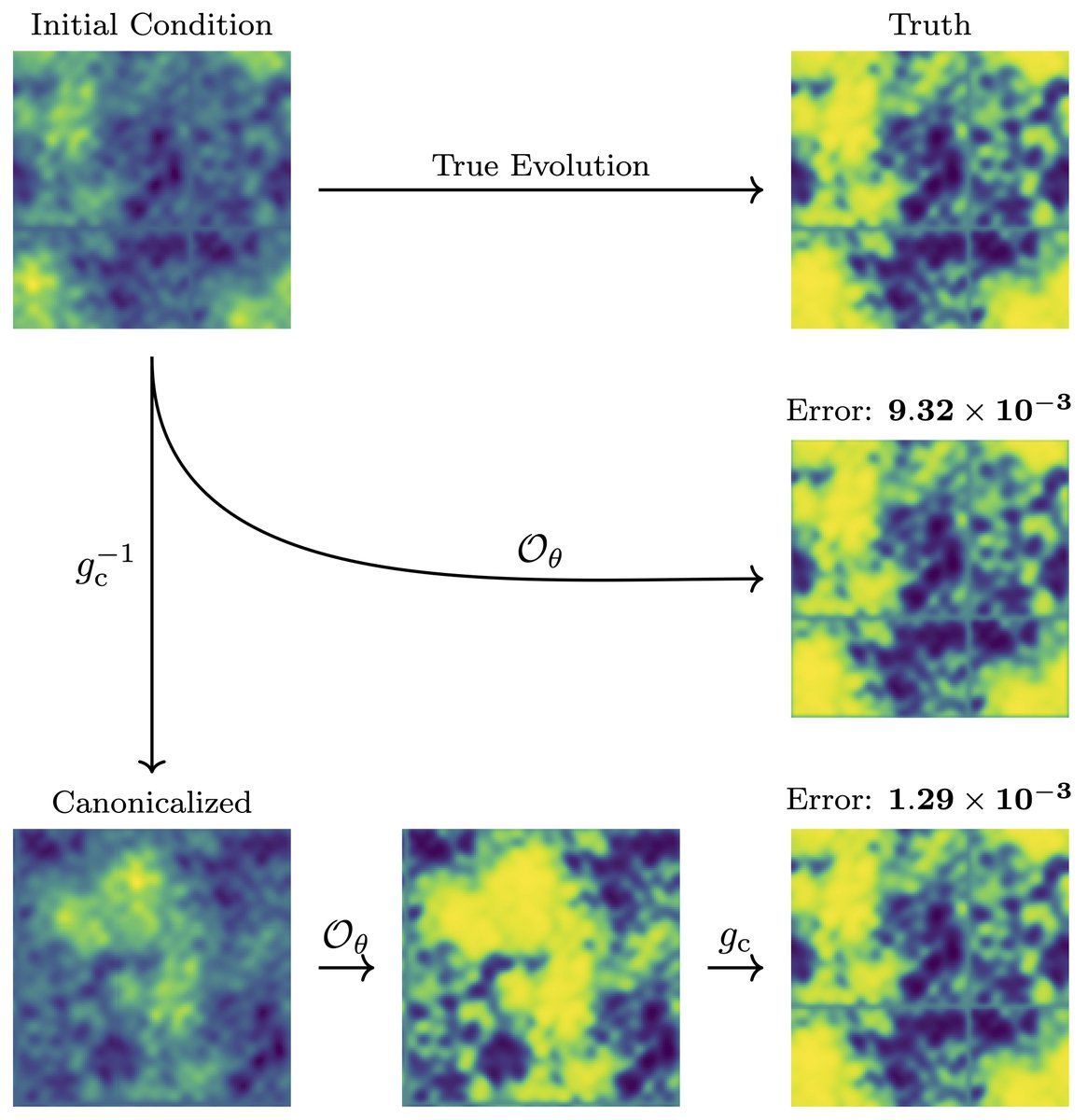
If you are coming to #ICLR2025 come say hello. We will be presenting on how to turn Neural Operators equivariant even when all you know is the lie algebra!
Generally happy to chat all things #geometry and #optimization in deep learning!
🔗https://t.co/5cieJWPbDg
I recently learned about a very cool fact: if you compose flows of two Hamiltonians, this is also Hamiltonian. What is more - you can write down the exact Hamiltonian!
In our preprint, for the 1st time we make neural operators equivariant with respect to PDE symmetry groups. These can be very complicated, and often only the Lie algebra is known, so a universal method is needed - a 🧵.
🔗 Read the full paper here: https://t.co/S76IDk9upb
@docmilanfar@TachellaJulian I was a bit confused by the terminology too, but it seems that divergence-free is used here to mean divergence-free in expectation, not pointwise.
@docmilanfar@EeroSimoncelli SURE(D) = ||D(y) - y||^2 + 2 sigma^2 div(D)(y) is not an expectation. The whole point is that it's an unbiased estimate of the test MSE, E[SURE(D)] = MSE(D)
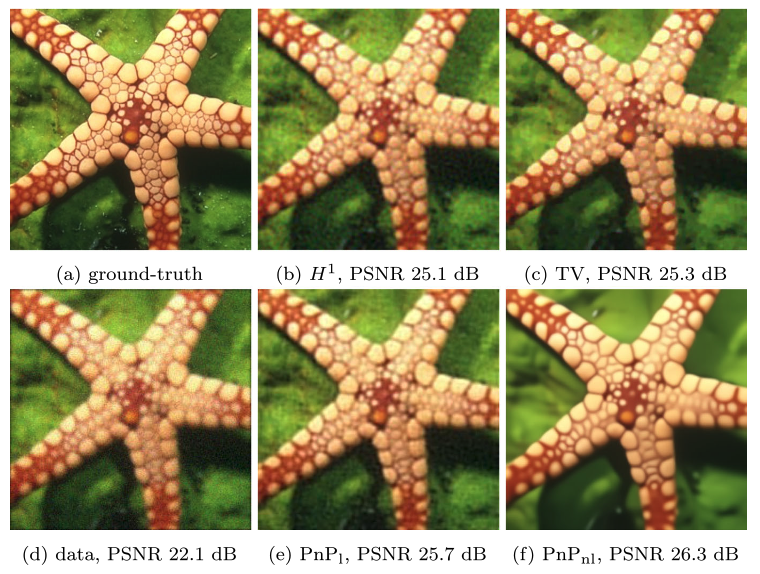
@asHauptmann@Subho1Mukherjee@caromitreka We give an overview of this theory and some theoretical results that have been proven for these methods, before focusing on the setting of PnP with linear denoisers and proving that convergent regularisation can be achieved through a novel spectral filtering approach.
I'm delighted to share that our paper (with @asHauptmann, @Subho1Mukherjee and @caromitreka ) on provably convergent regularisation using Plug-and-Play (PnP) methods has been published in FoCM!
The paper is available, open access, here: https://t.co/nAULkibDOv
@asHauptmann@Subho1Mukherjee@caromitreka In the past decade, PnP has been shown to be a highly effective way of incorporating prior information (in the form of a denoiser) into solution methods for inverse problems in imaging. PnP methods remain relatively unexplored from the perspective of inverse problems theory.
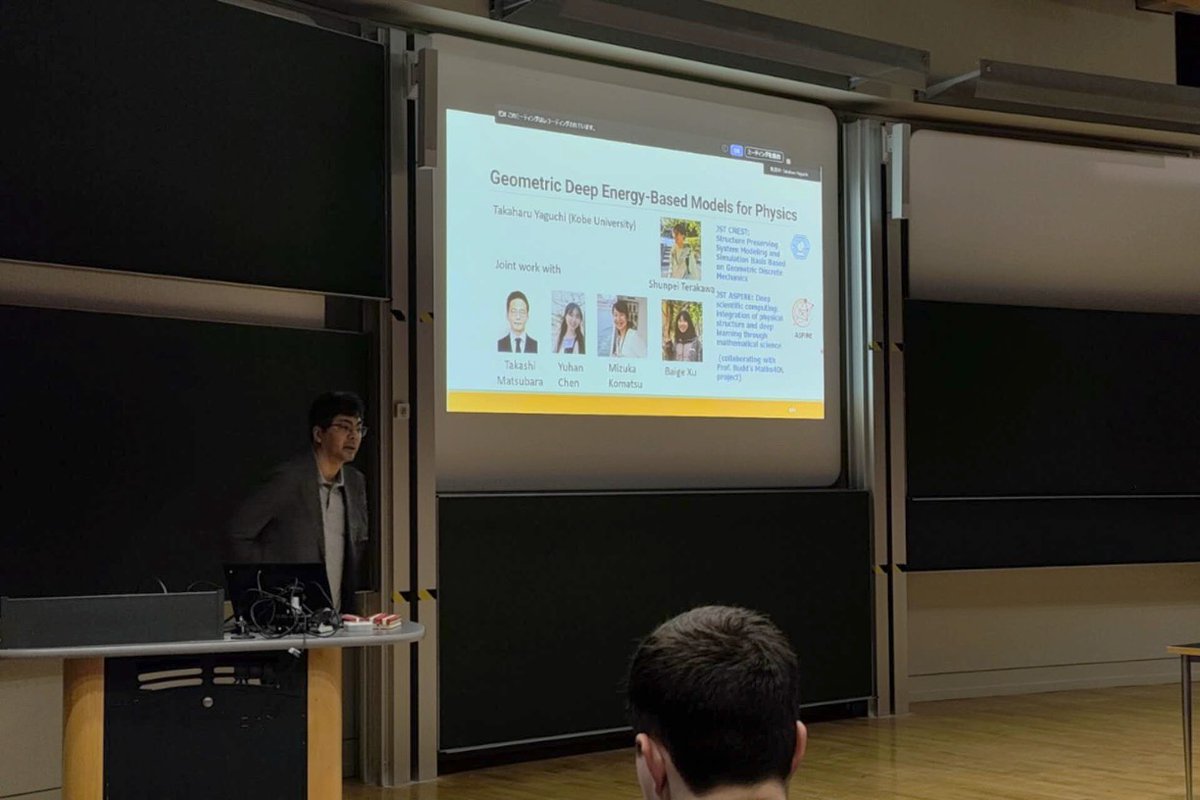
We are happy to host a joint seminar with the REMODEL programme, with Professor Takaharu Yaguchi speaking about Geometric Deep Energy-Based Models for Physics in our last CIA seminar!
We design non-expansive or averaged NNs and apply them to adversarial robustness, image denoising and Plug-and-Play methods. Imposing these constraints can be done while achieving high task performance, through a training approach that respects the underlying continuous system.
I'm glad to share that our paper (with @ElenaCelledoni, @MJEhrhardt, @dademurari, @b_owren, @caromitreka) on designing provably stable neural networks using connections to gradient flows in convex potentials has been published in Physica D!
Check it out: https://t.co/MkHtZ8FoDw!