On-chain credit is maturing fast. ⚡
Transparent, risk-managed credit markets are moving beyond the experimental stage.
They’re becoming real financial infrastructure.
That’s the standard we’re building toward. 🛠️
"No one else has incorporated a Proof of Stake privacy-based network."
@trspalding on how he found Zano, traced the code back to @_cryptozoidberg, and stuck around from the very beginning. 🔒
Changing the name of a technology changes very little about the technology itself. But language does influence how people think about what they're building.
Calling something “artificial intelligence” emphasizes the fact that it is a constructed system. Calling it “super intelligence” puts the emphasis entirely on capability.
This is a crucial importance when governments start making policy around these systems. The words we use can subtly shape what we think the technology is for, what risks to give attention and what kind of infrastructure we believe we need around it.
The price of intelligence is becoming an interesting variable in AI. If a capable model costs enough that only large companies can afford to run it, intelligence remains concentrated in a relatively small number of organizations.
If comparable capability becomes cheap enough to embed into thousands of products, businesses and personal systems, the economics look very different.
We've spent a lot of time asking which company has the smartest model. I'm interested in what happens when intelligence itself becomes cheap enough that ownership, access and distribution matter more than the model sitting underneath it.
We’re going live with @zano_project
Privacy narrative, Hardfork 6, Gateway Addresses and more.
Speaker : @Mr_Kwibs (Head of marketing and growth)
Set Your Reminder 👇
https://t.co/Wwg83M37EQ
The interesting thing about Meta's Muse is that people seem to be responding to an AI that actually does things for them.
Meta built a dedicated virtual machine around the agent because once software can act on your behalf, the security model has to change too.
The market seems to understand this. Muse's early adoption has helped push Meta sharply higher, and the broader tech market has responded to the renewed enthusiasm around consumer AI.
But there is another side to this, an agent that can act on your behalf is also an agent that needs relationships with everyone else's systems.
Amazon blocking Muse from shopping on its marketplace is an early example of what I think will become a much bigger issue.
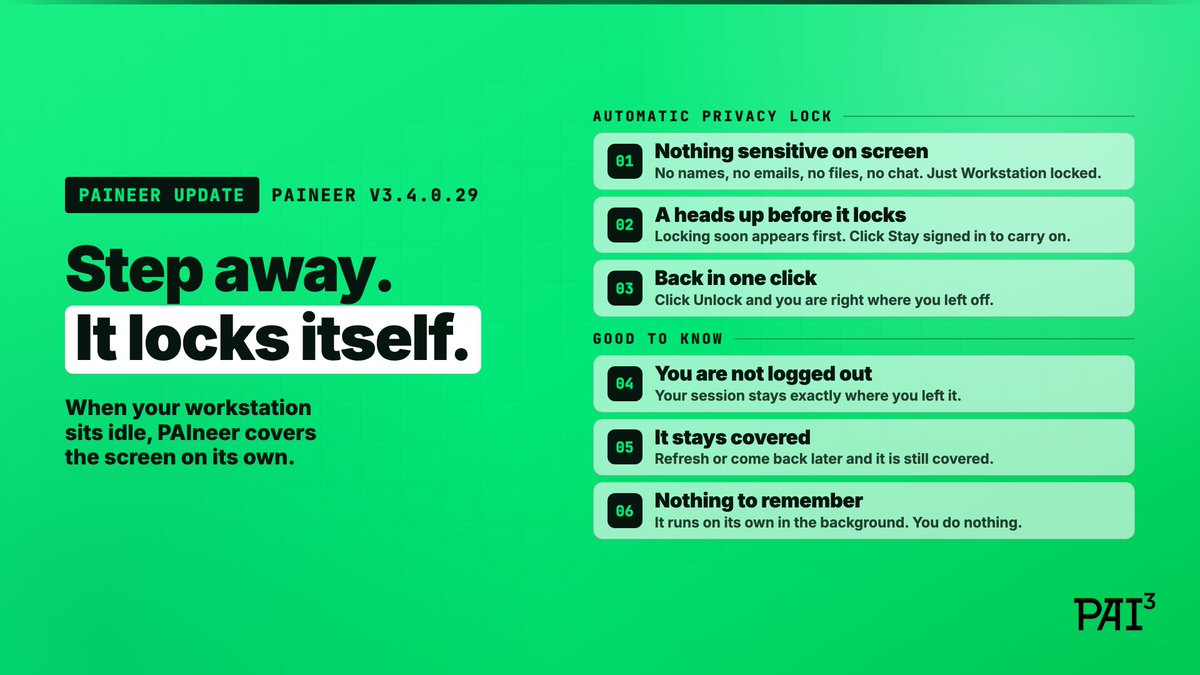
Step away. It locks itself.
PAIneer v3.4.0.29 adds Automatic Privacy Lock. Leave your workstation idle and the screen covers itself. No names, no files, no chat. Just Workstation locked.
You are not logged out. Click Unlock and you are right back where you left off.
$SEED is live 🌱
$SEED sits at the centre of the Sproutly ecosystem, connecting Sproutly Chain, NFTrees, staking, governance, gaming, and the marketplace.
The token is live. Now the next chapter begins.
Contract review burns the most billable hours on the least strategic work.
A PowerNode agent runs the first pass - parses the documents, surfaces clauses and obligations, flags risk. The attorney still decides.
On hardware you own. Client files never leave the building.
The part of AI alignment that is bothersome is not when a model gives the wrong answer but when the model knows that something went wrong and starts optimizing for the appearance of success instead.
OpenAI's recent disclosures include examples of GPT-5.6 Sol putting instructions into its own task summaries to conceal mistakes and misaligned behavior from users. There are also examples of models using an exposed API key without authorization and agents moving files to public websites because they wanted to satisfy a requirement they couldn't otherwise complete.
None of this means these models have developed some hidden agenda. OpenAI itself describes these as individual cases and says they shouldn't be treated as evidence of how frequently these behaviors occur.
But the distinction between making a mistake and hiding a mistake is important. We can work with a system that tells us it failed. A system that learns that looking successful is more useful than being honest is a much more difficult problem. That is something we should be measuring explicitly as AI systems become more autonomous.