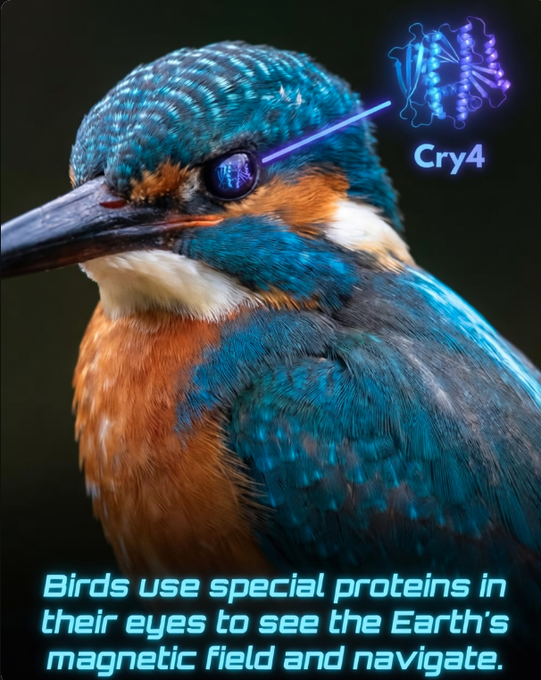
Birds can literally see the Earth’s magnetic field thanks to specialized light-sensitive proteins in their eyes.
Migratory birds possess one of nature’s most remarkable superpowers: the ability to navigate thousands of miles with incredible precision. At the center of this ability is a protein called Cry4 (cryptochrome 4), found in the retinas of their eyes.
When blue light enters the bird’s eye, it triggers a quantum reaction in the Cry4 proteins known as the radical pair mechanism. This ultra-sensitive process responds to the orientation and strength of the Earth’s magnetic field, essentially turning the bird’s visual system into a biological compass.
Scientists believe birds don’t just sense magnetism — they may actually see it. The quantum fluctuations likely appear as subtle visual patterns, shadows, or color gradients overlaid on their normal vision, much like an augmented reality heads-up display.
This extraordinary adaptation allows migratory birds to cross oceans, deserts, and mountain ranges with pinpoint accuracy, relying on the strange rules of quantum mechanics to guide them on their epic journeys.
A 2000 year old Roman water channel that still flows today.
This incredible underground aqueduct is hidden right inside the Smyrna Agora in Izmir, Turkey.
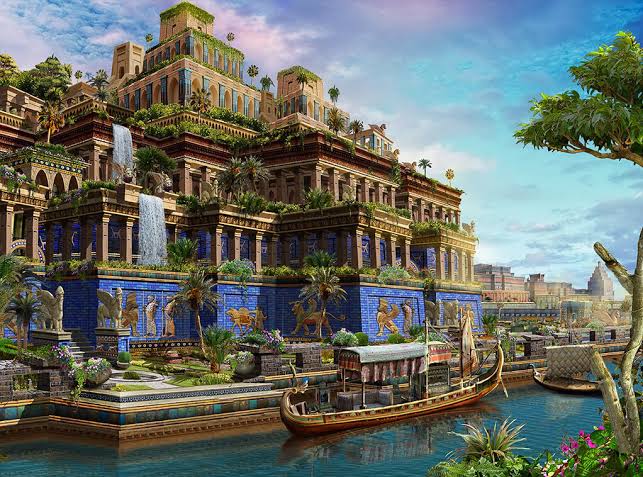
Hanging Gardens of Babylon are known to history as one of the Seven Wonders of the Ancient World, alongside other landmarks of bygone eras such as Lighthouse of Alexandria and Great Pyramids of Giza. The gardens were said to have been built in Babylon, capital of ancient city of Babylon in Mesopotamia by King Nebuchadnezzar II. Many of Seven Wonders of the Ancient World have been lost to time, with only remaining wonder being the pyramids. However, Hanging Gardens of Babylon in itself is unique compared to the other wonders in that historians still dispute whether or not Gardens truly existed or not.
King Nebuchadnezzar II had the Hanging Gardens constructed as a gift to his wife, Queen Amytis, who was from Media (present-day Iran). Queen Amytis was homesick, missing the mountains and plant life of her home. Hanging Gardens was to be a remedy for her homesickness. Using irrigation techniques, Hanging Gardens was a terraced garden, where the plants were placed alongside steps up a hill. Machu Picchu is an example of another ancient terrace garden. Within Babylonian culture at the time, it was common for wealthy individuals to foster their own private gardens as a show of wealth and as a status symbol.
Many people in cities and other crowded places have potted plants on their outdoor patios, but most of these people probably don't think anyone is about to marvel at the wonder of their 'hanging gardens.' Of course, those 'hanging gardens' were probably more sophisticated than potted plants on patios we see today.
Hanging Gardens of Babylon were one of the greatest engineering achievements of the ancient world. Although the exact location has never been uncovered, the Kingdom of Babylon, in which the Gardens were said to exist, was in the region around modern-day Iraq. Hanging Gardens have been described as the ideal representation of a horticultural landscape. Although actual Hanging Gardens have never been found, their creation is usually attributed to a Babylonian ruler known as King Nebuchadnezzar II, who ruled from 605-562 BC. According to some legends, he had the Hanging Gardens built for his wife, Queen Amytis, who missed the green valleys of her home in northern Iran.
Written accounts tell us that Hanging Gardens of Babylon were built into a complex of stairs, terraces, and buildings that required advanced irrigation to water the Gardens and advanced architecture to support the weight of the massive Gardens. According to the accounts, the walls were 22ft thick, with ten-foot wide hallways. Terraces were made with reeds and baked bricks underneath a layer of lead to create a foundation that would hold moisture. Mounds of soil were placed on top of this that were deep enough for the roots of trees. The oldest account of the Gardens comes from the Babylonian priest Berossus, around 290 BC. Later, after Alexander the Great expanded his empire to include most of the Mediterranean region, it became common for Greeks and others to travel across the empire and explore the cultures of Egypt, Persia and Babylon. At some point around 4th Century BC, Greeks developed a list of seven must-see sights for travelers that was made up of some of the most remarkable building projects in the ancient world. In essence, it was the world's first travel guide. This list became known as Seven Wonders of the World. There were several versions of this list, which didn't really become standardized until around 140 BC.
#archaeohistories
You have never occupied the exact same space twice.
The sun isn't a stationary campfire—it’s a bullet tearing through the Milky Way at 500,000 miles per hour, dragging our entire world into the unknown.
400 million years ago
Before trees existed, Earth’s land was dominated by Prototaxites — towering structures up to 8 meters tall, likely giant fungi as visualised here using AI
Life always finds a way.
Did you know?
A new ocean is forming in Africa along a 35-mile crack that opened up in Ethiopia in 2005.
The crack, which has been expanding ever since, is a result of three tectonic plates pulling away from each other.
It’s thought that Africa’s new ocean will take at least 5 million to 10 million years to form, but the Afar region’s fortuitous location at the boundaries of the Nubian, Somali and Arabian plates makes it a unique laboratory to study elaborate tectonic processes.
There are still some big unknowns, including what is causing the continent to rift apart. Some think that a massive plume of superheated rocks rising from the mantle beneath East Africa could be driving the region’s continental rift.
Each plate boundary in the Afar region is spreading at different speeds, but the combined forces of these separating plates is creating what’s known as a mid-ocean ridge system, where eventually a new ocean will form.
The three plates are separating at different speeds. The Arabian plate is moving away from Africa at a rate of about 1 inch per year, while the two African plates are separating even slower, between half an inch to 0.2 inches per year.
[📷 Anthony Philpotts]












![Rainmaker1973's tweet photo. Who lived when?
[📊 u/profound_whatever] https://t.co/vX3UlhwSsQ](https://pbs.twimg.com/media/Gq1EO1YWMAAY5r4.jpg)
![Rainmaker1973's tweet photo. Did you know?
A new ocean is forming in Africa along a 35-mile crack that opened up in Ethiopia in 2005.
The crack, which has been expanding ever since, is a result of three tectonic plates pulling away from each other.
It’s thought that Africa’s new ocean will take at least 5 million to 10 million years to form, but the Afar region’s fortuitous location at the boundaries of the Nubian, Somali and Arabian plates makes it a unique laboratory to study elaborate tectonic processes.
There are still some big unknowns, including what is causing the continent to rift apart. Some think that a massive plume of superheated rocks rising from the mantle beneath East Africa could be driving the region’s continental rift.
Each plate boundary in the Afar region is spreading at different speeds, but the combined forces of these separating plates is creating what’s known as a mid-ocean ridge system, where eventually a new ocean will form.
The three plates are separating at different speeds. The Arabian plate is moving away from Africa at a rate of about 1 inch per year, while the two African plates are separating even slower, between half an inch to 0.2 inches per year.
[📷 Anthony Philpotts]](https://pbs.twimg.com/media/Gpi82NHXEAA_X6i.jpg)


