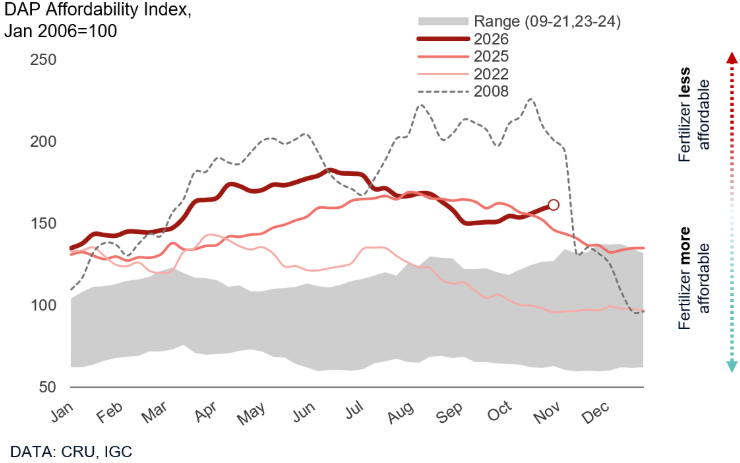
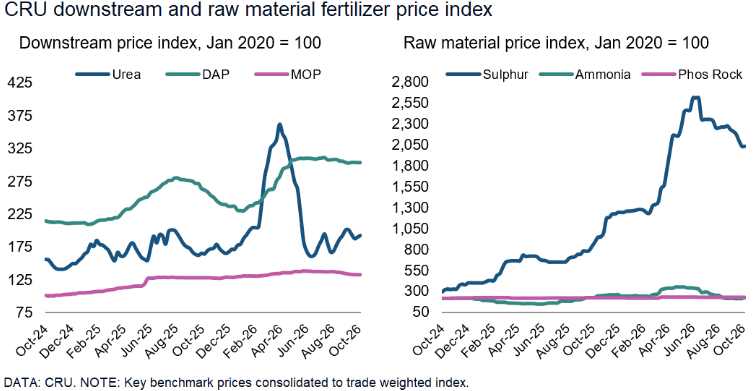
Poor affordability for #phophate#fertilizers is weighing on demand. Prices for phosphates have declined recently despite tight availability and high #sulphur prices, but lower agricultural prices have kept affordability worse than in 2022, when phosphates prices were even higher
#Urea prices weakened modestly in the absence of a new India tender, while #ammonia closed in on a month of gains. #Phosphate prices drifted downwards as demand remained scarce, while #sulphur prices, in the grip of a significant correction, gapped lower (3/3) #fertilizer
Attacks on shipping in the Strait of Hormuz remain the main concern for #fertilizer markets. Another Saudi #phosphate cargo, a Sabic #urea cargo, and two Qatari urea shipments escaped the waterway last week, along with more than 100kt of #sulphur (1/3)
Mosaic shares rallied over 20% in five days, even after a $72 M Q3 net loss, as it hinted at improving conditions on the horizon. Nor was Nutrien untouched by the feel-good vibes, despite a 39% slump in net income, while CF’s earnings were up 24% on #ammonia increases (2/3)
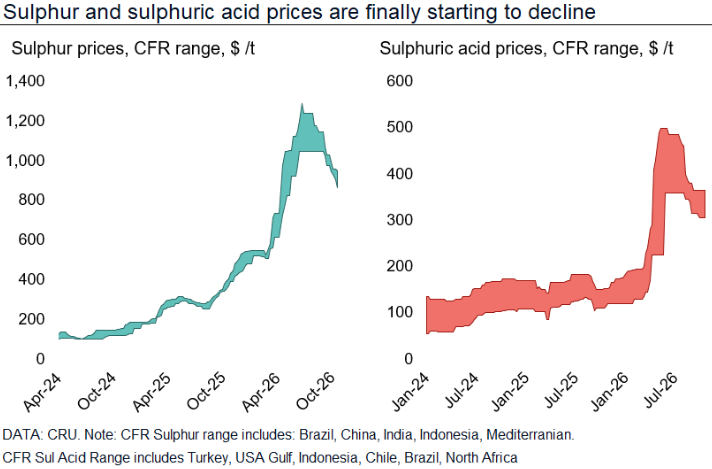
Our chart of the week shows that #sulphur and #sulphuric acid prices have started to decline from recent peaks, though prices remain historically high. Both commodities saw further falls this week, though downside is likely to be limited by tight availability
India’s next #urea tender is expected next week. #Phosphates were broadly stable outside the US, where they declined. #Potash prices are moving lower (3/3) #fertilizer
Europe’s TTF breached €100/MWh last week and AN production is now close to uneconomic. A trickle of #fertilizer vessels manages to pass the Strait of Hormuz, with an additional #DAP cargo and one #urea vessel navigating the waterway last week (1/3)
The Tampa #ammonia price for November advanced more than expected to $640/t CFR, and almost all ammonia prices posted double-digit gains. #Sulphur recorded significant falls, with most benchmarks now at six-month lows (2/3)
China issued a second round of quota allocations for ammonium #sulphate (AS) exports earlier this week. Market participants generally expect China's full-year AS exports in 2026 to remain below 2025's volume, despite stronger volumes in Q1-Q3 #nitrogen#fertilizer
Yara posted lower Q3 net income, reported significant ammonia output cuts and pointed to deferred Q3 buying. #Fertilizer price movements were less pronounced than in recent weeks, with #nitrogen broadly firmer, while #phosphates, #sulphur and #potash moved slightly lower (3/3)
Turmoil across global markets is now commonplace. Oil and natural gas surged as strikes on shipping in and around Hormuz ramped up and the Houthis extended their attacks on Saudi Arabia’s energy infrastructure (1/3)
Speculation mounted over a renewed US/Israeli military campaign against Iran after the midterms. Donald Trump extended his largess to US farmers, with another emergency assistance package taking government support closer to $80 billion over two years (2/3)
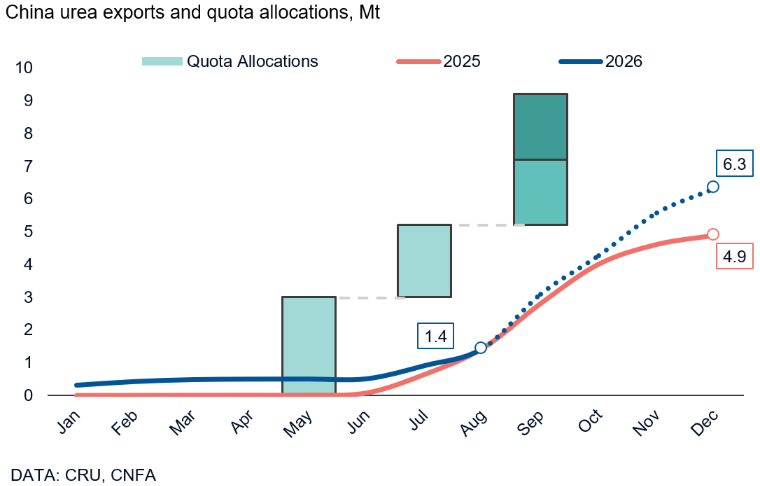
Our chart of the week shows the expected increase in China's #urea exports this year following recent quota allocation announcements #nitrogen#fertilizer
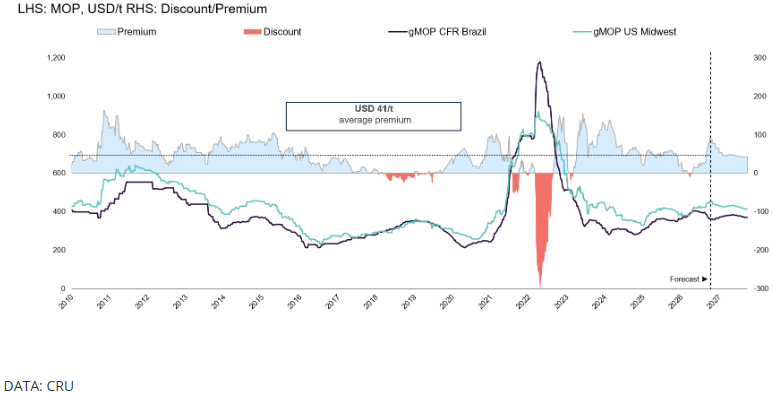
Our chart of the week shows the increased price premium for #MOP to the US over sales to Brazil, which is forecat to decrease but remain in line with historical acerages over coming months #potash#fertilizer
China is set to play a major role in India’s latest #urea import tender this week following a fourth final round of quota export allocations. Despite a severe #sulphur supply crisis that has driven up production costs, DAP/MAP prices were largely stable (3/3) #fertilizer
More crude oil is moving through the Strait of Hormuz than at any time since the outbreak of the US-Israeli conflict with Iran. Still, shipments of refined products and LNG remains severely restricted, and the standoff is fuelling global inflation (1/3)
European gas prices remain near their highest in three years and OCI #Nitrogen curtailed production in the Netherlands. Transit of #fertilizers and inputs appears lower down the priority list, though tonnes are still escaping the chokepoint (2/3)
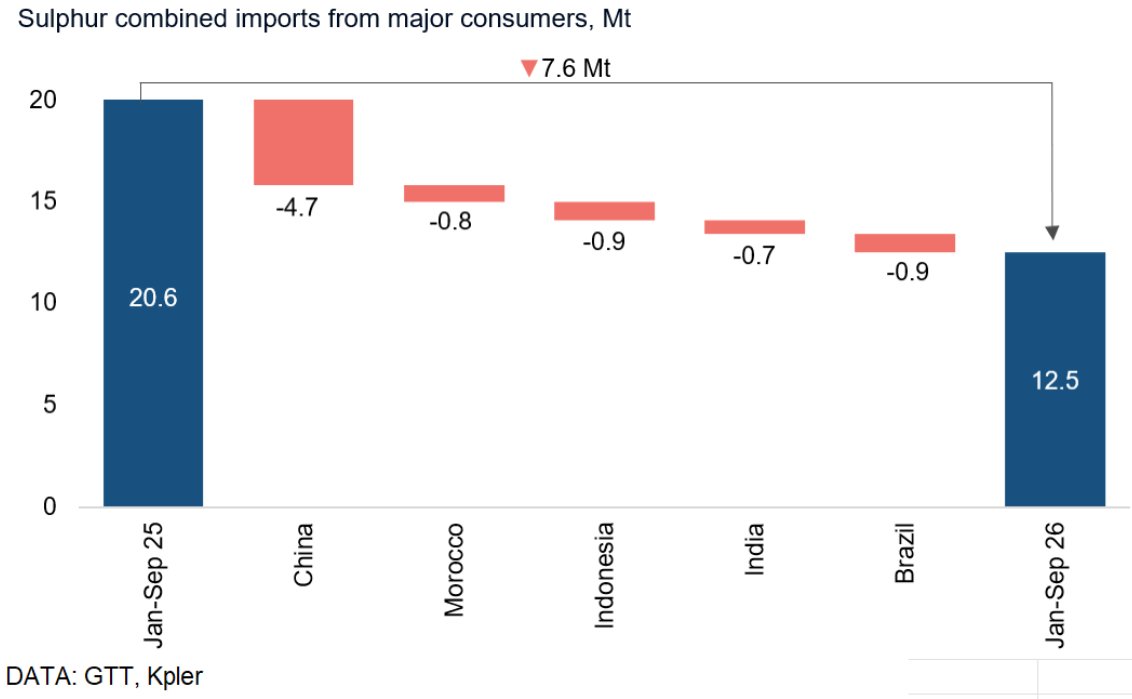
The reduction in #sulphur supply due to the conflict in the Middle East and the Hormuz closure (plus export restrictions from Kazakhstan and Russia) is evident in trade. Imports by major consumers for Q1-Q3 are estimated down nearly 40%, with the most severe drop in China
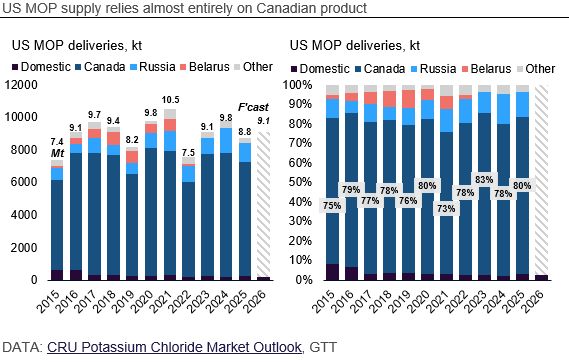
CRU's expectation, unchanged by last week’s announcements, is that Canada will remain the lowest-cost and most readily available source of US #potash supply over the medium term. Further tariffs or restrictions on Canadian imports would fall mostly on US farmers #MOP#fertilizer
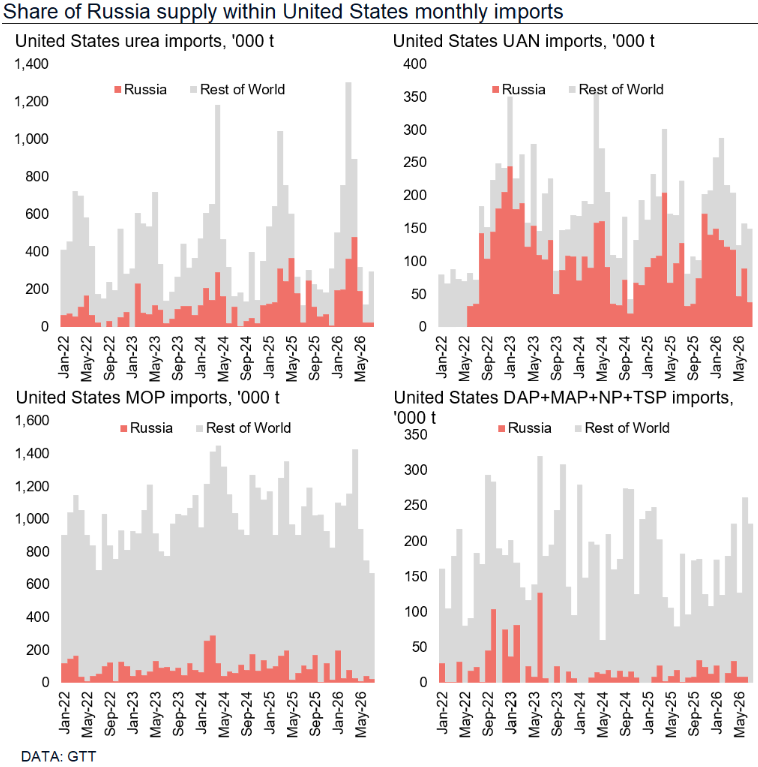
Donald Trump signed the Lindsey Graham Sanctioning Russia and Iran Act into law on 18 September. Uncertainty remains around potential treatment of #fertilizer under the legislation, but restriction on Russian supply could severely impact US pricing for #nitrogen#urea#UAN