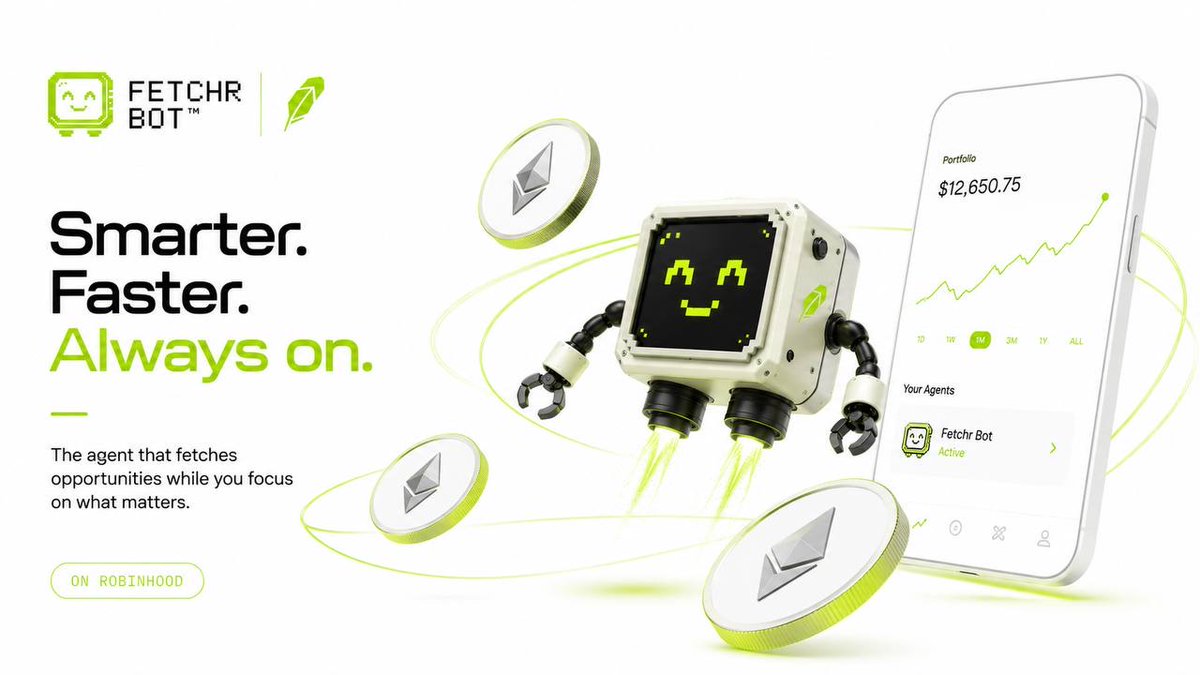
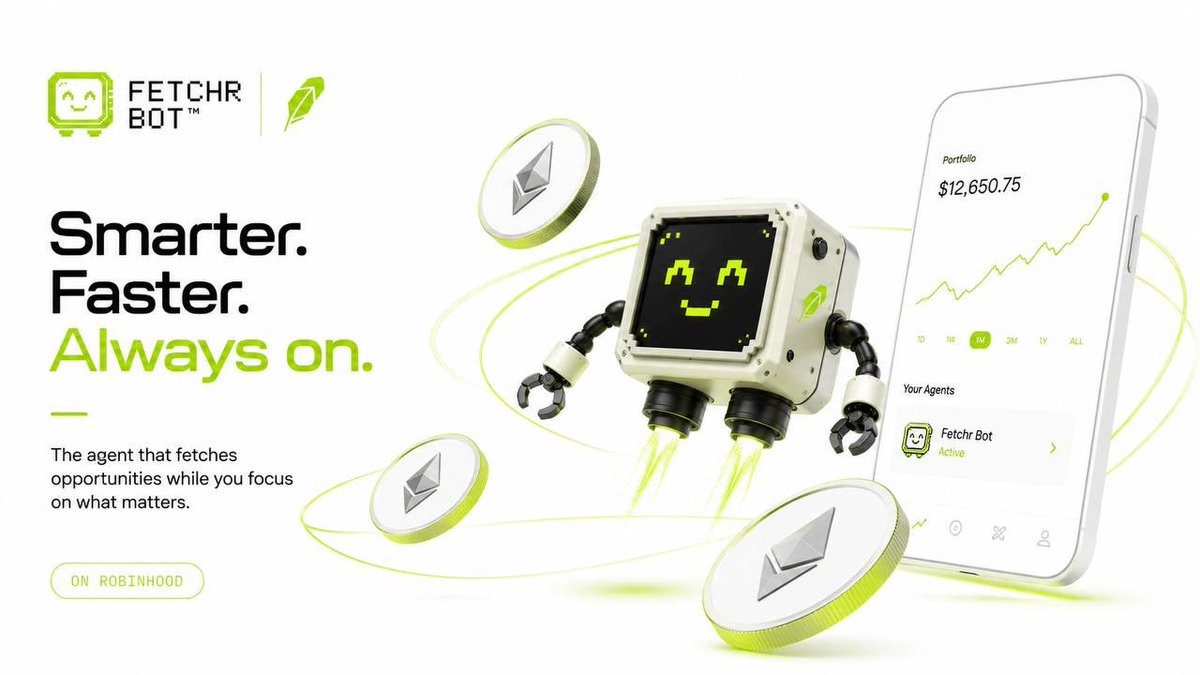
We are bringing Fetchr Bot back to Robinhood Chain. @RobinhoodApp
To build a personal buyer agent that people actually trust, we need three things: programmable assets, USDG settlement, and the ability to enforce hard spending caps on-chain.
Robinhood Chain provides the exact infrastructure we need to turn user-controlled budgets into autonomous retail demand.
Agentic commerce requires safe, programmable money. That’s why we’re here.
Traditional checkout relies on reusable card credentials.
Fetchr Bot uses USDG allowance vaults: users allocate a specific amount, set spending rules, and let the agent act only within that authority.
One model asks for broad access. The other starts with hard boundaries.
Built on @robinhoodapp.
An AI agent cannot execute with bounded risk if unrestricted wallet access is its only option.
Fetchr Bot is designed around revocable delegated authority. Instead of exposing a main account, a user can create a session key governed by maximum spend, approved targets, and an expiration condition.
The agent submits the action. Wallet validation logic evaluates the session policy. If the user changes their mind, they can revoke the delegated authority.
That is the model that makes agentic commerce more practical for decentralized applications on @robinhoodapp.
Blindly signing an open-ended approval is a security failure, not a user experience.
Revocable delegated authority gives decentralized applications a more useful model. A user can delegate a narrow task, such as purchasing an item under $50, to a session key.
The application can execute within that authorization without a new prompt for every action, but it cannot step outside the defined boundaries.
Fetchr Bot separates an agent’s shopping intelligence from its payment authority. You delegate the task. You retain the power to revoke it.
Built with @robinhoodapp in mind.
Most agents fail the security test because they require unrestricted access to a user’s wallet.
Fetchr Bot isolates payment risk with USDG allowance vaults. Instead of exposing a main account, a user allocates a scoped USDG balance and attaches spending rules to it.
The agent only receives authority over that vault. The vault releases funds only when the on-chain conditions are met.
That is controlled autonomous commerce on @robinhoodapp.
Intelligence is not a security layer. Enforceable policy is.
Fetchr Bot pairs USDG allowance vaults with ERC-4337 session-key controls. The user defines the policy: maximum transaction size, total budget, and approved merchant parameters.
A purchase outside those bounds is rejected at the policy layer. The AI handles shopping logic, while the payment authority remains constrained on-chain.
Built on @robinhoodapp.
Delegating a purchase should not mean permanently handing an agent the keys.
USDG allowance vaults limit the funds assigned to a specific buying task. If the brief changes, the user can adjust the allowance or revoke the agent’s session-key authority.
The agent receives limited authority. The user retains control over the policy and the funds assigned to it.
That is the model Fetchr Bot is building on @robinhoodapp.
A card payment says: “Here are my credentials—charge what I approve.”
A USDG allowance vault says: “Here is the exact budget this agent may use, under these rules.”
Fetchr Bot brings programmable limits to autonomous checkout, so delegation does not mean giving up control.
@robinhoodapp
Traditional checkout was built for a person who is present, reading the total, and clicking “buy.”
That model gets uncomfortable when you delegate a purchase to an AI.
Fetchr Bot takes a different approach: fund a USDG allowance vault, set the budget and rules, then give the agent authority to act only inside those boundaries.
It has permission to complete the task, not open-ended access to your money.
That is controlled autonomous buying on @robinhoodapp.
Traditional payment rails were designed for people clicking checkout.
Autonomous agents need a different model: scoped funds, enforceable caps, and transparent authority.
That is why Fetchr Bot uses USDG allowance vaults, giving agents enough permission to buy, never enough to overreach.
@robinhoodapp
Your agent should have a budget, not your entire wallet.
Fetchr Bot uses USDG allowance vaults to isolate the funds you approve for a task. Add a cap, define the rules, and let the agent shop within them.
No open-ended access. More control. Built on @robinhoodapp.
Most agents ask for open-ended payment access. Fetchr Bot uses USDG allowance vaults instead.
You fund only what you choose, set hard spending limits, and keep the rest of your funds out of reach. The agent can execute a purchase within its allowance, nothing more.
Security by design for agentic commerce on @robinhoodapp.
GM.
Fetchr Bot is building the rails for safe agentic commerce on @robinhoodapp:
USDG allowance vaults, ERC-4337 spending caps, x402 checkout, merchant checks, and decision receipts.
The agent can buy. The rules stay yours.
An AI agent should never have your credit card. @RobinhoodApp
Fetchr Bot uses x402 checkout so the agent never touches open-ended payment rails. Instead, you fund a USDG allowance and set hard on-chain spending caps. The agent executes the purchase, but the protocol enforces the limits.
Safe, bounded buying.
For merchants, a bot scraping a frontend is a liability. A buyer agent using x402 checkout is a customer.
Fetchr Bot brings payment-ready demand to retail. Because the agent operates within a pre-funded USDG allowance and strict spending rules, merchants get clear, accountable purchase intent, not just window shopping. @RobinhoodApp
How do you build a buyer agent you can actually trust? You separate the intelligence from the money.
Fetchr Bot stack:
— Passkey wallets and USDG vaults
— ERC-4337 session-key spending caps
— x402 checkout for bounded execution
— Decision receipts for full transparency
The AI finds the deal. The math protects the funds. @RobinhoodApp
Agentic commerce will not scale on legacy payment rails. Agents need programmable money to execute safely. @robinhoodapp
By using x402 checkout and on-chain policy controls, Fetchr Bot ensures every autonomous purchase stays within the exact limits the user authorized.
We are building the checkout standard for machines.
Fetchr Bot is building the transaction layer for agentic commerce: USDG allowance vaults, on-chain spending caps, x402 checkout, merchant reputation checks, and decision receipts. @RobinhoodApp
The result: agents can create real retail demand without ever getting unlimited access to a user’s money.
Everyone wants an AI assistant that can handle their shopping. The problem? Nobody in their right mind is going to hand a chatbot their credit card and just hope for the best.
Trusting an AI to recommend a product is one thing. Trusting it to execute a payment is entirely different.
Fetchr Bot solves this trust gap by completely separating the intelligence from the money. Instead of handing over open-ended payment access, you fund a specific allowance and set hard rules: per-purchase limits, weekly caps, and approved merchants.
The agent does the heavy lifting finding the deal, comparing options, and negotiating where possible but the blockchain enforces the limits. It literally cannot overspend what you have authorized.
We are building the foundation for safe, bounded agentic commerce directly on @robinhoodapp.
Launching soon… @RobinhoodApp
If you look at the current AI agent market, most of them ask for your trust. They operate like a black box, asking you to believe they’ll make the right choice with your money.
Fetchr Bot doesn't rely on trust. We rely on math and cryptography.
We built an execution layer that replaces promises with hard constraints:
— Passkey wallets and USDG allowance vaults
— ERC-4337 session-key policy controls
— x402 checkout integration
— Merchant reputation checks via ERC-8004
The AI sources the product, but the protocol controls the spend. And after every purchase, you get a full decision receipt showing exactly what the agent considered, why it chose the winner, and what it paid.
Execution with hard boundaries. Built on @robinhoodapp.
When people talk about the "AI agent ecosystem," they usually focus on the consumer side. But agentic commerce isn't just a consumer tool—it’s a massive, entirely new sales channel for retail.
Right now, merchants have no secure way to accept machine demand at scale. If an agent tries to buy something, it’s usually scraping a frontend and hoping a credit card goes through.
Fetchr Bot changes the paradigm. We turn a user's natural-language intent into a bounded, payment-ready purchase. When Fetchr Bot approaches a merchant, it arrives with a pre-authorized USDG allowance and a strict set of spending rules.
Merchants get a new source of payment-ready, autonomous demand with clear spending authority and direct on-chain settlement flows.
Connecting the next generation of buyers to retail, natively on @robinhoodapp.