Music @fevershamschool - sharing good practice in Primary Music - tips, resource recommendations, blogs, articles, ideas, training & support opportunities.
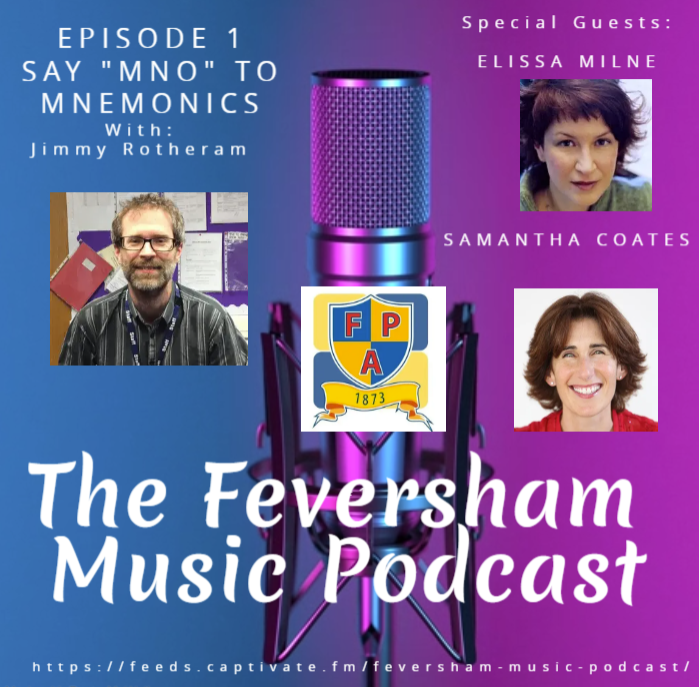
Catch our new podcast - episode 1 deals with the thorny issue of Mnemonics in reading music - Just say Mno! Education Goes Beyond Dumb Frases.https://t.co/nsWBNFeoie
@MadScientistFF Govt pays me to show big people how to show little people how to vibrate things at different speeds for different durations. I speak words to some people and write down words for other people who want to show big people how to teach big people to teach little people how to etc
@DrLizStafford@BirmCons@LeedsMusicDrama Also commercial and artistic failure is perhaps the one thing all honest musicians have in common. We've all had a music fail at some point.
@DrLizStafford@BirmCons@LeedsMusicDrama I don't believe there is any failure involved in being a musician. To me, it's like calling someone a "failed Buddhist" because they didn't make any money out of it or didn't pass an exam in advanced meditation. Being a musician is a life path, not a hat you can take on or off.
@DrFautley @Danmeemusic @GarySpruce1 All of the thinking about what repertoire is suitable, what approaches work best etc. Teaching a man how to fish is better than teaching a fish how to man. Or something like that.
@FevershamMusic @Danmeemusic @DrFautley@GarySpruce1 No need for words at all to 'correct'. Listen, model, repeat. Neither do we need constantly 'talk to your partner about how you think it went'. Less talking, more music making.
@ShellyGeeson A lot of the stuff used in primary schools is designed by secondary teachers. A lot of the stuff used in EYFS is designed by KS1&2 experts. This may be a reason why things aren't child developmental enough.
@daniel_bath@Miss_Snuffy Also, it wasn't society who sacked her, it was the royal family, because the royal family thought her behaviour was racist and unacceptable.
@EnglishCadence @Danmeemusic @DrFautley@GarySpruce1 I spend a lot of my time saying exactly this to teachers, but they feel like they may be penalised if they not feedback and correct in the moment, and it can be counterintuitive to some based on their ITE experiences, and can be an ingrained habit.
@Danmeemusic @EnglishCadence@DrFautley@GarySpruce1 Kodály, Orff, Dalcroze are often seen as kid's stuff - primary methodology - but they give you tools for teaching music at all levels, and are great for advanced musicianship.
@daniel_bath You sent me a response to my DM about notation but I can't see it - it says I can no longer see messages from you! You could forward to my personal account.
@EnglishCadence @Danmeemusic @DrFautley@GarySpruce1 I don't like "correcting" childrens music through verbal feedback, especially with younger children. We can usually fix the problem without the child feeling they are doing something "wrong". Kodaly said the purpose of music education is not to judge but to embed.
‘researchers often forget that there is no such thing as a creativity test. Tests provide only estimates of creative potential. Authentic creative behavior requires spontaneity, so if a student is required to take a test, the result is not really indicative of “creativity.”
@kpe123@AllyDaubney@AndrewEMC Approved knowledge types give us some leeway, so instead of talking about development of skills, for example, we explain in terms of procedural knowledge. It has been ever thus for music teachers who become adept at fitting their round pegs into the square holes of orthodoxy.