One night of sleep loss changes how your brain clears waste: Breakthrough News from PNAS
A new study shows sleep deprivation amplifies brain signals tied to CSF flow—possibly a compensatory “cleanup” mechanism.
But here’s the problem:
By midlife (40–50) that response largely disappears.
Sleep deprivation may be quietly accelerating brain aging.
#SleepDeprivation #BrainAging #Alzheimers #Neuroscience #Longevity
Sleep deprivation exhibits an age-dependent effect on infraslow global brain activity | PNAS https://t.co/iLfwtq1fdc
Gritti et al: Visualizing and Interpreting the Carbon Dioxide Reactivity Index in Traumatic Brain Injury
Link: https://t.co/BEGYK1z3ol
@neurocritical#neurocritcare
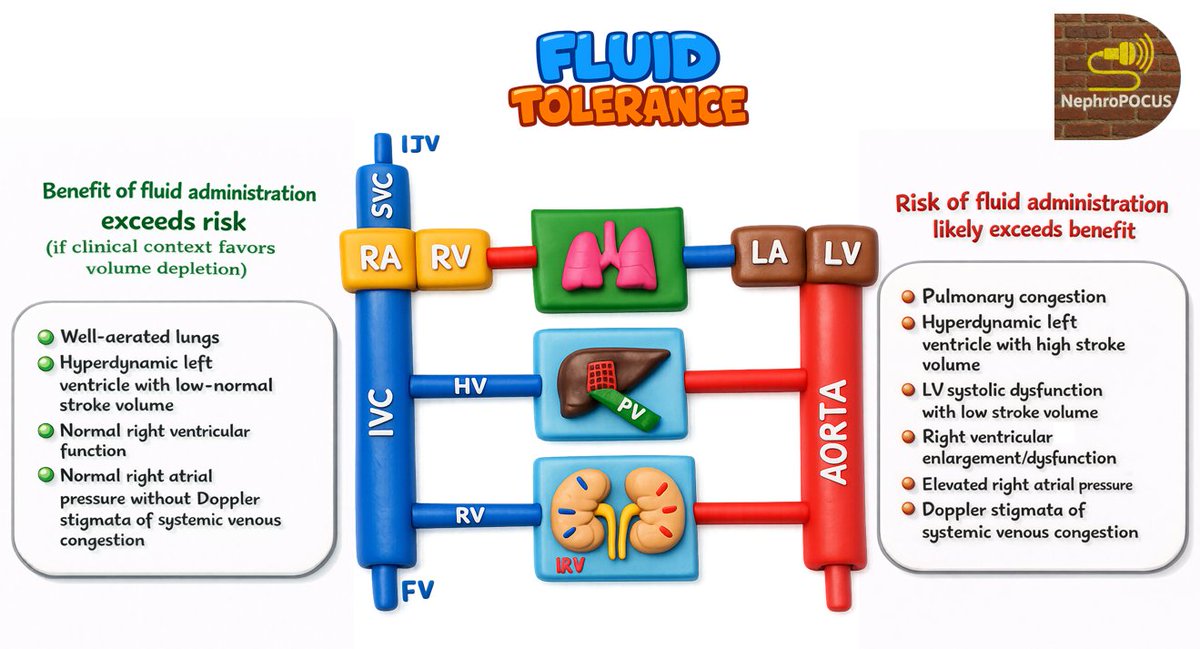
#POCUS assessment of Fluid Tolerance.
#FOAMed#Nephpearls
Fluid tolerance is defined as the absence of signs of congestion (pulmonary or systemic) in response to fluid administration.This concept represents a shift from focusing solely on whether patients respond to fluids (fluid responsiveness) to assessing whether they can safely accommodate the administered volume without developing harmful congestion.
AGREE! Doctors create compounding value every time they treat a patient—saving lives, preventing death & disability. Yet what they get paid drops every year while U.S. healthcare costs skyrocket hitting $5.6T in 2025. Admins now outnumber physicians, 10:1. The system has been DESIGNED to be overly complex in order to siphon money from sick people— it’s intentionally exploitative, and it needs to end.
#Nephpearls#POCUS#FOAMed
Latest post on https://t.co/5dIBLwYPMl -
Seeing the Invisible: Bedside #Ultrasound and the Effusion You Cannot Afford to Miss
🔗 https://t.co/df8dg5kUEm
September is Sepsis Awareness Month. Join in helping to reduce #sepsis mortality and morbidity and improve outcomes for survivors with resources from the #SurvivingSepsisCampaign: https://t.co/yJ99vEvSRG
#SAM2025#SCCM
🧵 "What really determines tissue perfusion?"
– and why most explanations get it wrong.
Let’s sort out MAP, CVP, CCP, autoregulation, vasopressors, and the flow that actually reaches your organs.
👇
🩸ROTEM & TEG Coagulation Testing: Excellent summary & review
👉Critical appraisal of new methodologies & current literature
🔗https://t.co/AArRowDx7S…
#FOAMcc#SCCMSoMe#MedEd#MedTwitter
Vascular leakage during circulatory failure: physiopathology, impact and treatments
CCR Journal Watch - tracking the critical care literature daily
https://t.co/Sp06oA6IDG
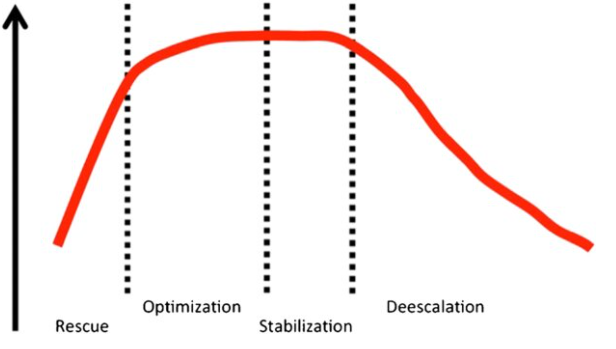
Lesson 1. Resuscitation is the easy part of caring for critically ill patients.
Resuscitation or ‘rescue’ is one of the most exciting parts of the job, however, is only a fraction of what’s needed to care for a critically ill patient.
Without being competent at resuscitation, the other aspects of patient care suffer, but hyper fixating on resuscitation can be at the detriment of patients.
After some time (typically hours), care needs to shift from resuscitation into stabilization. The things that may have benefited patients early on (e.g. fluids) may harm the patient later on.
Importantly, the intensity of resuscitation often corresponds to the intensity of deresuscitation required.
Transfusion Practices in Traumatic Brain Injury
Liberal transfusion strategy results in better neurologic outcomes than a restrictive approach
Hgb of 9 g/dL as the standard threshold for TBI patients
#PedsICU@BloodNet_PALISI@PALISInet#PedsNeuroICU
https://t.co/so7SfgVm2E
You've probably heard "don't give lactated ringers because it raises lactate"
This statement is ~98% false, but there's one crucial practice-changing fact that you need to know.
A 🧵 all about lactic acid and lactated ringers!
1/