KeOps 1.1 is out! We introduce an exact `LazyTensor` decorator for @PyTorch and #NumPy: free x30 speedup + linear memory footprint for kernel methods, mesh processing and Sinkhorn on the GPU. https://t.co/cOkwqTplAS
@nbonneel @BrunoLevy01 Bonjour @nbonneel , on commence par un buffet gratuit de 12h à 13h suivi par une heure d'exposé, qui se termine à 14h donc. Si tu donnes ton cours à Jussieu, tu es very welcome!
@tomrzah@gabrielpeyre@ZaccharieRamzi Je n'ai jamais utilisé KeOps pour implémenter ce type de trajectoires - mis Antoine Diez, oui : https://t.co/F3ZjpsoBUh
@TearsOfJake@entagma@gabrielpeyre From a geometric perspective, this implements a multi-scale (aka. “coarse to fine”, “divide and conquer”) approach into your Sinkhorn solver. You can find illustrations in my PhD thesis (https://t.co/PoPOGE3vK7), esp. in Figs. 3.19 (normal Sinkhorn) and 3.25 (with scaling).
@TearsOfJake@entagma@gabrielpeyre You’re very welcome! For reference, this technique is known as “simulated annealing” in the general case and “epsilon-scaling” in the context of optimal transport.
@entagma@TearsOfJake@gabrielpeyre You’re very welcome! GeomLoss is still far from being accessible enough… Unfortunately, writing papers and getting a position at INRIA kept me busy throughout 2021. Now that I have the time to come back to software development, the situation should improve quickly :-)
@entagma Twitter automatically truncated the link… The correct command is detailed here: https://t.co/qUt4u0HVQv (The beta for KeOps v2.0 is in the “python_engine” branch.)
@entagma You may also want to try our beta for KeOps v2.0, which is now super close to release: “pip install git+https://t.co/JP47KmW3v0”. If you encounter problems, a GitHub issue would be very appreciated :-)
@entagma@TearsOfJake@gabrielpeyre Notably, letting “epsilon” decrease at each iteration is absolutely critical for performance. Use “epsilon = q^it” with q=0.5 or q=0.9 as a good rule of thumb.
@entagma Finally, if you prefer to implement a solver from scratch using e.g. CuPy (@TearsOfJake): appendix E of https://t.co/cal0gzrrye could be a good follow up to @gabrielpeyre ’s numerical tour.
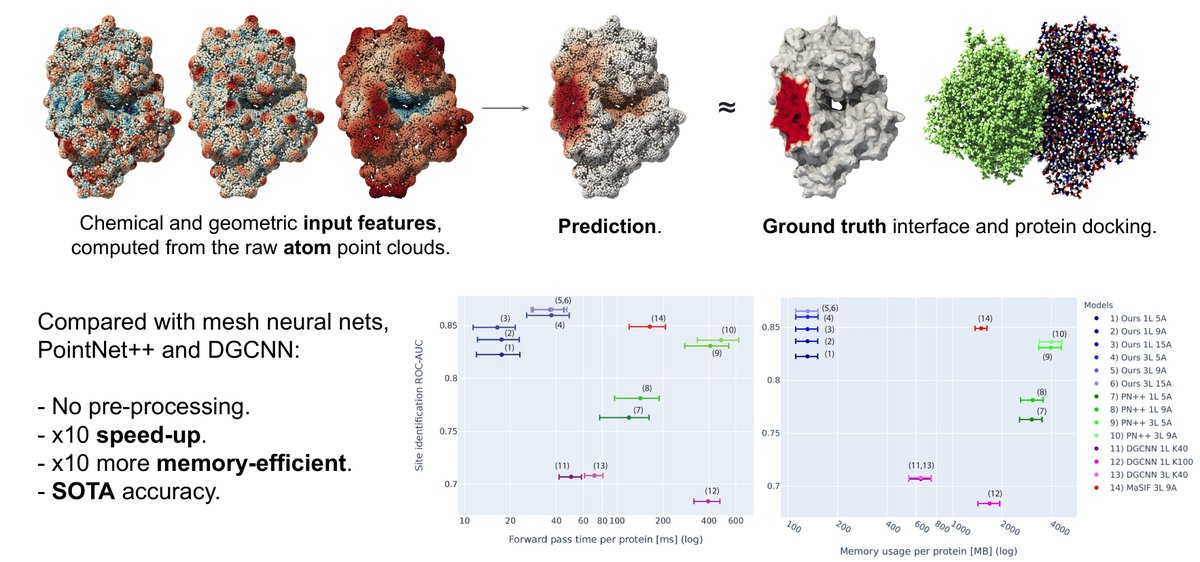
Fast end-to-end learning on protein surfaces (w. @FreyrSverrisson, @befcorreia and @mmbronstein) will be live soon at #CVPR2021. Join us for a chat at 10pm-12.30am EDT (Paper Session 11).
https://t.co/tau6sprFpU
@gabrielpeyre What a coincidence! Antoine Diez from @ImperialMaths just released the first version of Sisyphe, a very nice KeOps-based library for the simulation of particle systems in biology and physics: https://t.co/KpvjVPMfa0
A most original use of GeomLoss on 3D shape textures, with pairwise Wasserstein distances between 1,000 curvature histograms. Enabling the use of OT as a "standard" tool for large-scale data analysis is a major target for 2021! @RFlamary
To visualize the space of 3D shape textures, we combine UMAP with the optimal transport distance on 2D curvature diagrams. @leland_mcinnes@gabrielpeyre
Membranes and tubules are part of the same family!
These 3D shape textures optimize curvature functionals that generalize the traditional Willmore and Helfrich energies.
https://t.co/rsyncRHbJW
our paper with @befcorreia@FreyrSverrisson@FeydyJean on fast learning on proteins is accepted to @CVPR End-to-end differentiable architecture, precomputations on the fly, more accurate and x100 faster than #MaSIF
https://t.co/Bk1FAHCQYI
Code coming soon