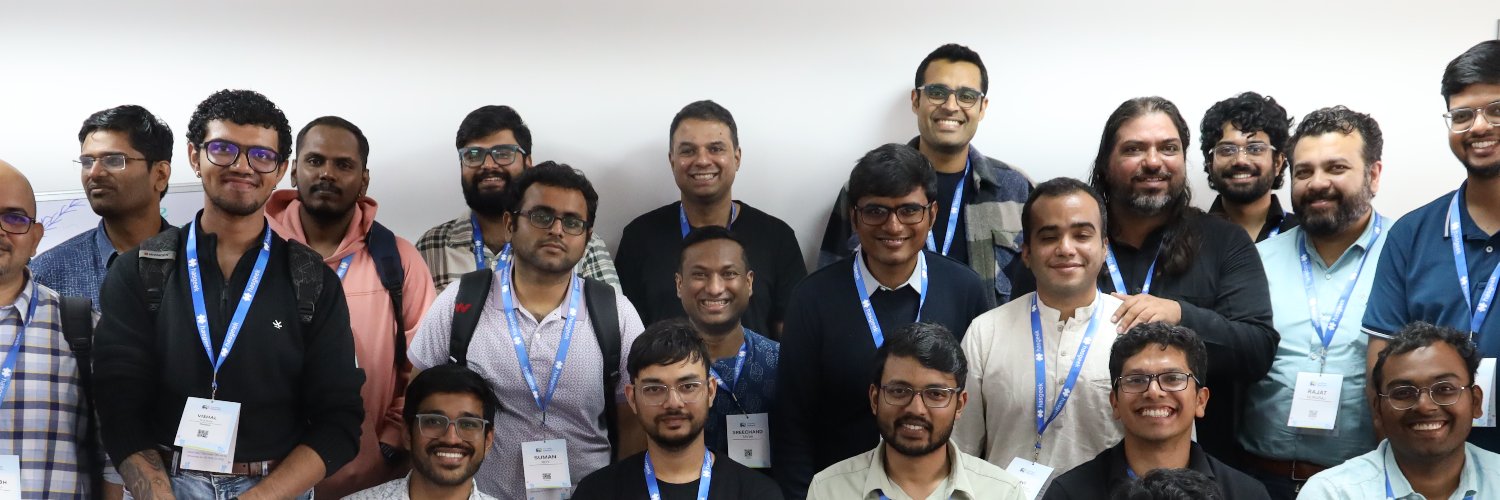
Is your data built for humans or for agents?
Agents don't need clean joined tables - they need relationships, checklists, and context. @sanand0 is running a hands-on workshop on engineering data for agents (and how agents can help build it).
MCP servers are becoming a critical part of enterprise AI How secure are the #MCP servers powering your AI agents?
Akash Sathish from @SahajSoftware explores the answer at The Fifth Elephant's Enterprise AI in Production meetup.
@hasgeek@fifthel
🔗 https://t.co/epcfTJQ7iW
2/
@FireboltHQ will also be hosting a hands-on workshop on building a lakehouse post our meetup, so do stay back if you'd like to make this Saturday all the more worth it!
https://t.co/hpqaNBsJwN
Excited to speak this Friday about our journey of making Generative UI work in production.
I’ll be covering:
1. Our initial approach to building C1
2. The architecture for consistent and deterministic UI
3. Why we had to move away from JSON for OpenUI
At Friday's Enterprise AI in Production meet-up, hear lightning talks and demos on grounding, governance, inference infrastructure, data quality, generative UI, and agent workflows from @Apple@IBMResearch@zahlekhan & others.
📅 19 June | Bengaluru
https://t.co/HEko0oVOGY
Not every production AI lesson needs a 30-minute talk.
Sometimes it's:
⚡ a benchmark
⚡ a deployment mistake
⚡ a governance headache
⚡ a latency graph
⚡ a data quality incident
AI benchmarks: 97.4% accuracy.
Production:
"Why is the agent calling the same tool 37 times?"
"Why did inference costs triple?"
"Who approved this MCP server?"
"Why is compliance asking for logs from February?"
If these questions sound familiar, come to the Enterprise AI in Production meet-up.
Talks from practitioners at IDfy, IBM Research, Fractal Analytics, Nutanix, Apple, Isotopes AI, Sahaj Software, and more.
There’s a big, under-appreciated reason why people may have very different experiences and opinions about using AI for work — are they using it for tasks they’re already an expert at, or tasks they can’t do themselves? The former leads to a *growth cycle* and the latter leads to a *dependence spiral*.
When I use AI to do something I’m an expert at, like coding, I treat it as a tool. I can build quickly, maintaining an understanding of the code, knowing that if necessary, I can fix the code myself. It feels empowering. It frees up my time to think about the complex, judgment-oriented parts of software engineering that I can’t or won’t delegate to AI. That means my own skills improve rapidly, and I get to climb the ladder of complexity and develop higher-level skills, much more so than when I write the code myself. I feel in control. I can lock in and achieve a flow state — when AI is working, I’m reviewing, building understanding, and planning the next steps. I never get the feeling that the tool is about to replace me. This is the growth cycle.
(Of course, the growth cycle is not automatic. I still need to exercise agency to use AI responsibly. But it’s the same challenge with any productivity-enhancing technology, and those who’ve navigated such transitions before are well-equipped to navigate it with AI as well.)
On the other hand, if I use it for tasks I don’t understand and haven’t learned to perform myself, I have no choice but to treat it as a superintelligence. If something breaks, the best I can do is ask AI to fix it and hope for the best. I generally can’t evaluate the quality of the output myself. The only way to find out if it's any good is if and when the work is ultimately reviewed by an actual expert. The experience is confusing, unsettling and disempowering. And forget about flow state. By over-relying on AI, I risk losing whatever skill I had at the task in the first place, even if it boosts productivity in the short term. This is the dependence spiral.
It’s no wonder that entry-level workers and students preparing to enter the workforce find themselves in a bind. To compete with the AI-enabled productivity of more seasoned workers, they must adopt AI themselves, but doing so risks the dependence spiral. I have some thoughts on solutions that I will share in later posts, but I think having a clear diagnosis of the problem is a useful first step.
The Fifth Elephant 2026 is accepting proposals for another week! Good time to start putting things together and hit the submit button.
CFP link: https://t.co/i4cOpk8hhm
We're seeing submissions that move beyond "build an agent" and tackle the harder question: How do you trust what the agent produces?
If you're working on evaluation, verification, observability, governance, safety, or production AI systems, we'd love to hear from you.
AI project in production? Perfect! Submit a talk.
We're looking for talks on:
⚡Latency
💰 Cost
📈 Scale
🤖 LLM agents
🛠️ Real-world AI infrastructure
Tell us what broke, what you learned, what you rewrote, and the metrics that proved it
https://t.co/DCxcaWXE8g
@fifthel@hasgeek