🚀 Announcing mcp-clojure-sdk: A Clojure SDK for Model Context Protocol Servers!
I'm excited to open-source our Clojure SDK for building Model Context Protocol (MCP) servers!
https://t.co/phqhJSg856
Hey @GoogleAI : I have no interest in upgrading my plans just to try Carbon. That seems like a dumb move to me. Let me try it on my existing plan. If I like it, I'll happily upgrade to continue using it.
Who would've thunk it, but the hardest part of working in a big team on a big project today is verifying that the changes made by your agents.
With everyone modifying codebases at warp speed, it's tough to know if the changes you've made are still valid, especially if they're in a PR for a long time.
So this approach of "no PRs" makes total sense and I think it's what everyone will converge on.
It's one more thing in a series of things that makes onboarding new folks so difficult!
We're still so small but I'm loving the team we've got at Superlogical. They're so talented and kind and love their craft. It's a different era of software development and our expectations and practices reflect that. I want to share a bit about how we work.
First, everyone is trusted to push to main. We do machine-aided code review pre-push and human plus more machine-aided code review post-push. Limited to no PRs.
Culturally, we've all agreed that if we ever hire someone who we DON'T trust to push directly to main, then they probably aren't the right fit for the team (so far, not an issue).
Some common sense here: if someone is stepping outside their lane or comfort zone, we'll open PRs. For example, I'm pretty trash at macOS/iOS UI, so I'll open PRs for UI-affecting functionality and ask for eyeballs/help. But for business logic and internals, I push to main.
Second, everyone can cut a release. Our release process is fully automated and when you start a release (for any platform) it triggers a Slack notification and a 15 minute countdown.
The 15 minute warning is a final gate that allows people to review plus collaborate on a changelog. During that 15 minutes, anyone in the company can pause the release rollout. After 15 minutes, the train leaves the station. You can't override the 15 minutes (except to pause). It gives everyone a chance to step in.
Third, we avoid synchronization through fast remediation rather than through planning. The server and clients on various platforms ship features as fast as they can. We use post-hoc human review and AI-assistance to identify feature mismatches across products ("Windows has support for X and Mac doesn't." or "Mac and Windows differ in their behaviors for Y in this way.").
This avoids expensive "sync" meetings and coordination. We trust that producers of features are mindful of what they're producing and we trust that adjacent product lines will self-synchronize quickly. In practice, we see feature parity across platforms within 24 to 48 hours.
All of this works on mutual trust. It ONLY works with mutual trust.
Everyone at all times has to trust that they've got each others back:
1. Push to main only works if you fix your mess, or if you don't, that someone else will quickly but that you'd do the same (and generally in equal amounts).
2. Anyone can deploy only works if you trust everyone to cut at the right time, with the right changelog, and that people will respect the 15 minute timer.
3. Sync through fast remediation only works if you trust other teams will pick up and integrate your work quickly, which only works if you would too. It also only works if you are fairly producing mismatches (e.g. not constantly).
We've got a great team. I know we're still small and that these practices will change in many ways as we scale. But this is already a markedly different practice than what I would've done 15 years ago.
In general, we are building from day 1 on a foundation of mutual respect, excellence, and trust. And it's been awesome.
Comparing US AQI standard (left) vs NAQI (National Air Quality Index India).
Same pollutants, different representation. We’re also switching to US AQI standard as default as per requests.
I hate loud firecrackers with the intensity of a thousand suns.
Folks who burst those loud bombs are probably already deaf, have never had a small kid, or pets.
Seriously, fuck those assholes.
You don't need a software factory. You need an abstract software factory provider which can instantiate concrete software factories without coupling the client to a specific software factory implementation. Have some fucking self-respect.
I'm firmly in the camp that believes that AI will solve the world's problems long before things can get really bad along any timeline.
Many of the world's most serious problems are due to an uneven distribution of education and, consequently, intelligence, across large parts of the world. But intelligence will soon be accessible everywhere and somewhat uniformly distributed. It only takes one generation of curious kids to be educated and motivated to today's best levels by AI, and a whole country changes shape.
To put my position simply, I think people around the world will become so dependent on external intelligence that they will become defanged, deradicalized, and de-weirded. They'll be biased, influenced, and ultimately changed for the better by the models themselves. We'll see AI basically running people's lives around the world in 5-10 years. And it will make people behave, simply by not helping them if they don't.
I also think the logical extension of LLMs being able to write model weights directly is that in a decade they'll be able to rewrite neurons in your brain. If they can make Qwen 6x better at math, then probably they can make you 6x better at math too.
Maybe the procedure will be via neuralink, or crispr, or maybe in time it won't even break skin. But LLMs are going to be able to rewrite people. Bob will go into the machine to get a math upgrade and he'll come out not being an asshole anymore, and people will be like, huh, what happened?
And so I'm an eternal optimist about the future, no matter how crazy it gets in the short term, say 3 to 5 years. Things are going to change a lot. Imagine what happens when people can rewrite their own genes in 10 years. Society will struggle with it.
But in the 15-20 year horizon, I think we're going to stop fighting each other because of AI. And the world will be an astonishingly better place.
to the most respected finance minister. i have a doubt. please find time to answer me.
you say that the venue for a debate is the parliament.
you say that my home minister, amit shah has offered a special session to debate.
you say that if rahul gandhi - the leader of opposition, wants to debate my prime minister, he should come to the parliament.
ma'am, let's start by pointing out some facts.
jul 20 - the parliament session opens. narendra modi, the ever so hon'ble prime minister - addresses the media - outside the parliament. he asks for a fact-based debate.
jul 24 - Amit Shah's National Honour Bill is introduced in Rajya Sabha, by Nityanand Rai, who is MoS for home affairs. Jairam Ramesh asks "Where is the Cabinet Minister". This is present in the RS Transcript.
jul 29 - Rahul Gandhi, the leader of opposition - asks "why is the Home Minister not here today?". This is also present in the LS Transcript.
jul 30 - Rahul Gandhi asks "why Shah is so scared of coming to Parliament"
aug 4 - Amit Shah, is seen in the parliamentary complex. at an NDA Parliamentary Party Meeting. He Doesn't enter the house. as per reporting from Navbharat Live.
aug 6 - Mallikarjun Kharge, in Rajya Sabha, asks "Why is the Prime Minister not coming? Why is the Home Minister not coming?" as Per Kerala Kamudi - this is consistent with the RS transcript.
aug 11 - congress MP Manickam Tagore attacks the absent home minister. as per reporting by the ANI.
aug 12 - Amit Shah says to the media, "have been coming to Parliament regularly since the Session began; I sit in my chamber."
talking to the media, at around 12:30 PM, Amit Shah offered "If the Opposition wrote to the speaker, there would be a debate from 3 PM wednesday (12 aug - the same day) to 3 PM thursday (13 aug - the next day)
this was roughly a 2 hour window to submit the letter.
he further said "I will sit in the House; I will listen to everyone and respond to every point."
Rahul Gandhi said "We are not interested in listening to his lecture, Who shot those students? Who blinded that student? Who ordered the lathi charge?"
this referred to the Pellet Shots fired at the Student, Sahil Lochav. He asked about the Lathi Charge that happened in the protests on July 20th.
The Opposition wanted a statement from Shah about this, Shah wanted them to submit a letter to the speaker, in a window of roughly 2 hours - after not being present for 17 straight settings. with no recorded appearance.
aug 13 - Lok Sabha sits for 4 minutes. 11:00 AM to 11:04 AM. The National Song, Vande Mataram, is played. and then, the house is adjourned sine die. Both ever so honourable Prime Minister Narendra Modi and Home Minister Shri Amit Shah were present on these days. for the 4 minutes.
---
Respected Finance Minister Ma'am,
These were the facts I have pointed out. I have not said anything that was my own opinion. I have not framed the facts in a way that support any party. My facts were gathered by scraping Documents from the LS and RS portal, OCR'ing the PDFs, then parsing them and then Aggregating News Sources. - and pointing out facts from them. Cold, Hard, Records.
I have not asked any questions yet - which I will do now.
I am a human. I have evolved Pattern Seeking skills.
I spot a pattern here. I see that for the entirety of the Monsoon Session, Prime Minister Modi, and Home Minister Shah, did not utter a word on the record of the Lok Sabha. They were not present in the house except for the last 4 minutes, on the last day.
Shah says "He was sitting in his cabin",
Ma'am, I don't think debates happen when you sit alone in a cabin. It happens on the floor, where the other side can ask questions too.
I don't see a meaningful debate happening in an environment like the Parliament. I say this with utter disappointment.
If Parliament is the venue for debate, why did the two most senior members of the government not speak there once in 19 sittings? And why was the one offer to debate made to the press on the 18th day, with a deadline of a couple of hours?
Why are there "offers" even? I think it is your responsibility to be in debates because that is your entire job.
As you say, "Demanding answers also carries an obligation to hear them." -- Well, were Amit Shah or Narendra Modi, hearing the Questions being asked? They were not in the house even.
Please Answer my Doubts. I would be very obliged if you do so.
Regards,
Sarthak
i've reproduced the results from the MIT blog post today on weight-space programming. but one additional result i have to add: this is a new, step-change emerging capability that's appeared in just the latest set of models.
There’s 100% a kind of mania you can get into with coding agents, where it feels like you’re getting a lot done and working all the time but nothing is really happening.
I think it's often a form of avoidance of something else in life.
This is probably going to be pretty bad for a while. How long? Nobody really knows yet. The backlog of vulnerable software seems to me to be ~decades in length and we have not yet reached anything like consensus on “Give AI alllll the keys; that will work things out.”
As someone who has personally spent $500k / mo+ on Google Ads for years, I can tell you with certainty:
This revenue growth in Search is artificial & extremely unhealthy for Google’s business long term
Search volumes are declining as legacy search is being increasingly cannibalized by non-monetized LLM queries
Google’s response?
Manufacture revenue growth via short-sighted, highly extractive, customer-hostile tactics. I.e. charge advertisers more for lower quality clicks, including clicks they do not want and explicitly did not approve Google to charge them for
A few examples to illustrate:
For all of its history until recently, Google operated on a 2nd price auction model
I.e. if you bid $5 CPC and the next highest bidder bids $1 CPC, Google charged you $1.01 for the click (one penny more than the 2nd highest bidder) rather than the $5 you bid
This was a genius move by Google early on as it incentivizes advertisers to input their true maximum willingness to pay rather than trying to play the game of bidding low and constantly adjusting to try to stay just ahead of the next highest bidder while still not paying too much
However recently, Google silently deprecated the 2nd price auction and began charging advertisers as much as their bid and budget caps allow, regardless of what anyone else is bidding
It’s a short-sighted cash grab at the expense of the long term health of the advertiser ecosystem
Making thing worse, Google also recently nerfed keyword targeting precision
Google previously had precise keyword targeting settings that allowed advertisers pick individual search phrases to bid on, defined down to the character w/ exact match or phrase match targeting
This was one of the core features that made search advertising magic, enabling advertisers to run extremely precise campaigns based on exactly what their target customer typed
But now, even if you bid on a specific term or phrase using the strictest exact
-match targeting settings, Google will show your ad across 1000’s of unrelated keywords, labeling them as as “exact match (close variant)”
The definition of “close variant” means whatever they want it to and changes constantly. The result is advertisers get billed for clicks that are totally irrelevant to their business and that their targeting settings explicitly forbid Google from targeting. Google does it anyway and there’s no ability to turn this off
So now exact match is broad match, and broad match is just meaningless spam
This is all very bad for advertisers, but for Google, it allows them to show your ad and bill you for clicks across 1000x more searches that were previously going unmonetized (mainly because they’re garbage queries no one wants)
This is how you grow revenue atop declining search volumes
Lastly, and perhaps most egregiously, Google quietly stopped respecting budget caps by a factor of 2x. For example campaigns we’ve been running for years with $1000 daily budget caps suddenly began spending $2000+ per day
And the extra spend is entirely on the garbage keywords Google arbitrarily throws in as “exact match (close variants)” which have no value to our business, but can’t be turned off
Google offers no refunds nor any recourse for overspend or spend on keywords you explicitly did not target
These are not the actions of a healthy business. These are the actions of company whose core business is in decline but desperately needs to pump quarterly earnings so Wall Street will continue to fund insane capex while hopefully looking through their rapidly deteriorating negative free cash flow
Google operated a benevolent monopoly for the better part of 25 yrs
Meaning the value Google captured from Search was but a small fraction of the value it created, and that spread produced a potential energy that justified expectations of high earnings growth far, far into the future
This is now no longer the case
At the alter of AI capex, Google is sacrificing the golden goose
@0xglitchbyte He’s not talking about that. All the community around software is slowly dying. The beauty to share, talk, discuss about something that is not AI is slowly disappearing and you can see it everywhere. Of course you can do things alone, but that’s just depressing.
@joaomendoncaaaa@hotlinemagi the interesting crowd has stopped talking about actual tech and started talking about their boring ass agent setups.
nobody has ever cared for the uninteresting crowd. nothing gained, nothing lost there.
every product i use should just be a headless mcp, that feeds into an agent, where i never have to think about anything underneath.
except for our product, of course.
in our product, customers love the ui and love us very much.
we're special that way.
it's getting close to 2 years of coding agents being a thing
looking back on that time the majority of discussion on here on where they're going, what's cutting edge, what matters has been primarily wrong
you had to actively ignore what was going on here to win in this space
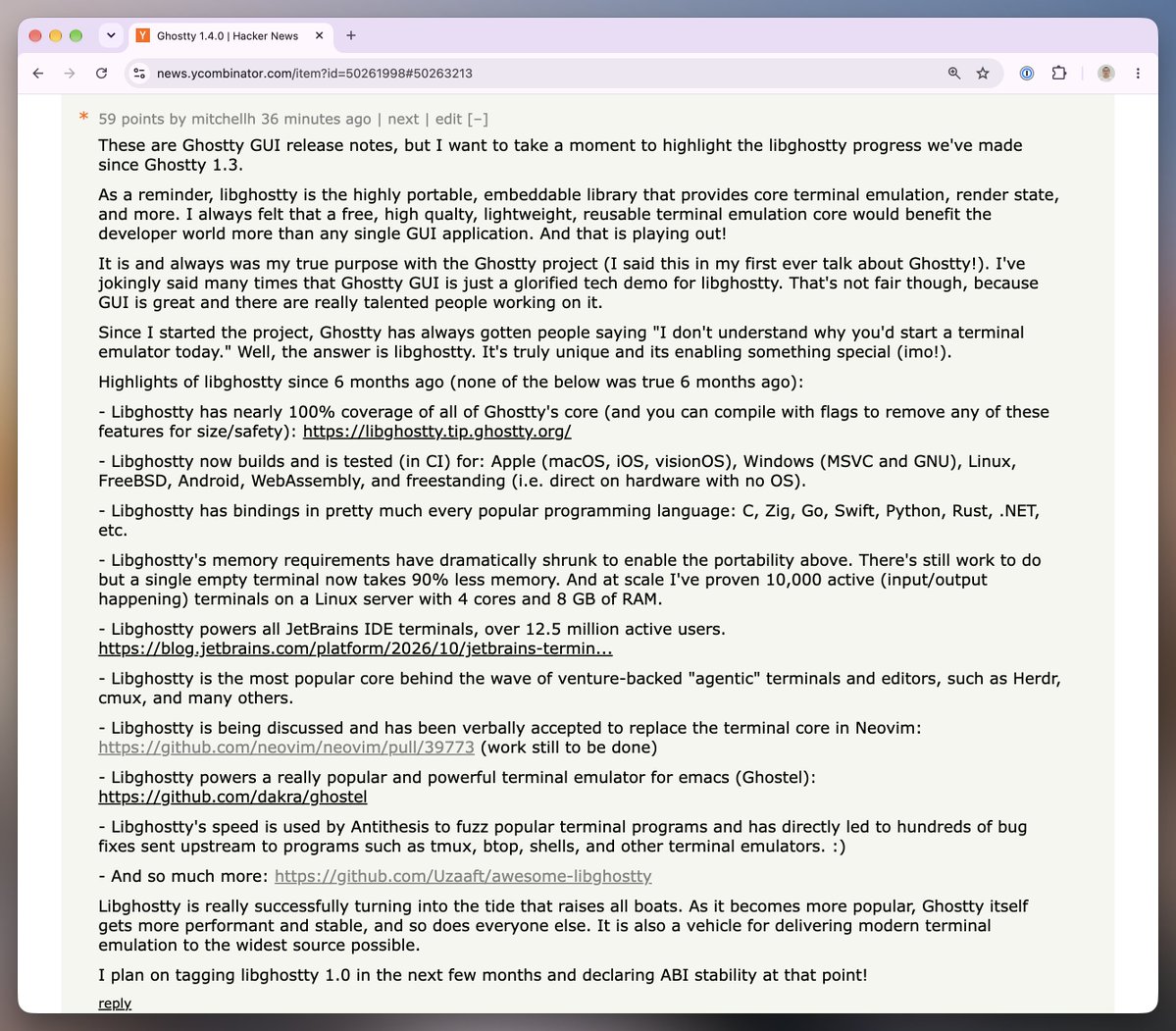
Libghostty progress in the past 6 months. It's amazing that NOTHING IN THIS LIST was true 6 months ago, and now its ALL VERY REAL. I remember bringing up the idea of libghostty 4 years ago and most people saying "but why." I did it anyways. And here we are!
Text reproduced in case its easier to read this way:
As a reminder, libghostty is the highly portable, embeddable library that provides core terminal emulation, render state, and more. I always felt that a free, high qualty, lightweight, reusable terminal emulation core would benefit the developer world more than any single GUI application. And that is playing out!
It is and always was my true purpose with the Ghostty project (I said this in my first ever talk about Ghostty!). I've jokingly said many times that Ghostty GUI is just a glorified tech demo for libghostty. That's not fair though, because GUI is great and there are really talented people working on it.
Since I started the project, Ghostty has always gotten people saying "I don't understand why you'd start a terminal emulator today." Well, the answer is libghostty. It's truly unique and its enabling something special (imo!).
Highlights of libghostty since 6 months ago (none of the below was true 6 months ago):
- Libghostty has nearly 100% coverage of all of Ghostty's core (and you can compile with flags to remove any of these features for size/safety): https://t.co/y8MY1k3gG7
- Libghostty now builds and is tested (in CI) for: Apple (macOS, iOS, visionOS), Windows (MSVC and GNU), Linux, FreeBSD, Android, WebAssembly, and freestanding (i.e. direct on hardware with no OS).
- Libghostty has bindings in pretty much every popular programming language: C, Zig, Go, Swift, Python, Rust, .NET, etc.
- Libghostty's memory requirements have dramatically shrunk to enable the portability above. There's still work to do but a single empty terminal now takes 90% less memory. And at scale I've proven 10,000 active (input/output happening) terminals on a Linux server with 4 cores and 8 GB of RAM.
- Libghostty powers all JetBrains IDE terminals, over 12.5 million active users. https://t.co/GD8Wgyk3L2...
- Libghostty is the most popular core behind the wave of venture-backed "agentic" terminals and editors, such as Herdr, cmux, and many others.
- Libghostty is being discussed and has been verbally accepted to replace the terminal core in Neovim: https://t.co/8aCBceaY1v (work still to be done)
- Libghostty powers a really popular and powerful terminal emulator for emacs (Ghostel): https://t.co/Ce7mrr1EC9
- Libghostty's speed is used by Antithesis to fuzz popular terminal programs and has directly led to hundreds of bug fixes sent upstream to programs such as tmux, btop, shells, and other terminal emulators. :)
- And so much more: https://t.co/lAJXhCX8GC
Libghostty is really successfully turning into the tide that raises all boats. As it becomes more popular, Ghostty itself gets more performant and stable, and so does everyone else. It is also a vehicle for delivering modern terminal emulation to the widest source possible.
I plan on tagging libghostty 1.0 in the next few months and declaring ABI stability at that point!