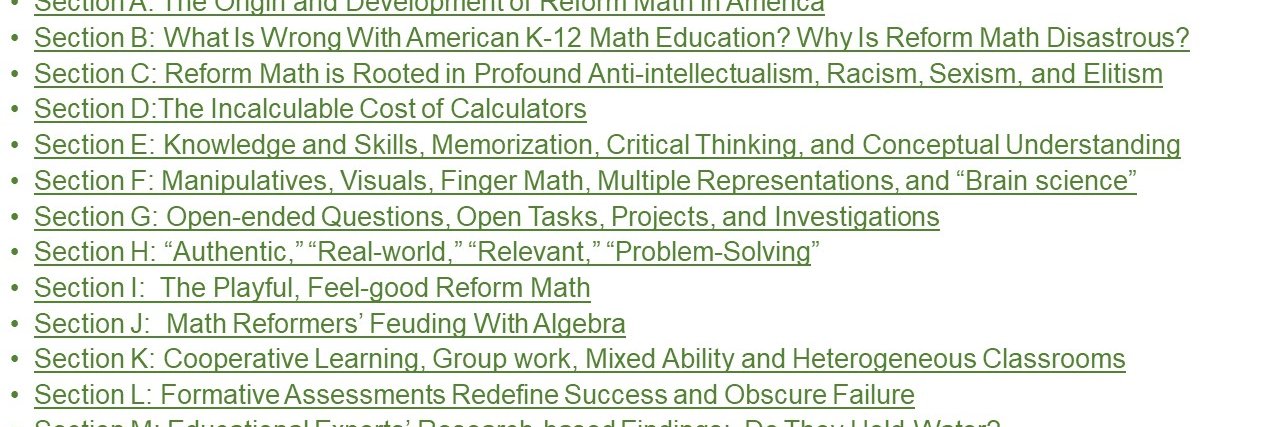
My articles and presentations on how progressive education dogmas have corrupted K-12 math education in the US and beyond:
•Jo Boaler’s Fame, Stanford’s Shame; Students’ Gloom, America’s Doom: https://t.co/qV4sa2JPl2
•Jo Boaler's Reform Math Fallacy: https://t.co/vXKZYRj7TY
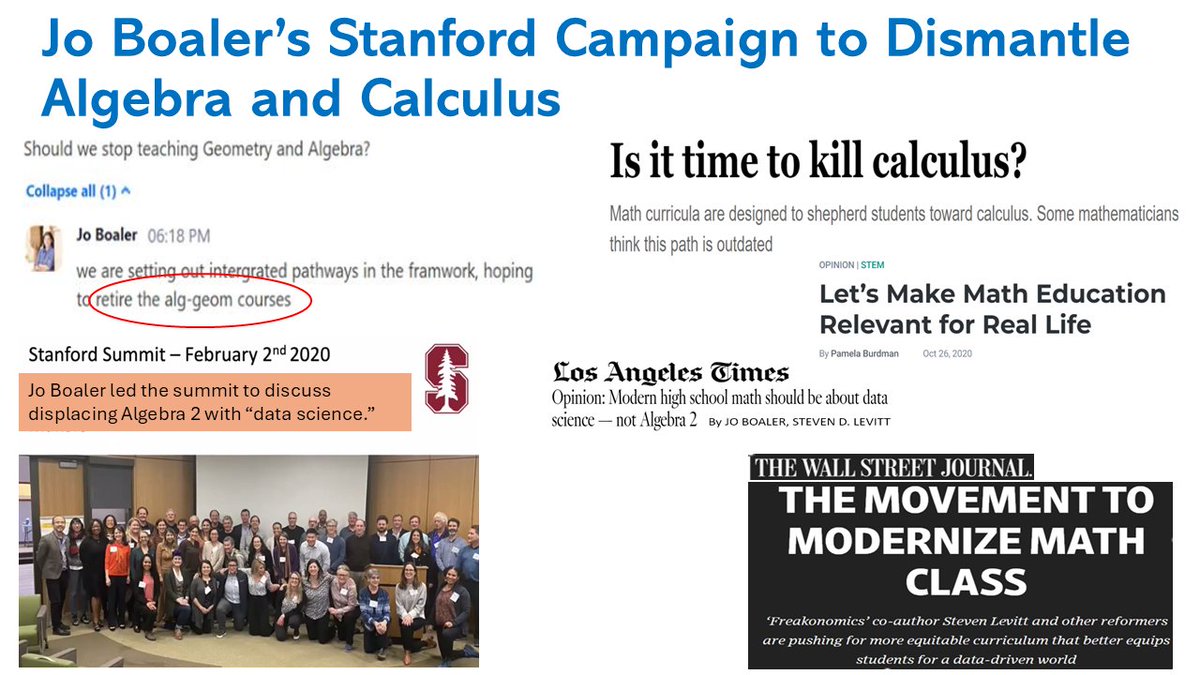
•Stanford Professor Jo Boaler’s Math Revolution and War Against Algebra 2: https://t.co/Ou4esxMwBO
•Why Have American Schools Failed in Closing the Achievement Gap? A Case Study of California’s Palo Alto School District: https://t.co/zUKgmyIdop
•Letters from Mathematicians: https://t.co/WTwkFx3Sh1
Letters from R.James Milgram and Wayne Bishop on the deterioration of K-12 math education.
•是谁夺走了美国人的数学能力? 美国百年数学战争演义 (Who Deprived Americans of Their Math Ability? A Saga of Century-long American Math Wars) https://t.co/PwKd7H8jGq
@rpondiscio@AEIdeas Why are K-12 education’s chronic failures never solved? Because the very people who claim to solve the problems — progressive educators and reformers — are the ones who created them.
New from yours truly for @AEIdeas : How we are led astray by powerful and persistent illusions in teaching.
"The greatest danger in education isn’t bad intentions. It's confidence in ideas that are obvious, intuitive, seductive…and wrong."
https://t.co/EZdGvHz2Re
Knowledge is the foundation for critical thinking.
In this episode, I talk with Robert Peal about why a knowledge-rich curriculum matters and why critical thinking is an outcome of building knowledge, not the starting point.
🔗 Link below
#ChalkandTalk#CriticalThinking #KnowledgeRich #Education
“We are admitting a cohort that cannot read at a college level and are pretending otherwise.”
Another college professor adds to the chorus of concern about student capacity.
In @chronicle:
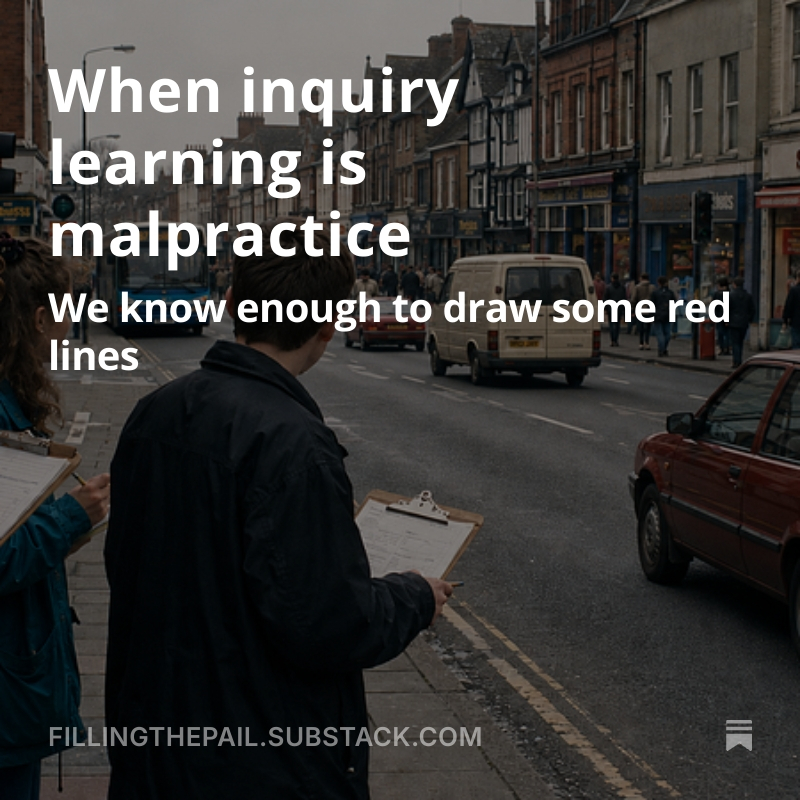
“Six weeks into the term, I assigned my rhetoric and writing students a 20-page article. It was the same length I had assigned for five years and the same length I had read without complaint as an undergraduate a decade ago. Not one student finished it.
When I asked why, a student answered honestly: It was too long, and she kept losing track of what the paper was about. This was not a remedial class: These were students who had cleared the admissions process and written essays good enough to get them here. Yet a routine academic reading assignment had defeated them.
Every generation of professors has complained that their students cannot read. The lament is usually overblown, but data have caught up to anecdote, and what I am seeing in my classroom is no longer a hunch. There is a measurable, generational collapse in sustained reading and writing, and the academy is responding to it with improvisation and exhaustion rather than the structural overhaul it requires.
In February 2024, Adam Kotsko, who teaches in the Shimer Great Books School at North Central College, wrote in Slate that students who once handled 30 pages of reading per class meeting now seem “intimidated by anything over 10 pages and seem to walk away from readings of as little as 20 pages with no real understanding.” Crucially, he added that this is “not a matter of laziness on the part of the students” but of underlying skills they were never given a chance to build.
The Chronicle of Higher Education’s 2024 investigation found the same pattern across institutions as different as the Stevens Institute of Technology and Wellesley College, where the average SAT exceeds 1400. Nicholaus Gutierrez, an assistant professor at Wellesley, told The Chronicle that the baseline for what students consider a reasonable amount of work has dropped so noticeably that he has cut his readings accordingly; a 750-word essay now strikes many students as long. At Stevens, the science and technology studies associate professor Theresa MacPhail described following the mantra of “meet your students where they are” for so long that she has begun to feel “like a cruise director organizing games of shuffleboard.”
Worse, the national data tell the same story in colder language. On the 2011 National Assessment of Educational Progress (NAEP) writing assessment, which is the most recent comprehensive writing benchmark, only 24 percent of 12th graders reached the Proficient level, and just 3 percent reached Advanced; another 21 percent scored below Basic. The reading side of the ledger is worse, and getting worse fast: The 2024 NAEP results released in September 2025 show 12th-grade reading scores at the lowest level recorded since the assessment began in 1992. Thirty-two percent of 12th graders now score below NAEP Basic in reading, meaning that, in the assessment’s own language, they likely “cannot draw general conclusions based on concepts presented explicitly in a text.” And yet more than half of these same seniors reported being accepted to a four-year college. That last sentence is the whole problem in one line: We are admitting a cohort that cannot read at a college level and are pretending otherwise.”
In Chinese schools, artificial intelligence now reviews homework by scanning notebooks, grading assignments automatically, and printing feedback that highlights errors.
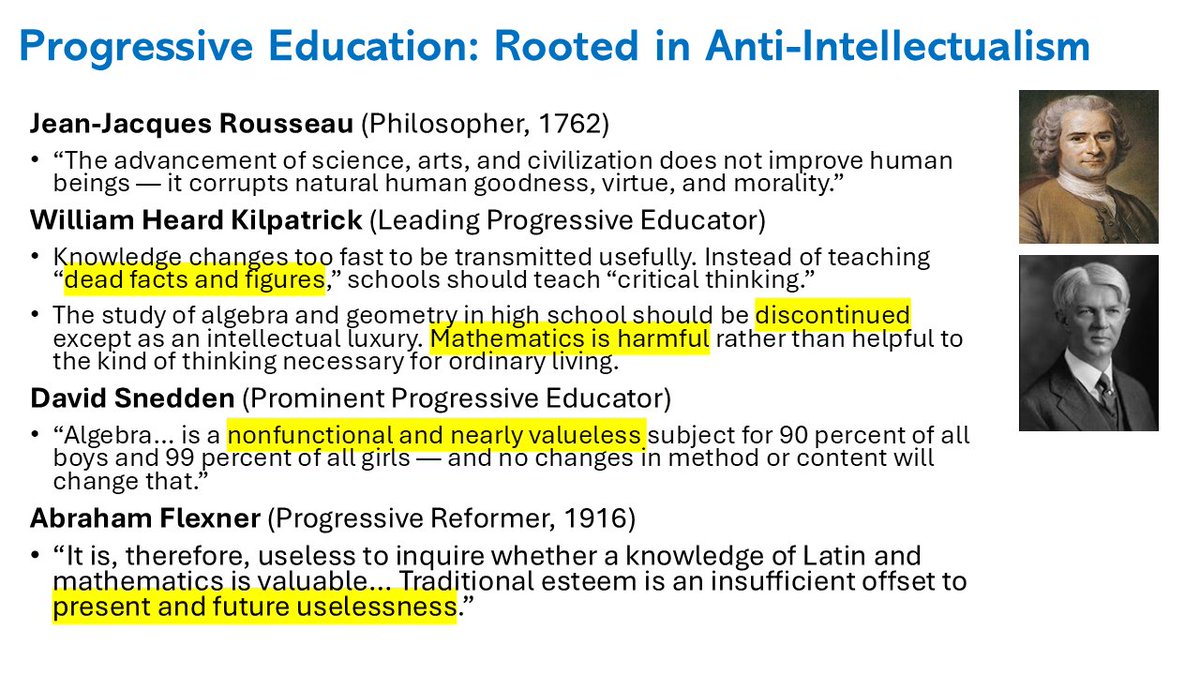
Today, progressive education ideology dominates K-12 systems across much of the world. Meanwhile, the perspectives of essentialists and traditionalists are increasingly dismissed as eccentric or outdated by many teachers, administrators, and the broader public.
We need a coordinated international effort to present the evidence, restore balance, and tell the full story about what works in education.
15/20
Buzzwords change, but the mission never does.
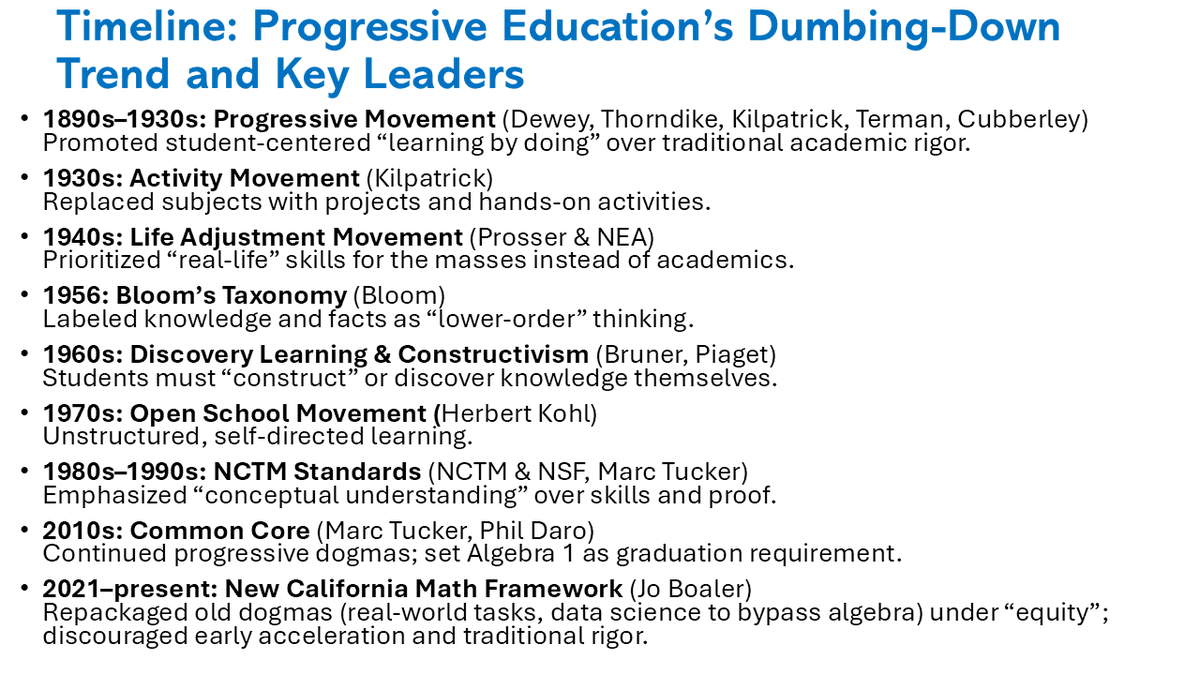
From John Dewey to Marc Tucker, and from William Heard Kilpatrick to Jo Boaler, the playbook is the same: invent new gimmicks, then dilute real mathematical learning for ordinary kids.
Their elitist and racist convictions have never disappeared: most ordinary students “don’t need” advanced math — and disadvantaged kids especially can’t master it.
14/20
This elitist, racist vision became the official DNA of American education.
For over a century, progressive reformers’ mission has never changed: dilute Algebra, Calculus, and advanced math, and train the masses for low-skill jobs and practical living only.
Only the slogans evolve — “life-adjustment,” “relevant,” “real-world,” and now “data science.”
Today tech tycoons pour billions into “modernizing math.” Blind to Reform Math’s evil roots, they claim to advance “equity” — yet they perpetuate soft bigotry of low expectations.
The Great Dumbing Down is still running at full speed.
13/20
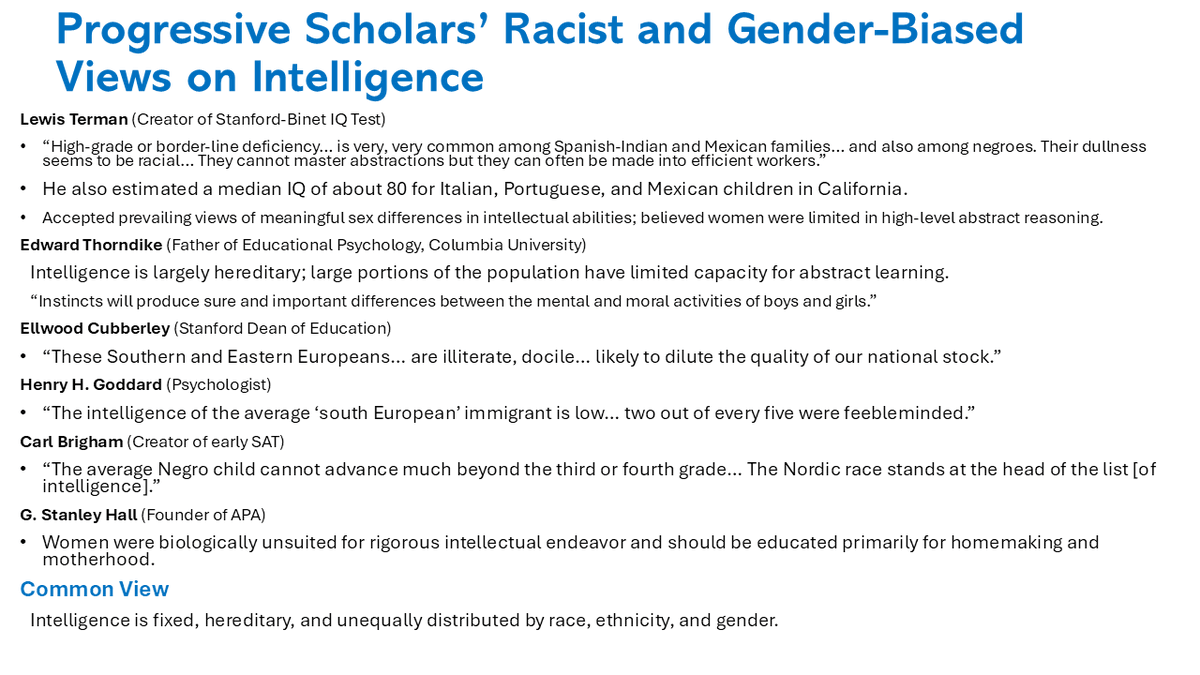
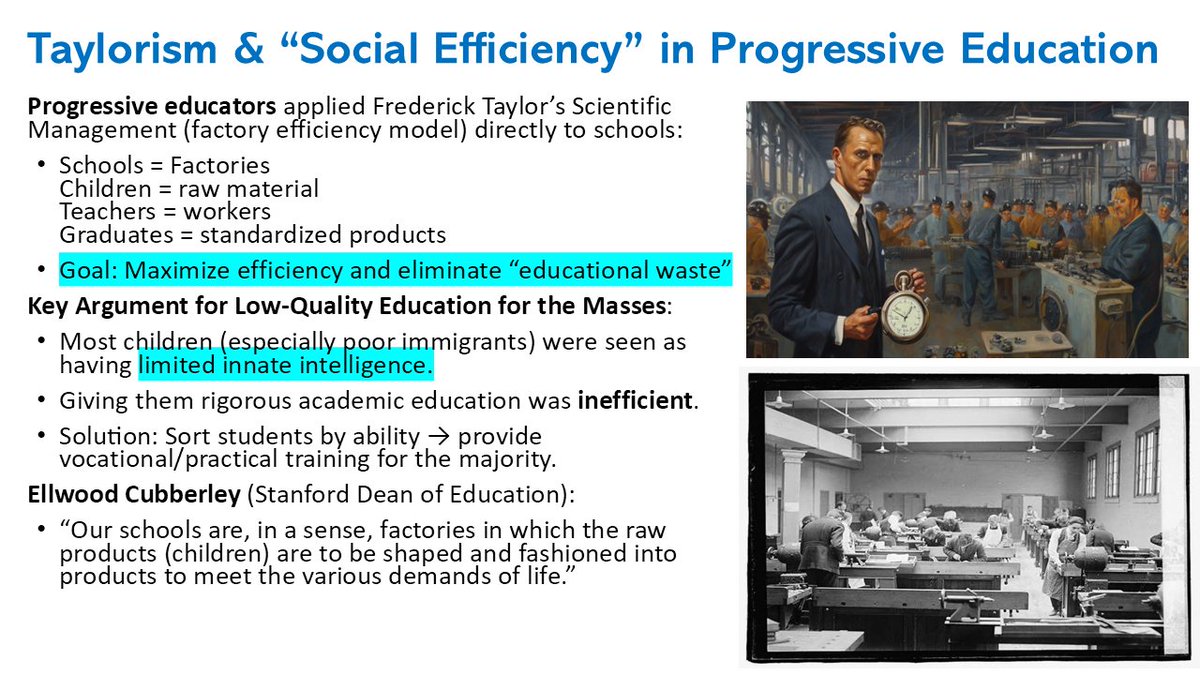
Progressive pioneers were brutally honest.
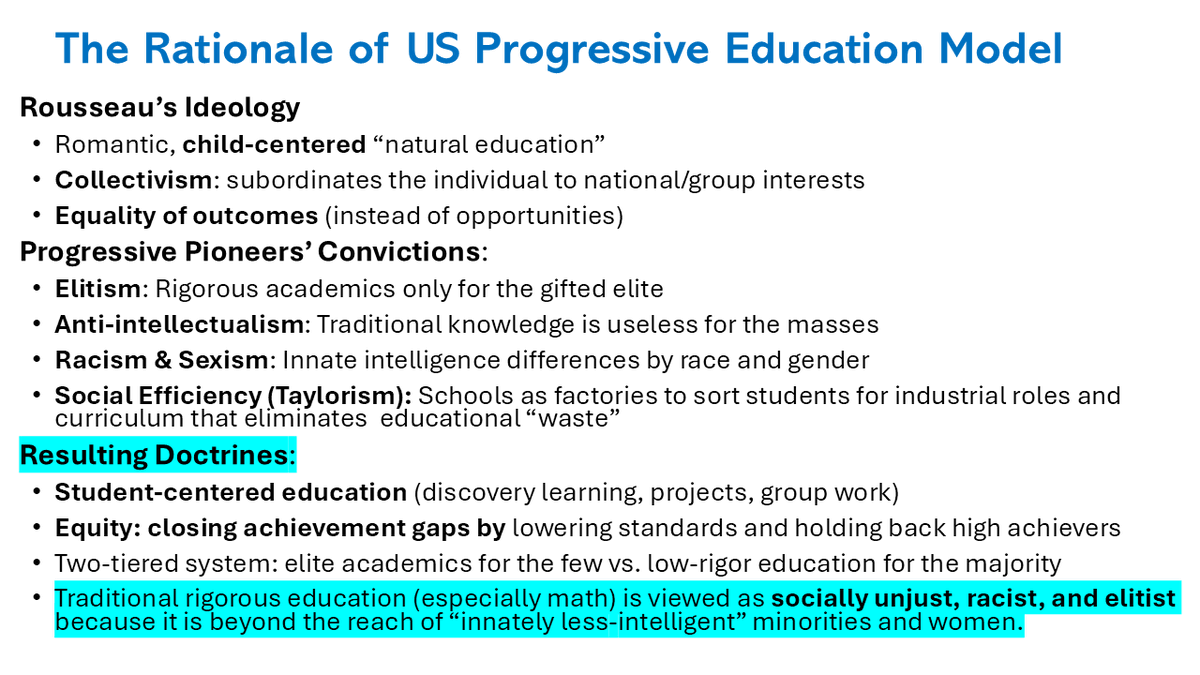
They declared intelligence fixed, hereditary, and unequally distributed by race and gender.
Leaders like Terman, Thorndike, and Hall called Black, Mexican, and immigrant children inherently “dull.”
They built a two-tiered system: real academics for the elite, low-rigor “practical” training for everyone else.
That racist, elitist foundation still shapes today’s progressive education.
12/20
In 1992, Hung-Hsi Wu wrote:
“It enraged me to see a group of people going out of their way to dumb down the curriculum.”
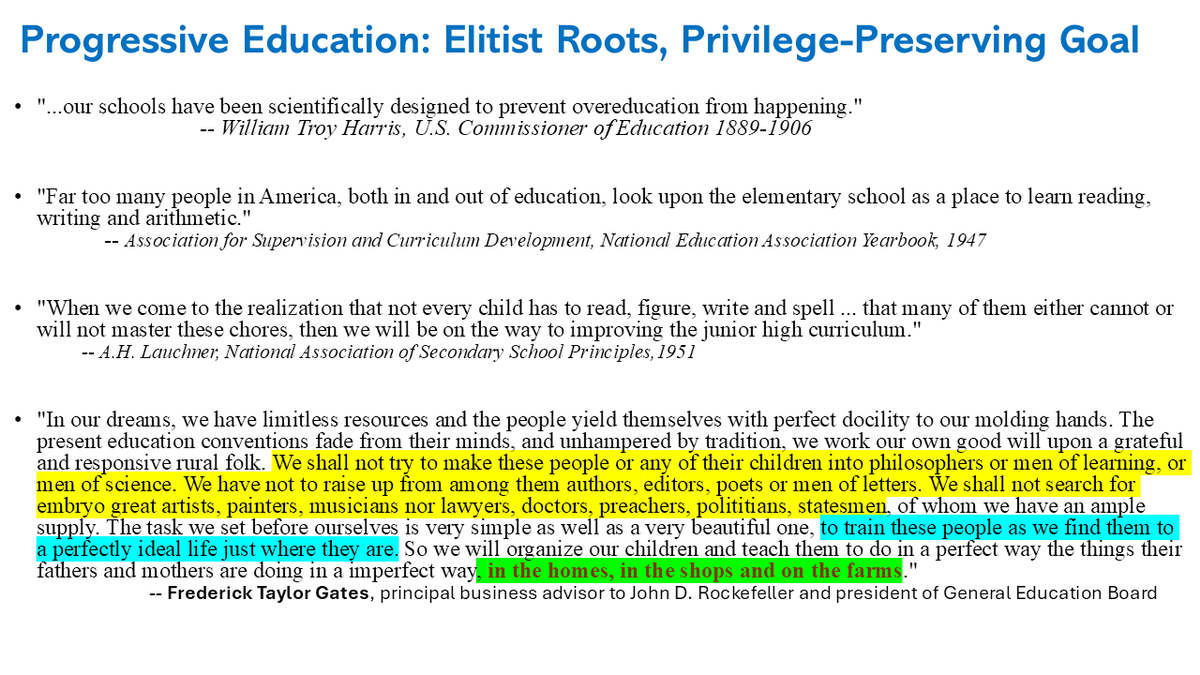
The dumbing down began with the progressive pioneers in the early 20th century.
The movement they led was never an accident.
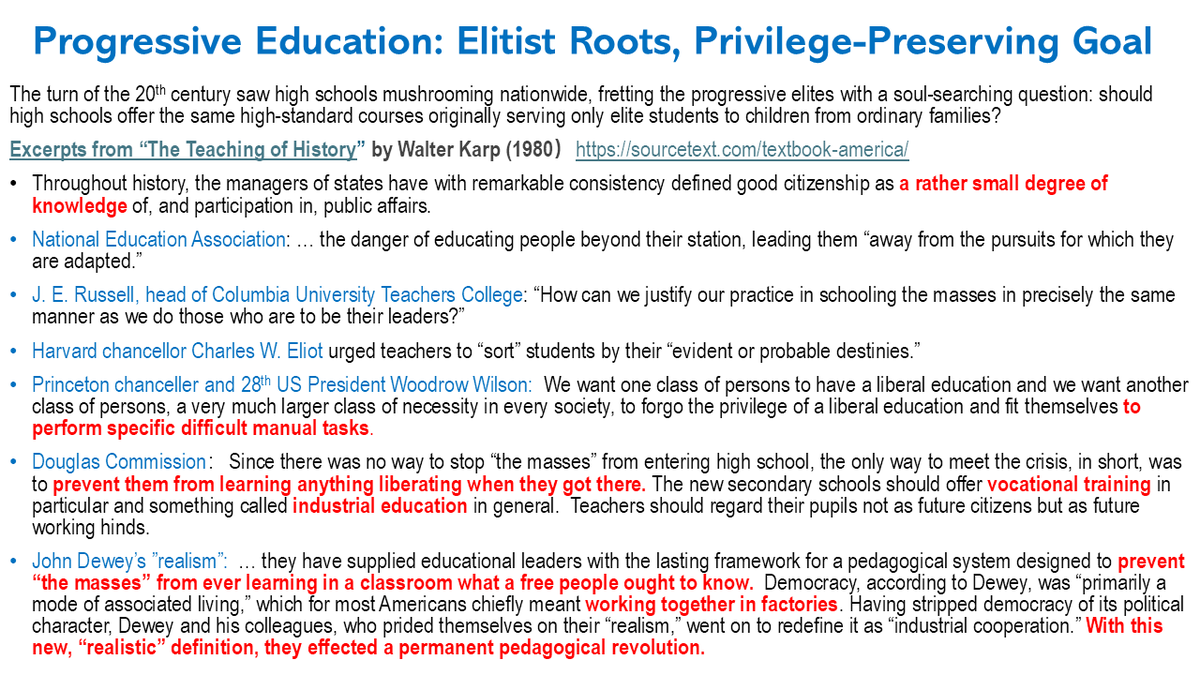
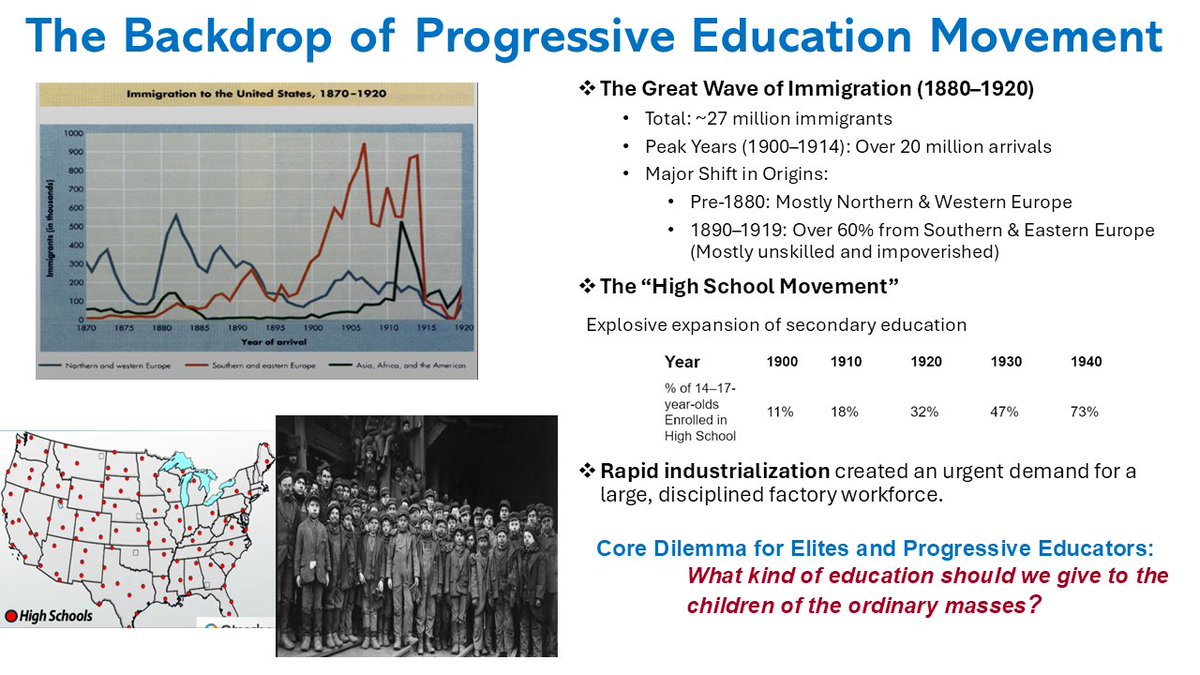
It was deliberately built on elitist roots during the 1880–1920 immigration wave.
Elites faced a dilemma: what education for the “ordinary masses”?
Their answer: Not the rigorous kind we give our own children.
This is a good article and this point is more critical than ever: "But if teachers are not taught explicitly about the connection between knowledge & critical thinking, some may leave with the impression that factual content matters less than it used to."
https://t.co/Dt93QsY7O3
I think the opposite. Basic skills will increase in value because they are foundational to content knowledge in all domains. Basic skills have been declared "dead" many times over the past century--typically by ed progressives--but as the world grew more complex, and tech more able, the premium for knowledge increased.
NEW PODCAST Episode has just dropped. @caiti_wade and I discuss x 2 critiques of cognitive load theory and ability grouping. Available on your favourite podcasting app or in this thread.
🎙️ New episode is live!
I talk with Robert Peal bout what makes West London Free School one of the top performing schools in England.
🎧 Link below to listen
@nettermike The collapse of K-12 mathematics education was inevitable — it was designed into the system itself. Read the full thread to understand how and why.
https://t.co/VFzAYQlXLj
1/20
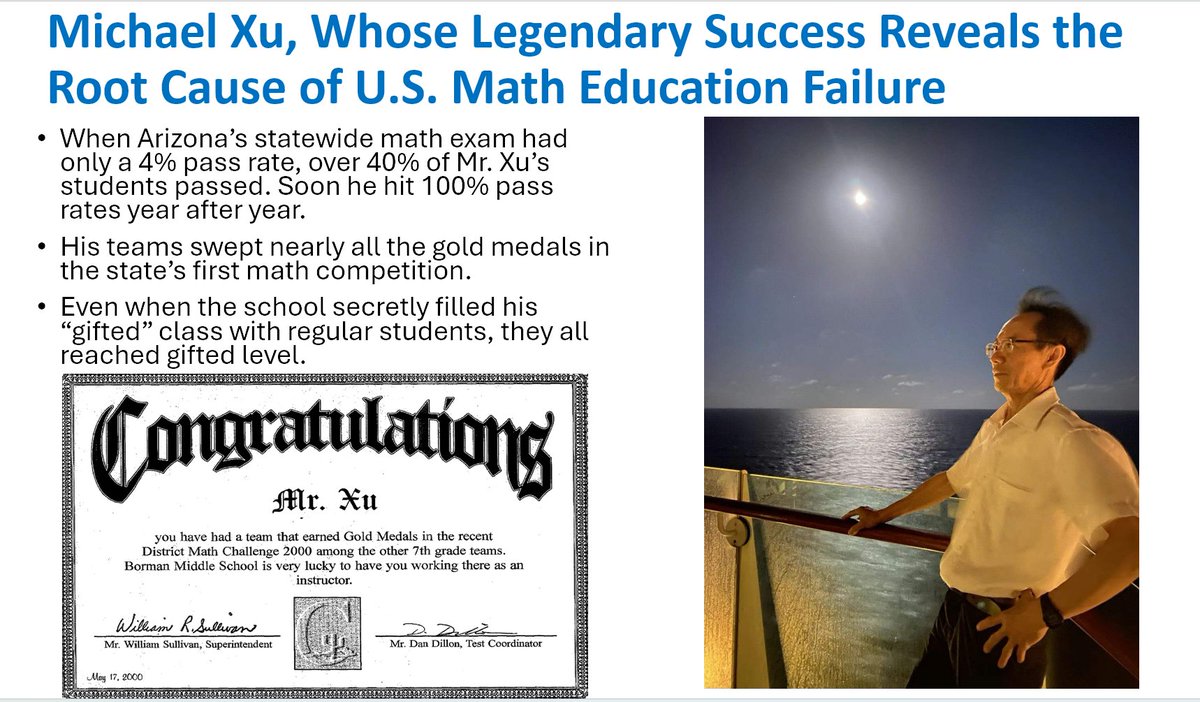
Most people only know Jaime Escalante from Stand and Deliver.
Few know there was a Chinese immigrant teacher who did something just as extraordinary:
For 20 years in the Arizona desert, he took the state’s poorest Indigenous, Latino, and Black middle schoolers — many with broken English and shattered foundations — and turned them into statewide champions.
His name is Michael Xu.
The “Sage from the East.”
A man who survived China’s Cultural Revolution, hard labor in the jungle, lifelong dyslexia, and insomnia… yet became a legendary math teacher.
This thread is the first time his full story is being told.
And it reveals something much bigger than one teacher’s success.