The answer is 4.
Raise 2 to the whole product and each log lifts it by exactly one integer: 3 → 4 → 5 → … → 16.
So 2^P = 16, and P = 4.
The 14 is bait — that is just how many logs there are. № 010
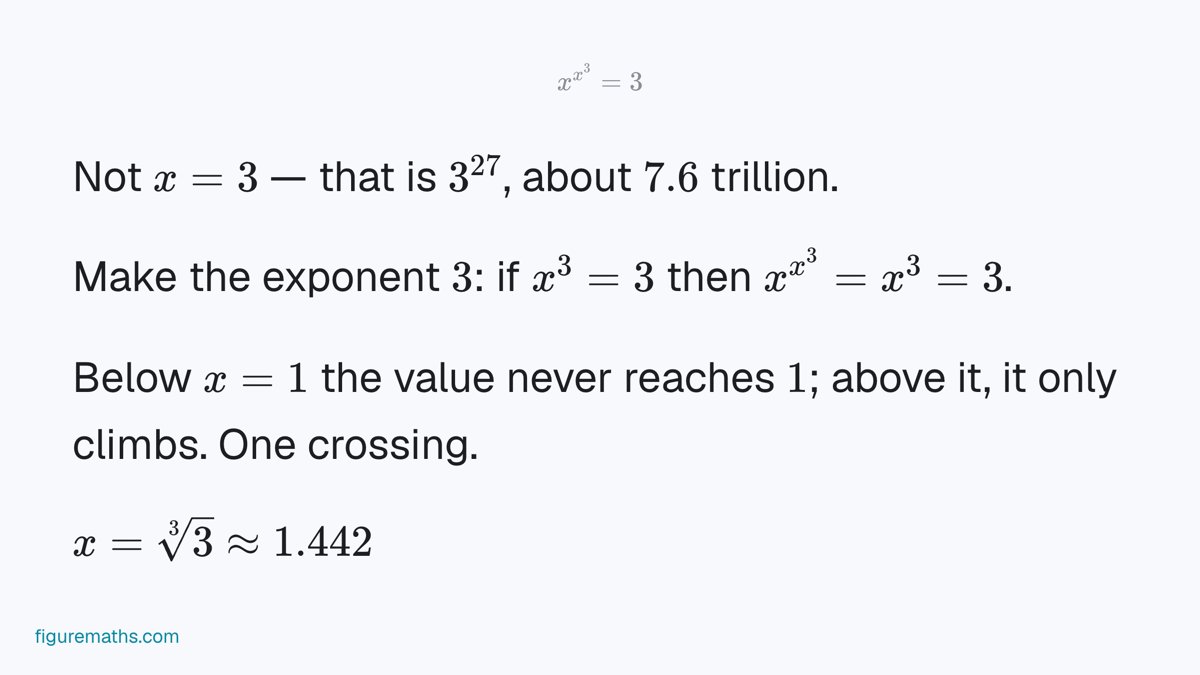
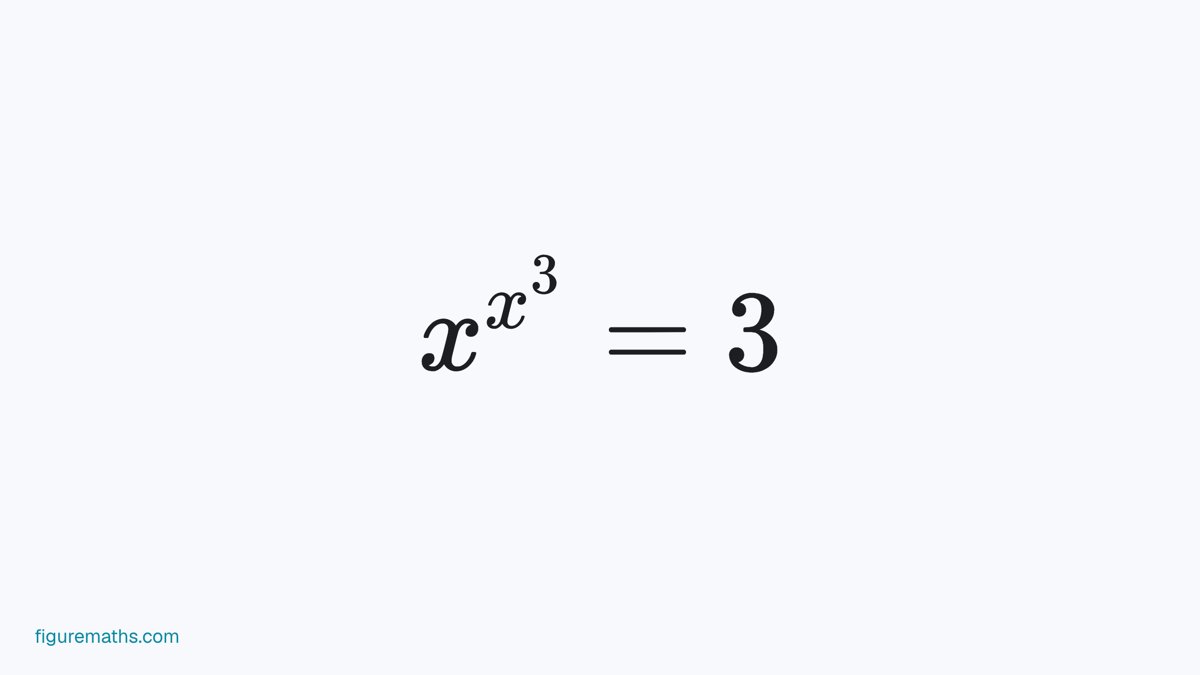
∛3 — about 1.442.
Not 3: that is 3^27, about 7.6 trillion. The trick is the exponent, not the base. If x³ = 3, the whole tower collapses to x³ = 3.
If you said 3, the base got you.
More like this: https://t.co/H2BEnUeTAQ
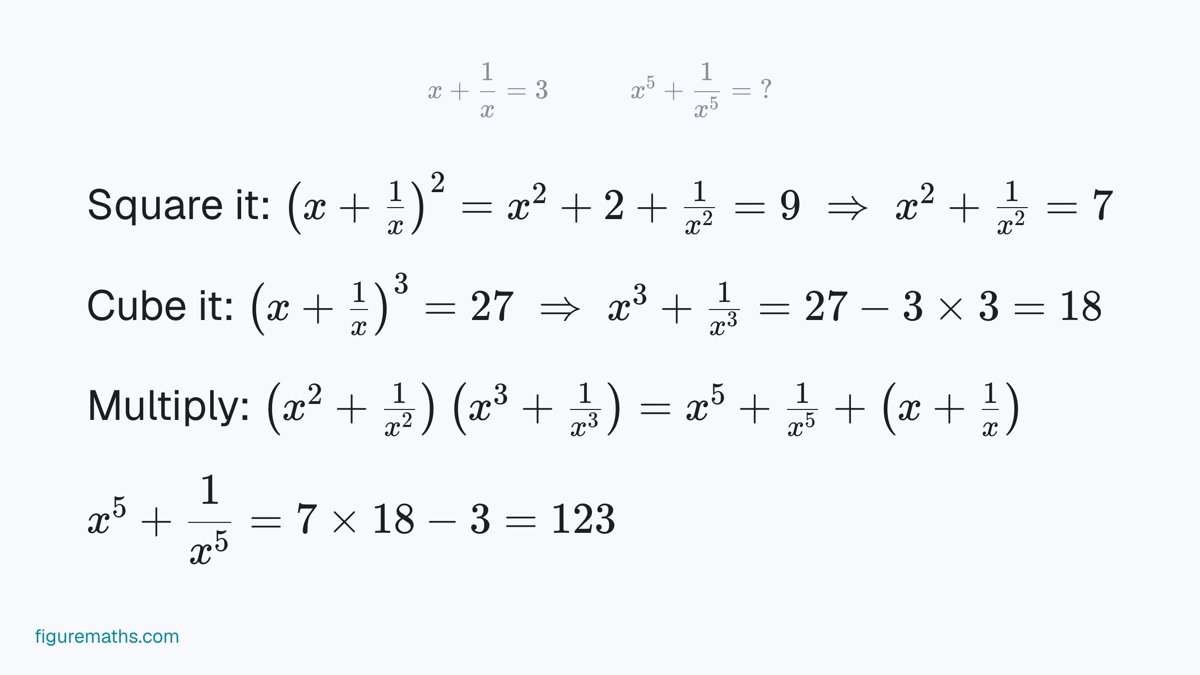
123.
Square: x² + 1/x² = 7. Cube: x³ + 1/x³ = 18. Multiply those and you get x⁵ + 1/x⁵ — plus an unwanted x + 1/x. So 7 × 18 − 3.
If you said 126, the cross terms got you.
More like this: https://t.co/H2BEnUeTAQ
If you have a Year 11 starting this week: the maths year is shorter than it looks. Mocks in November, real papers in May. Roughly 30 teaching weeks between them, minus holidays.
The students who cope best build a small weekly revision habit now, not at Easter.
Three. x = 2, x = 4 — and one more near x = −0.77.
For negative x, 2^x is tiny but still positive, and x² comes back down to meet it: sign change between −1 and 0.
If you said two, you stopped at the easy pair.
More like this: https://t.co/H2BEnUeTAQ
x = 2, 3, 4, 5, 6, 7 — six of them, consecutive.
Base 1: x = 2, 5. Base -1 with an even power: x = 3, 4. Power 0, base non-zero: x = 6, 7.
If you found two, you solved the base and stopped.
More like this: https://t.co/H2BEnUeTAQ
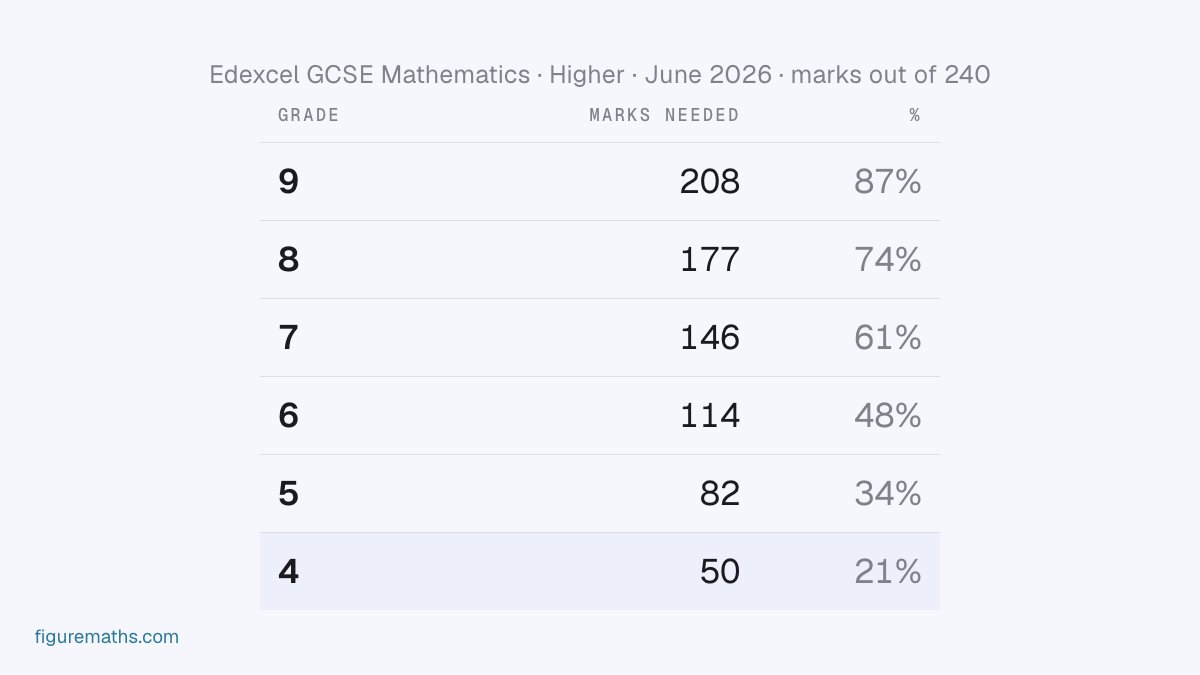
This June, a grade 4 in Edexcel GCSE Maths (Higher tier) needed 50 marks out of 240. That's 21%.
Not because students got worse — the papers are genuinely hard, and boundaries move to match.
Every board's 2026 boundaries: https://t.co/ByQ0hrcdR0
x = 72°.
If you said 90°, you trusted your eyes — nothing in a regular pentagon makes those diagonals perpendicular.
Isosceles triangles: each diagonal makes 36° with the sides. Exterior angle: 36° + 36°.
More like this: https://t.co/H2BEnUeTAQ
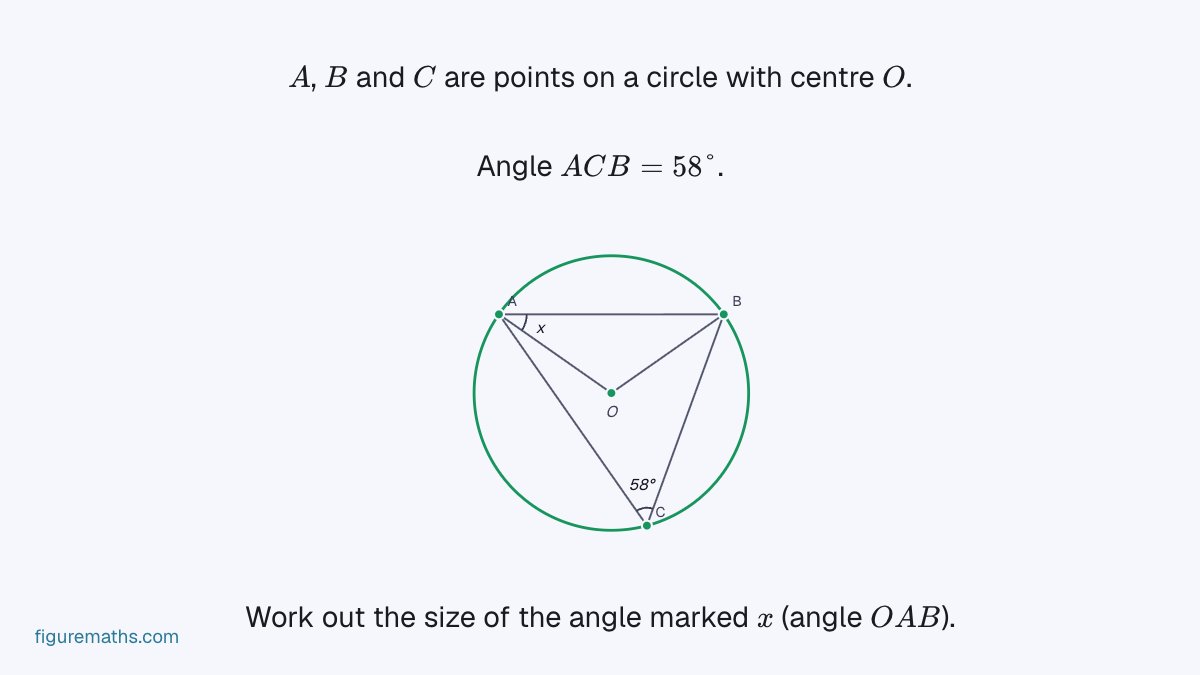
x = 32°.
Angle at the centre is twice the angle at the circumference: AOB = 2 × 58° = 116°. OA and OB are radii, so triangle OAB is isosceles: x = (180° − 116°) ÷ 2 = 32°.
If you said 58°, you assumed OAB = ACB — that's the trap.
More like this: https://t.co/H2BEnUeTAQ
The trap: multiplying by 2x only. The inside derivative is the WHOLE bracket — every term differentiates, so it's ×(2x + 3). Full working below.
More questions like this: https://t.co/H2BEnUeTAQ