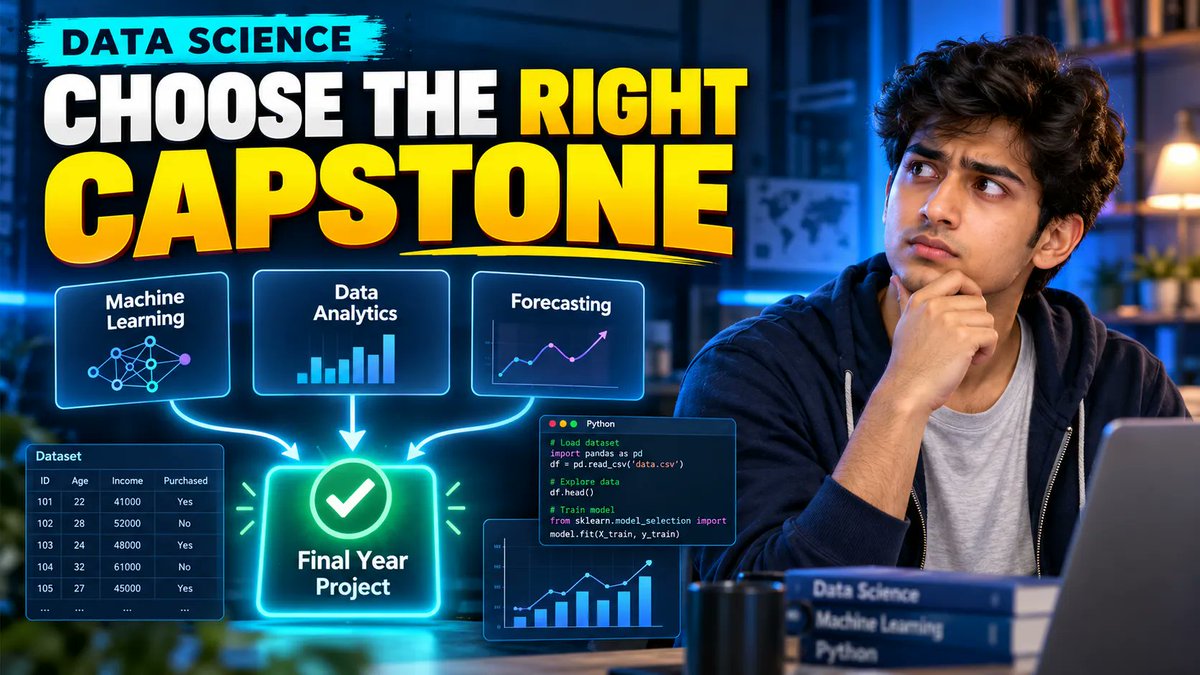
Plan your capstone evaluation before choosing a model.
Our FileMakr guide compares 10 US dataset projects, with scopes and deliverables:
https://t.co/hKdYa8Xa8D
A good CS capstone proves one engineering claim.
Choose the test before adding features.
FileMakr compares 20 project ideas by stack, difficulty, MVP, and evaluation:
https://t.co/S7u4gAifo2
The best project is one you can build, test, document, and explain.
FileMakr compares 20 CS capstone ideas by stack, difficulty, MVP, and evaluation:
https://t.co/S7u4gAifo2
A strong CS capstone isn't the project with the most features.
It's one where you can explain the technical problem, build a working solution, and prove it behaves correctly.
7 ideas to keep in mind when choosing a senior project:
For cybersecurity projects, define the threat model and test only authorized systems.
An offline DDoS classifier is not live network defense.
A secure document vault needs access controls, not just encryption.
A better capstone question is not:
“Which topic sounds most advanced?”
Ask:
“Can I defend the problem, dataset, baseline, metric, validation and deliverable?”
Full 40-point scorecard + 10 examples:
https://t.co/jd6Wo9lZVa
Choosing a data science capstone by starting with the algorithm is backwards.
Start with:
Problem → Dataset → Baseline → Metric → Validation → Deliverable
Then choose the model
Build the smallest complete version first:
Load → Clean → Explore → Model → Evaluate → Present
An end-to-end project you can explain is usually stronger than an ambitious model stuck in an unfinished notebook.
A better capstone question is not:
“Which topic sounds most advanced?”
Ask:
“Can I defend the problem, dataset, baseline, metric, validation and deliverable?”
Full 40-point scorecard + 10 examples:
https://t.co/jd6Wo9lZVa
Build the smallest complete version first:
Load → Clean → Explore → Model → Evaluate → Present
An end-to-end project you can explain is usually stronger than an ambitious model stuck in an unfinished notebook.
Protect your evaluation.
Avoid data leakage.
For time-series projects, don’t randomly mix future observations into training.
Your validation setup should resemble how the model would face genuinely new data.
Don’t default to accuracy.
For imbalanced problems like fraud detection, a model can look “accurate” while missing the cases that matter.
Choose metrics based on the real objective: precision, recall, F1, MAE, RMSE, etc.
Give every project a baseline.
Classification → logistic regression
Regression → linear regression
Forecasting → naive forecast
Recommendations → popularity ranking
Then ask: did the advanced method actually improve the result?