Kids born with Down syndrome used to die young. In 1960, the average one didn't make it to 10.
Today they live to around 60. That means a lot of them will outlive their mom and dad, and somebody has to figure out what they do with the 40 years after high school.
In the US, the answer is usually not much. The one national survey we have of adults with Down syndrome found barely half had any paid job, and only 3% worked full time. The jobs they did get were mostly wiping tables, mopping floors, mowing lawns and filing paperwork.
The café in this video is called Kopi Kamu, in South Jakarta, and it started with kind of a lucky break.
A group of Indonesian parents raising kids with Down syndrome, called POTADS, taught their sons and daughters to make coffee. The plan was to open their own café. It never happened, so they ended up pouring coffee at weekend bazaars instead. At one of those, an eco festival in Jakarta, the owner of Kopi Kamu walked by their booth. By December 2023 he'd hired seven of them.
They started out on two-and-a-half-hour shifts. The manager says they had the energy for four, so he made the shifts longer.
Indonesia has had a law since 2016 saying private companies have to fill 1% of their jobs with disabled workers. The country's own human rights commission says the quota isn't being met because nobody enforces the penalties. This coffee shop didn't wait for anyone to make them.
The longer shifts might matter more than anyone at that café realizes.
People with Down syndrome have an extra copy of chromosome 21. That chromosome carries the gene for the protein that turns into amyloid, the sticky stuff behind Alzheimer's. So their brains start building up Alzheimer's plaques in their 30s, decades before most people.
Researchers at the University of Wisconsin followed 87 adults with Down syndrome for about a year and a half. The ones whose jobs had them dealing with people and handling things all day lost less memory and showed fewer early signs of dementia.
It's a small study. Still, it lines up with what scientists have seen in everyone else for years, where people whose jobs keep their brains busy tend to hold onto their memory longer. Taking someone's order and remembering which table it goes to is real exercise for a brain that's racing a clock most of us never think about.
A reporter who visited in 2024 met one of the baristas, a guy named Arik. He worked three mornings a week, and his parents drove him in and picked him up every single shift.
Someday his parents won't be able to make that drive, and a job like this is a big part of how Arik keeps going to work after they're gone.
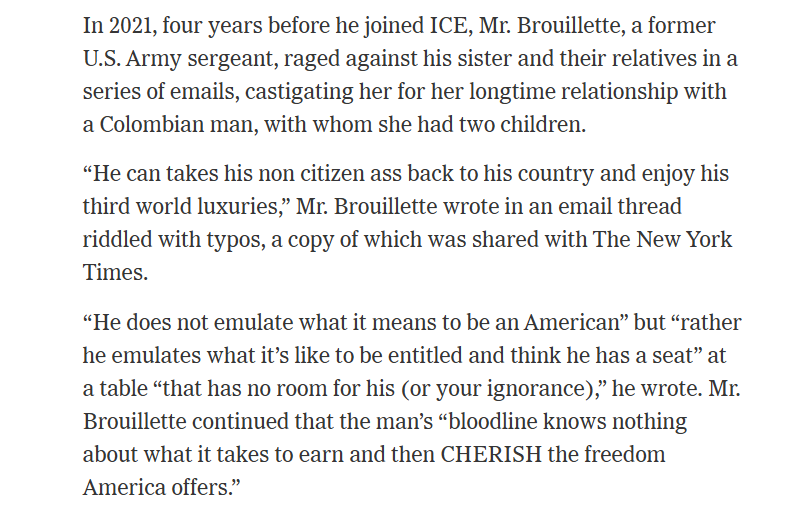
Unsurprisingly, the deeply unstable ICE officer who shot and killed Johan Sebastián Durán in July also made racist comments about a Colombian man (a PhD candidate at the time) dating his sister in 2021.
It is an ongoing scandal that ICE hired this man and put a gun in his hands.
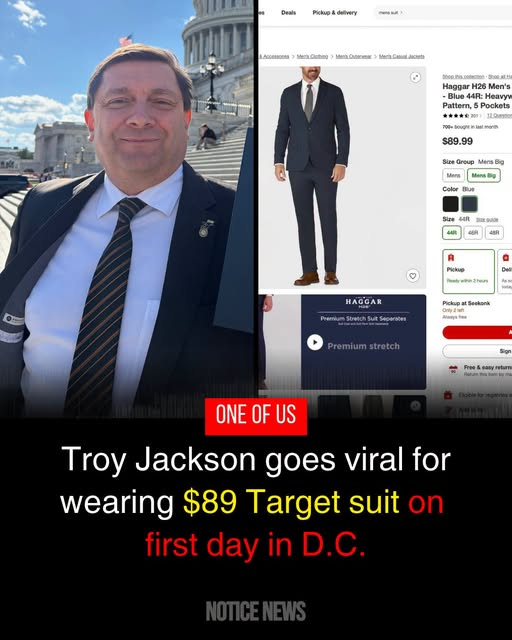
Maine’s new senator showed up to Washington in an $89.99 suit off the rack from Target — and it tells you everything about who just got elected, and the populist story behind this election.
Troy Jackson posted a selfie on the Capitol steps this week holding his U.S. Senate folder. People zoomed in on his sleeve, spotted the Haggar label, and tracked it down to Target.
It fits. Jackson is a fifth-generation logger from Allagash, Maine. His mom was 16 when he was born. He spent years working 80-hour weeks in the woods, and he got into politics fighting for loggers’ pay.
He wasn’t even supposed to be on the ballot. He stepped in with about 100 days to go and beat Susan Collins, who had held that seat since 1997.
The Senate is a millionaires’ club.
People whose last job before politics was blue-collar have never held more than about 2% of the seats in Congress. Most of the people writing laws about your wages have never had to live on one.
Jackson is a longtime Bernie Sanders ally. He ran Bernie’s Maine operation in 2016, and Bernie campaigned with him across the state this fall. He’s going to Washington to fight for Medicare for All, protect and expand Social Security, back unions, and make billionaires pay their fair share.
A senator who knows what a paycheck actually buys. In a $90 suit.
I have taken about 900 thousand photos of Texas. There are few that stick with me more than this one, which I post here every Veteran's day. This is a ceramic photograph that I found on a grave marker in a rural black cemetery near Giddings. The cemetery is fairly remote, such that there's no way I could navigate back to it without the help of a map.
The inscription on the tombstone reads:
Pvt. Clinton Francis
Born March 29, 1893
Died Nov. 24, 1918
A Soldier's Death
I initially thought that Private Francis must have died from wounds he received during World War I, but some of y'all tracked him down via genealogy records and his death certificate reads that he died of tuberculosis. My guess is that perhaps that is actually incorrect and that he died of the Spanish Flu that was raging that year.
But look at him looking back at us though the generations. See how handsome he is in his uniform and his gloves and his boots.
I can't say why this photo sticks with me. Anybody who knew Private Francis is long gone. He is now just a forgotten man in a lonely cemetery, dust blowing around the corner, smoke slipping through a keyhole, dust illuminated by sunlight in an old room.
But I have not forgotten you, Private Francis! Every Veteran's day, I remember. And I raise my glass to you and to the uncountable others and offer only the hope that we not let the memories of your sacrifices be forgotten.
A soldier's death, indeed.
🚨 IMPORTANTE
Exclusiva de Reuters muestra el verdadero móvil de la operación militar que llevó a la captura de Maduro
La investigación reveló que una semana antes de la operación militar del 3 de enero, el vicepresidente JD Vance abordó la futura venta del crudo venezolano con un operador de la firma Vitol y megadonante de su campaña, allanando el camino para que Vitol y Trafigura recibieran sin licitación el monopolio de comercialización petrolera que ya les ha generado cientos de millones de dólares.
Registros de vuelo ubican el avión oficial de JD Vance y el jet privado de John Addison (operador de Vitol) juntos el 27 de diciembre en Bozeman, Montana, rumbo al exclusivo Yellowstone Club.
Según una fuente enterada del encuentro, Vance preguntó qué tan rápido podrían vender el crudo venezolano si EEUE tomaba el control del suministro.
Aunque Addison negociaba gasolina en EEUU y carecía de experiencia técnica en contratos internacionales de crudo, había donado 300.000 dólares a Vance en 2022 y 7 millones de dólares a comités de Trump en 2024 (el mismo año en que Vitol pagó 50 millones en California por un caso de manipulación de precios donde Addison fue señalado).
Recomendado por Vance, Addison recibió el 5 de enero (dos días después de la operación) la llamada del secretario de Energía, Chris Wright.
La Casa Blanca omitió la licitación pública y el 9 de enero Vitol y Trafigura ya tenían las licencias.
Con más de 200 millones de barriles exportados en lo que va de 2026, expertos estiman que los operadores ganan entre 3 y 3,50 dólares por barril (un margen de 3,5 % a 4 %, superior al 1 %–3 % habitual de Vitol). Ambas firmas mantienen en secreto sus contratos con PDVSA, y Vitol confirmó tener además relación comercial con NABEP, la petrolera de Alejandro Betancourt
Este reporte se suma a la filtración del informe de KPMG publicada ayer por The New York Times, según la cual Vitol y Trafigura concentraron el 61 % de los 12.260 millones de dólares ingresados a la Cuenta de Custodia de Venezuela antes de que Washington transfiriera casi la totalidad de esos fondos de vuelta al Banco Central de Venezuela
Es decir:
Una semana antes del ataque militar, el gobierno de Trump ya estaba coordinando en un club privado de esquí cómo repartir la comercialización del petróleo venezolano a sus megadonantes de campaña sin licitación pública.
https://t.co/U3MFGkmOn9
🔥Talarico SHUT DOWN Fox host with 3 sentences:
“We don’t accept cheating in our politics.
We don’t accept cheating in our relationships.
We shouldn’t accept cheating in our elections.”
A few years ago, I had a group of students from Arizona visiting me in my Senate office, and one of them asked me which of my military medals meant the most to me. It’s a funny question to get from a kid. I joked that one of my daughters once gave me a medal for being a good dad, and that one meant a lot to me. And then I went on to tell them that military service isn’t usually about the medals, it’s about accomplishing a mission, together. In the military, you have a job to do. You train for it, and you count on the people around you to do their jobs too.
That clicked for me on my first combat mission. I was flying an A-6E Intruder with my bombardier navigator Paul Fujimura. One of my primary jobs as the pilot was to fly the plane and get us safely over the target. The bombardier navigator’s job was to navigate us to the target, identify it and track it with the weapons system.
We started taking anti-aircraft fire and I saw a surface-to-air missile coming right at us. I told Paul about the missile, and his response was simple: “Roger, I’m tracking the target.” I told him again and again, and got the same response each time. That’s when I realized that to accomplish the mission, Paul had to do his job and I had to do mine. I rolled the airplane upside down, added full power, and pulled the stick into my lap. The missile went over us and exploded. I got the airplane upright, checked that the engines and hydraulics were still working, and turned back toward the target. We dropped our bombs and accomplished the mission. The guys who maintained our jet did their job too, so it performed as we needed it to. And so did the Landing Signal Officers who helped us land safely when we got back.
I flew 39 combat missions, but I never flew any of them alone. And supporting all of us were families back home making sacrifices of their own. When I think about Veterans Day, I think about those people I served with, the men and women serving today, and the generations of patriotic Americans who have signed up to risk their lives for our country. In return, our country makes a promise that after their service, they will receive the care and support they earned.
As a combat veteran, I take that promise personally. I helped pass the PACT Act to expand VA health coverage for servicemembers who were exposed to toxins during their service. I worked with my Republican colleagues to pass the ACES Act to study cancer rates among military aviators and aircrew. And I’ve successfully passed a bill to help build a veterans center in Gila County, Arizona.
When I was 22 years old, I swore an oath to protect and defend the Constitution. That oath stayed with me through 39 combat missions and four trips to space. This Veterans Day and every day, I’m proud to stand alongside the millions of Americans who have answered the call to serve. Like I told those students, when you talk with a veteran, know that they didn’t do it for the medals or the recognition. They did it for their country and their fellow service members.
And now serving as a U.S. Senator, swearing the same oath to the Constitution again, I remember the same lesson from that first combat mission. We all have a job to do, our piece to accomplish the larger mission for our neighbor and our country.
Sorry mendacious climate deniers. The #HockeyStick is longer and sharper now, as demonstrated by an independent group of ~80 paleoclimate scientists around the world: https://t.co/XQHw5QUpvD
Zelenskyy: At the Abu Dhabi talks, the sides discussed the humanitarian track. That includes a prisoner of war exchange of 1,000 for 1,000, maybe 1,200.
That would be very positive. I see no reason for Russia to refuse, but anything can happen. 2X
Zelenskyy: Our proposal is to swap all Ukrainian prisoners of war for all Russian ones.
There are 5,000-plus POWs in Russia and in Ukraine. What is the problem with exchanging them all, so they stop living in those hard conditions? I can't see one. 1/
If the administration’s rural healthcare investment is such a success, why shouldn’t a reporter ask whether it offsets the losses created by the same law?
Gray Media’s Molly Martinez asked Dr. Mehmet Oz that question. He accused her of repeating “talking points” that were “deliberately duplicitous.”
The exchange was real. But the viral meme describing it needs corrections—and the criticism is stronger when we get the details right.
Here is the funding picture:
• The 2025 reconciliation law created a $50 BILLION Rural Health Transformation Program, allocated over five fiscal years, 2026–2030.
• KFF estimated that the law would reduce federal Medicaid spending in rural areas by $137 BILLION over TEN years, compared with spending expected without the legislation.
• KFF therefore estimated that the rural Medicaid reductions would exceed the entire new fund by approximately $87 billion.
Those figures describe different time periods and different funding mechanisms. They are not interchangeable annual budgets. Grants supporting rural healthcare do not automatically replace Medicaid coverage or the revenue providers receive from treating insured patients.
The $137 billion is also a projection—not money already removed. It concerns rural Medicaid spending broadly, not exclusively payments to rural hospitals. Congress passed the legislation and Trump signed it; Oz did not personally enact those cuts.
One more correction: Martinez did NOT expose a contradiction using “his own administration” as her source. She cited the Center for American Progress and the Congressional Budget Office. CBO serves Congress, independently of the executive branch. The specific $137 billion rural estimate comes from KFF.
These distinctions matter. They also leave the central question standing:
How will a temporary $50 billion grant program compensate for a larger projected reduction in Medicaid spending serving rural communities?
Oz can challenge the estimate’s assumptions, explain where he believes it misrepresents the effects, or show evidence that the grants will deliver better outcomes.
Calling the question duplicitous does none of those things.
Thank you, Molly Martinez, for pressing for an answer.
References:
Gray Media’s report https://t.co/Obr6JpQA1k
KFF’s rural Medicaid analysis https://t.co/z9y2dgCKzG
CMS program details https://t.co/cbxpDMF35D
Reported exchange and Martinez’s named sources https://t.co/JoBm5JFTuK
What CBO is https://t.co/BFW02GvCVZ
@JohnKolb2 Yes, in addition to our regular forms of communication with farm workers we are working every system we have access to, from social media to texting to running radio PSAs in the affected areas.
Protecting dairy workers protects everyone.
As a reminder, consumers are not at any reasonable risk from consuming pasteurized milk. The front line of this risk, the human firewall, are the workers in the dairies (and the workers in the plants who process the raw fluid milk).
Farm workers need to be compensated for the costs of this workplace-caused infection. Zoonotic infections like avian flu are compensable. That includes missed work, medical costs and death benefits to the families of workers killed by this infection.
These workers need to be given real information and useable PPE. They need PAID sick time to need to be tested and treated.
Flu shot clinics for dairy workers and their families would provide some protection and prevent commingled infections of seasonal and novel influenza A.
UFW staff are trying to support sick workers, but there are many barriers. Workers with milder symptoms are reluctant to be tested or miss work because sick cattle still need care.
Workers are very afraid of ICE-related retaliation if they don’t follow employers instructions.