Hard to tell whether the suboptimal nature of this MOI is a product of shoddy lawyering, or lack of lawyer counsel, or disproportionate leverage where Alberts is who UM wanted and they wanted him locked in, period. But only do this purposefully and with intention, not by omission
This is a clear lesson to any buyer or seller in an M&A deal -- don't sign LOIs without your (presumably experienced in M&A) lawyer reviewing them carefully. You take substantial risks of missing something otherwise.
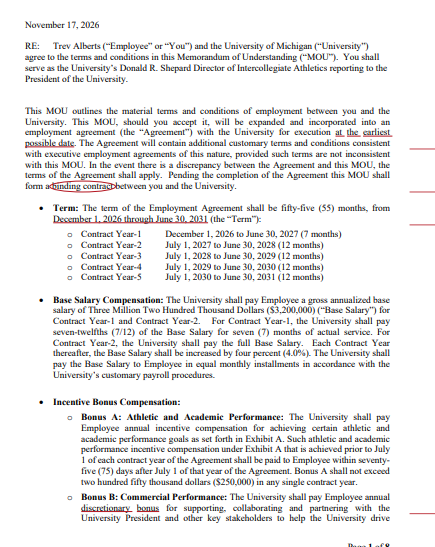
I went through all 8 pages of the Michigan/Trev Alberts MOU. The full annotation is below.
In short, it's not just bad. It's terrible. Someone should be fired level of bad...
> They specified the private-plane hours and country-club benefits. They left “Cause,” “Good Reason,” and “Disability” for a future agreement.
> Page 1 expressly says the MOU is already binding.
> There is no express background-check contingency in these eight pages. Michigan’s own HR guidance says that condition should be stated explicitly in a contingent offer.
> The problems continue: a bonus worth up to $5 million depends on undefined athletics “resources.” Academic-bonus thresholds overlap. The $500,000 first-year guarantee is not clearly reconciled with the termination provisions.
> If Scenario A applies to the cancellation, its full-term salary and deferred-compensation formula comes to roughly $16.7 million before mitigation. The separate $4 million prior-employer buyout is another promise.
> The final liability requires more than reading one document. But these drafting gaps are substantial.
If Michigan signed this before finishing its vetting and assumed it could simply walk away without paying, somebody responsible for approving that decision should be fired!
Making a binding commitment of this size while leaving the critical exit terms unfinished is atrocious risk management.
Letting him walk away from his job with massive contingent liability before hammering out the full details and completing a background check was criminal level negligence!!
One angle to defend against paying out is the "pending further agremeent" language, including how cause/good reason are to be defined. Is it a great argument? Not sure it is. Is it something? Yes.
Eric's mostly right, but UM is not without at least a few arguments to muddy the water. No doubt I'd rather be in Trev Albert's position than UM's, this is pretty bad to have agreed to without the usual contingencies about definitive agreements and background checks etc. 1/2
I went through all 8 pages of the Michigan/Trev Alberts MOU. The full annotation is below.
In short, it's not just bad. It's terrible. Someone should be fired level of bad...
> They specified the private-plane hours and country-club benefits. They left “Cause,” “Good Reason,” and “Disability” for a future agreement.
> Page 1 expressly says the MOU is already binding.
> There is no express background-check contingency in these eight pages. Michigan’s own HR guidance says that condition should be stated explicitly in a contingent offer.
> The problems continue: a bonus worth up to $5 million depends on undefined athletics “resources.” Academic-bonus thresholds overlap. The $500,000 first-year guarantee is not clearly reconciled with the termination provisions.
> If Scenario A applies to the cancellation, its full-term salary and deferred-compensation formula comes to roughly $16.7 million before mitigation. The separate $4 million prior-employer buyout is another promise.
> The final liability requires more than reading one document. But these drafting gaps are substantial.
If Michigan signed this before finishing its vetting and assumed it could simply walk away without paying, somebody responsible for approving that decision should be fired!
Making a binding commitment of this size while leaving the critical exit terms unfinished is atrocious risk management.
Letting him walk away from his job with massive contingent liability before hammering out the full details and completing a background check was criminal level negligence!!
Donald J. Trump
@realDonaldTrump
The NVIDIA Board of Directors has made the correct and proper decision to return Jensen Huang to the position of CEO. The Country needs Jensen’s leadership at NVIDIA in order to ensure the Success and Prosperity of not only the Company, but the American Economy. The United States Government has no reason to believe that Jensen’s return to NVIDIA poses any risk to National Security. The Attorney General of the United States has confirmed that the U.S. Government does not possess evidence that he has engaged in any unlawful conduct. On a personal note, I have gotten to know Jensen, and he is a Great Patriot and National Treasure. Separately, NVIDIA should continue its thorough internal investigation of the Company’s compliance with U.S. export controls in order to ensure that it is fulfilling its legal obligations and Patriotic Duty to protect U.S. National Security. Congratulations to Jensen, the NVIDIA Board, to the People of the United States — and, indeed, the World! Thank you for your attention to this matter. President DONALD J. TRUMP
https://t.co/EJbGXfz1A4
@AdviserCounsel And he did an intentionally slapdash job interviewing Ghislane Maxwell, likely promising her some kind of pardn or leniency in exchange for shutting her mouth (and/or threatening her).
I think it's worth being candid about what happened here. The US government pressured the board of a private company to reinstate a CEO who had compromised US national security and broken serious internal HR policies because they liked what he did to the share price
Chain restaurants put a lot of America's supper clubs out of business in the 1950s and '60s, but the family-run dinner establishments continue to thrive in Wisconsin, built on Midwestern hospitality and friendliness. Correspondent @MoRocca reports.