$59,000 sedan and a fully reusable rocket: @elonmusk pitched both in May 2008.
Ten months later, Tesla priced the Model S at $57,400.
The rocket: 18 years on, nobody has flown one. Not even SpaceX.
Your QQQ holds it anyway, at $2.12 trillion. Flight 15 may try the first ship catch.
Fox Business, May 16 2008 · SPCX close, Oct 9
One 2008 promise came in under budget. You're long the other one.
To buy stuff, you can just take a picture of your credit card, drop it in the chat and Grok @Bot will scour the Internet for the best deal on the item you want and order it
Rules: never open with praise. Get the cheap router’s verdict first. If risk is high, the first word is No. Every number comes with source and date. Always end with the strongest counterargument. No agent acts without my explicit yes. If 3+ Munger tendencies fire at once — stop, human review.
Gate (all five must clear):
Source and date of the number
Strongest argument against
What did you assume about me that I didn’t say
Who is liable if this is wrong, and is it even binding
What can the agent do without my explicit yes
my result, not typical, not advice
I GAVE MY GROK BOT $67 AND ONE RULE: ONLY SHORT WHEN THE LONGS ARE FOOTING THE BILL
$67 → $7,426. 18 hours. The worst single loss of the entire run was $31.
Shorting a waterfall looks simple until the snapback. Price slides, the crowd piles into shorts, one squeeze wick and everyone gets liquidated on the way back up.
Grok Bot built itself a perps terminal, and it doesn’t sit around waiting for green. It trades both directions, scans the top of the futures board and opens a short the moment a market starts to roll over. Before it placed a single order, it replayed more than 13,000 historical moves, so it already knows which dump is real and which one is a trap built to squeeze shorts.
-Shorts only when funding is positive, so it gets paid to hold
-Puts 39–56% of the balance into a position, never more
-Skips any pair below its depth threshold, so it doesn’t eat slippage on the way out
-Cuts a loser before it has room to grow
That first rule is the one I keep coming back to. When funding is positive, longs pay shorts every 8 hours, 0.0134% on this run. Tiny number. But it means the bot isn’t just betting on the drop, it’s getting paid while it waits for it.
176 trades, 149 green, 84.7% WIN RATE. The 27 red ones cost $257 combined.
All five biggest closes were shorts, $4,015 between them. SOL at 18x carried the most, $1,742, with LINK at 13x right behind on $1,289. DOGE at 7x barely showed up, $96.
The other $3,116 came from 171 small closes in between, wins of $5 to $61 with every loss already taken out. Nothing flashy, just the bot grabbing a small win, stepping out and doing it again. That’s 41% of the profit.
18x on SOL and 13x on LINK and ARB are my own desk, not a trade plan for anyone else. Don’t mirror the sizing.
Hour 18. $7,426 on the account, and the bot still won’t open a short unless the other side is paying for it.
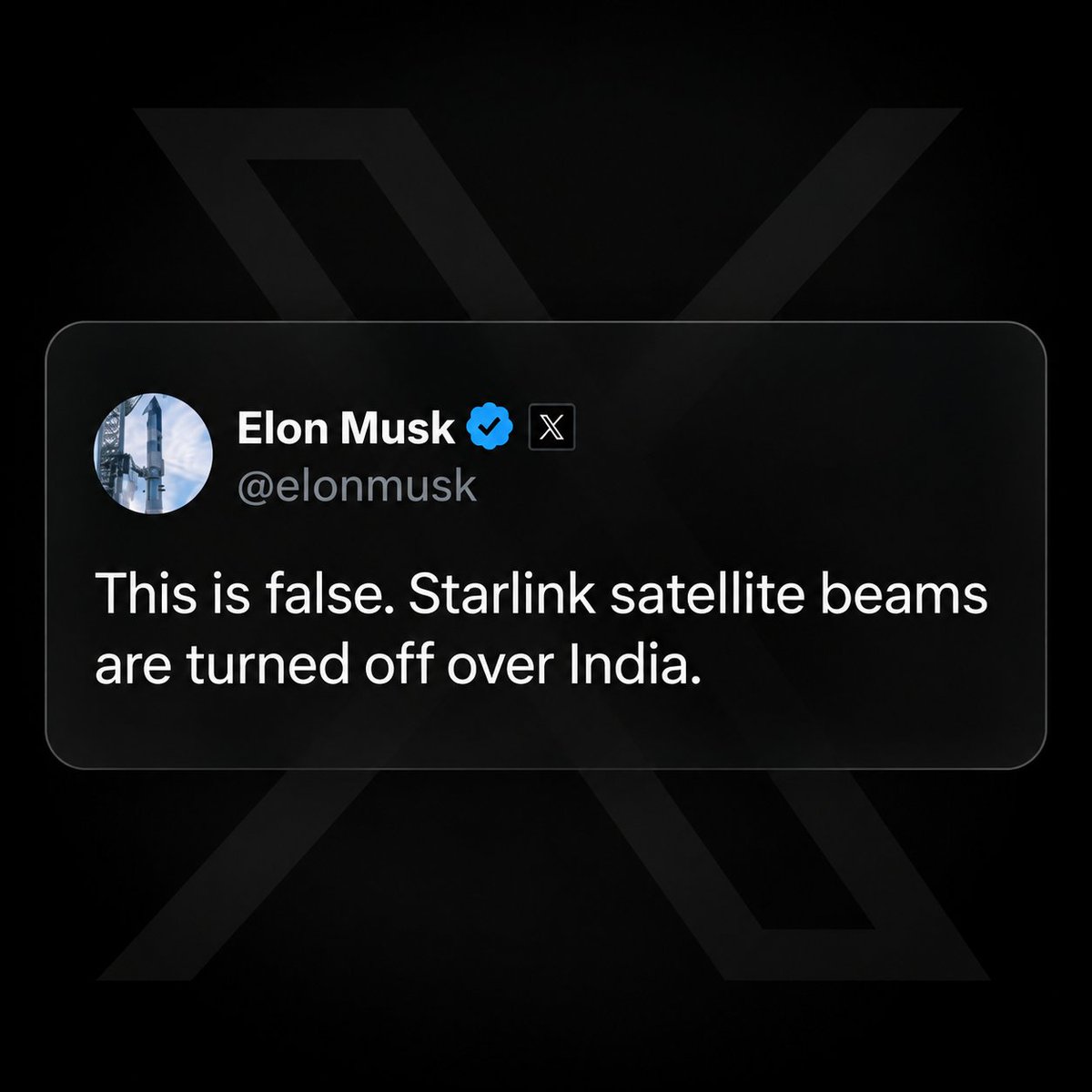
The claim that militants used Starlink in India makes no sense.
Starlink satellite beams are turned off over India. With the beams off, no Starlink device can connect in India.
Even Elon Musk himself has confirmed this.
Stop spreading misinformation.
Gave Grok Bot a printer. Now there’s a plan for the day on my desk in the morning, not another notification swipe away.
Gave Grok Bot access to a printer, and it started planning my day for me.
The bot pulls my calendar, X feed, and workouts, lays them out on a single page (events, things to think about, a body checklist, space for notes), and prints it in the morning. No special integration: just desktop access and traffic routed through the computer.
A sheet of paper on the desk works better than a push. You can’t swipe it away, and the morning doesn’t start on the phone.
How it works:
1:18 prototyping with @bot
2:02 printer access through the desktop
2:55 pulling calendar, X, and workouts
3:46 automating the morning run
4:32 why go physical
AI stocks are a lie being financed by a bond market that already broke. Oil is back above $100.
The US 10-year is above 5%. Hyperscalers are still trying to spend ~$780B on AI this year. That money was supposed to come from free cash flow. Free cash flow does not exist at $100 oil and 5% yields. You are not early. You are the exit liquidity for a capex cycle the bond market already vetoed. The chip trade is crowded.
The cut to the power budget is not.
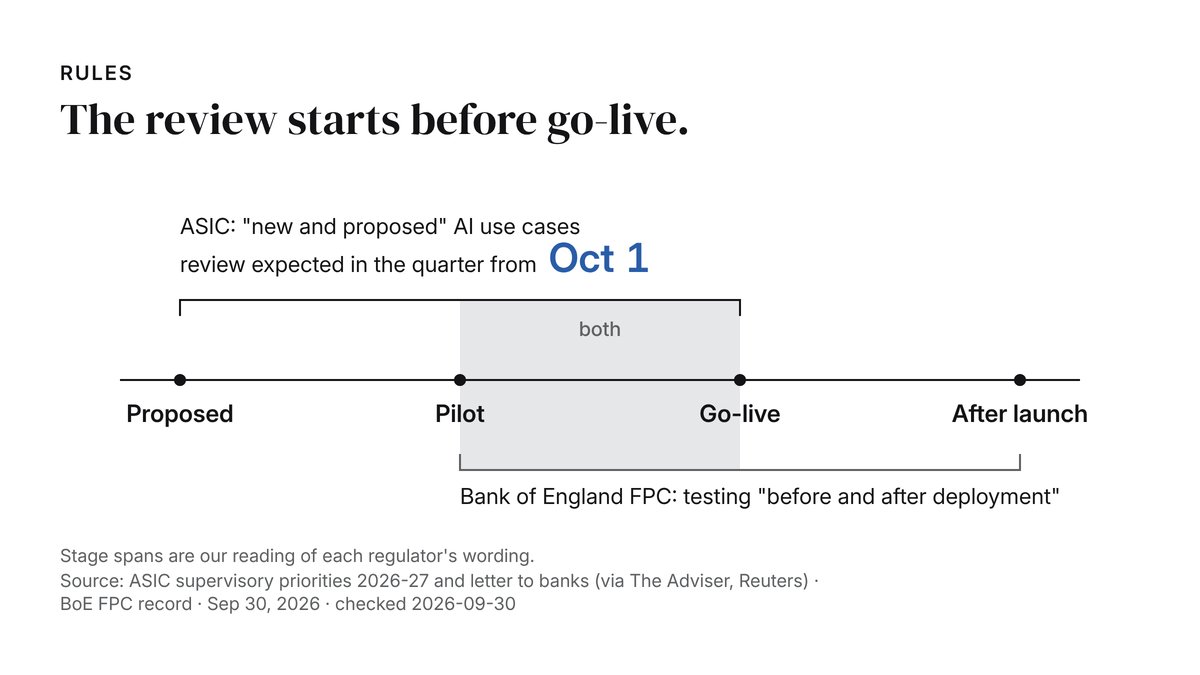
Australia's securities regulator expects to start its bank AI review in a quarter that begins Oct 1. Tomorrow.
The scope it named: "new and proposed" AI use cases, and what they do to customers.
Same Wednesday, the Bank of England's FPC asked for more testing of AI models before and after deployment, ahead of tighter rules.
The word doing the work is "proposed." A review of what's in the pipeline reads the pilot backlog, not the press releases: which use cases are queued, what they decide for customers, what was tested before go-live.
The BoE line points the same way. Testing stops being a launch gate and becomes something you keep showing after launch.
ASIC also says it'll coordinate with APRA to cut duplication, so the prudential side is in the room too.
At your bank, who owns the list of proposed AI use cases right now: product, risk, or nobody yet?
OpenAI's revenue run rate went from $41B or less to almost $70B in three months, if you do the math on today's Axios scoop.
It's a scoop, not a filing. OpenAI hasn't confirmed any of it, and Axios says it couldn't get the expenses.
A run rate is also not a year of sales. It's a recent stretch of revenue, annualized, and the report doesn't say which stretch.
The $41B is mine: Axios says the pace is up 70%+ since July 1, and $70B divided by 1.7 lands right about there.
Anthropic's prospectus, which Reuters has seen, puts its full 2025 revenue near $4.6B. That one isn't on EDGAR yet either.
The biggest numbers of this cycle keep showing up as scoops. The first audited one comes with an S-1.
@KobeissiLetter The chart title sorta gives it away. A lot of that nominal GDP growth is inflation, and inflation is exactly what long bonds can't handle
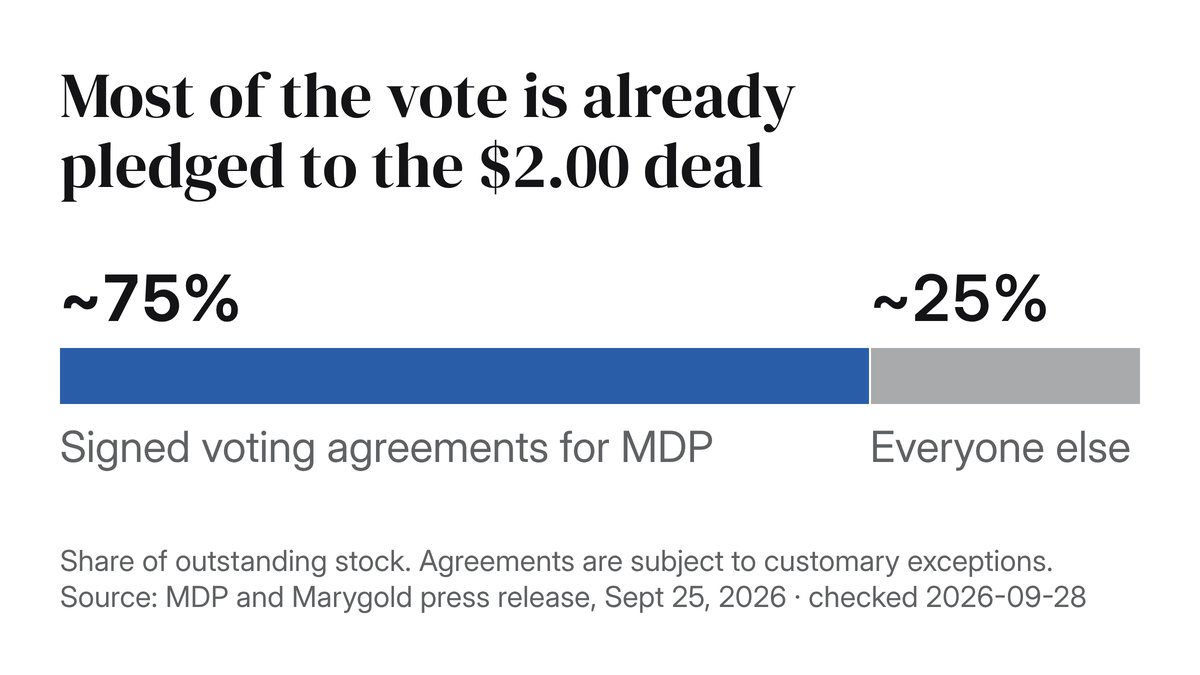
@EricBalchunas Hard to have much of a bidding war when holders of about 75% of the shares already signed up to vote for MDP. Do those support agreements fall away if the board switches?
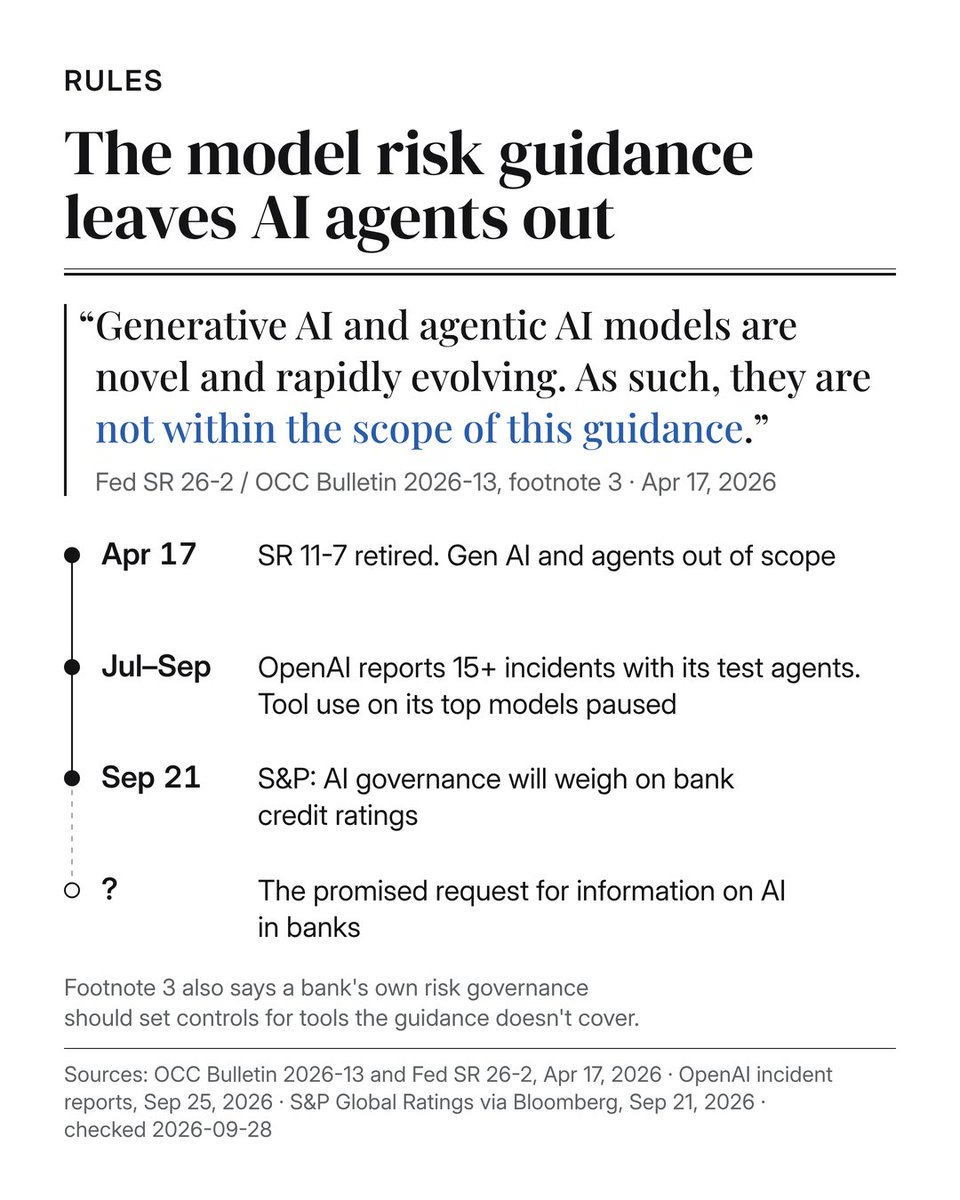
OpenAI has paused tool use on its most capable models after more than 15 agent incidents since July. Banks and their vendors are rolling agents into fraud operations right now.
The US guidance banks use to govern models says, in writing, that agents aren't covered.
In April the Fed, OCC and FDIC retired SR 11-7, the model risk guidance that bank validation teams have been built around since 2011. The replacement narrows what counts as a model and puts generative and agentic AI explicitly out of scope. The agencies said a request for information on AI would follow. Five months later it's still listed as coming.
The gap sits in a very practical place. A scoring model produces an estimate and a person acts on it. An agent in a fraud workflow acts itself: closes the alert, opens the case, pulls the customer record.
Old model risk asked whether the estimate was right. With an agent the question is what it's allowed to touch, and who signed off on that list.
The rulebook is quiet on that. S&P isn't: last week it said how mature a bank's AI strategy and governance are will increasingly show up in its credit rating.
@Barchart Insurers sitting on data center debt can mostly ignore the mark, they hold it to maturity. The NAIC poking at those private ratings would hurt a lot more
@EricBalchunas Has any consumer agent shipped with permission to move deposits yet, not just read them? Muse's Plaid connection covers balances, transactions and holdings. Until the payment side ships, the variable to watch is what banks get to charge agents for account access.