Wei Dai has been thinking about AI safety longer than I've been alive, and his recent ideas deserve more attention. As far as I know this is his first podcast interview (of sorts!)
Big news: Fin is joining @Salesforce.
We built the #1 AI Customer Agent, and Salesforce has the reach to help us bring it to the world.
Read more from our CEO @eoghan here: https://t.co/3rnEQ5cdMX
The UK commentariat will spend this week deluded about the Anthropic situation. “It’s just Trump.” “It’s a one-off.” “We can build our own.” “We don’t want or need crappy American AI anyway.” None of it holds up.
US has been using AI as a geopolitical lever since 2022. Chip controls, model weight restrictions, Chip Security Act embedding trackers directly into hardware, and now model restrictions. The direction of travel is clear.
The UK has four AI Growth Zones, two without delivery partners, and OpenAI paused its Stargate UK data centre in April. Powering a data centre here costs four times what it does in the US. It is illegal to build LLMs that could compete with Claude because we cannot train models in the UK under our copyright laws. The idea we will build our own infrastructure under business as usual is unrealistic.
We need to adopt. We need the productivity gains. Debt servicing costs are at historic highs, the tax burden is already at a 70-year peak, and the OBR’s long-run projections assume some productivity recovery. If professional services (the one sector generating real trade surplus) gets automated away by American AI while UK firms lag on adoption, the fiscal math becomes genuinely dire.
Under current trajectories, we will arrive late, dependent on foreign infrastructure, with no domestic capability and no leverage.
Nobody is taking this seriously enough and I’m feeling despondent.
Broiler farming is so well-optimised that ~60–70% of costs are just feed. 1kg of feed converts into about 400g of edible chicken. Horrifyingly efficient
Cultivated meat is not on track to ever be economically competitive with animal meat.
Modern factory farms have cut out almost all costs that aren't strictly biologically necessary for the production of muscle. And animal evolution has been optimizing the conversion of energy into muscle for billions of years.
That means that cultivated meat needs to beat billions of years of accumulated evolutionary efficiency to become competitive.
That's an extremely hard challenge.
It's maybe even harder than building AGI, since evolution has only been optimizing for intelligence for tens of millions of years.
Very fun to chat with @toby_tremlett and @frances__lorenz for their podcast!
We talked about the altruistic case for trying to reach great futures, why I think truly transformative AI is more likely than not, and ‘illusionism’ about consciousness.
Toby also devises a compelling new analogy for our moment in history
hello girlies I'm here to say that @toby_tremlett & I are now co-hosts!!! We did a podcast episode with @finmoorhouse (Research Fellow at @forethought_org ). We trick Fin into solve our personal problems by thinly veiling them as “philosophical thought experiments.”
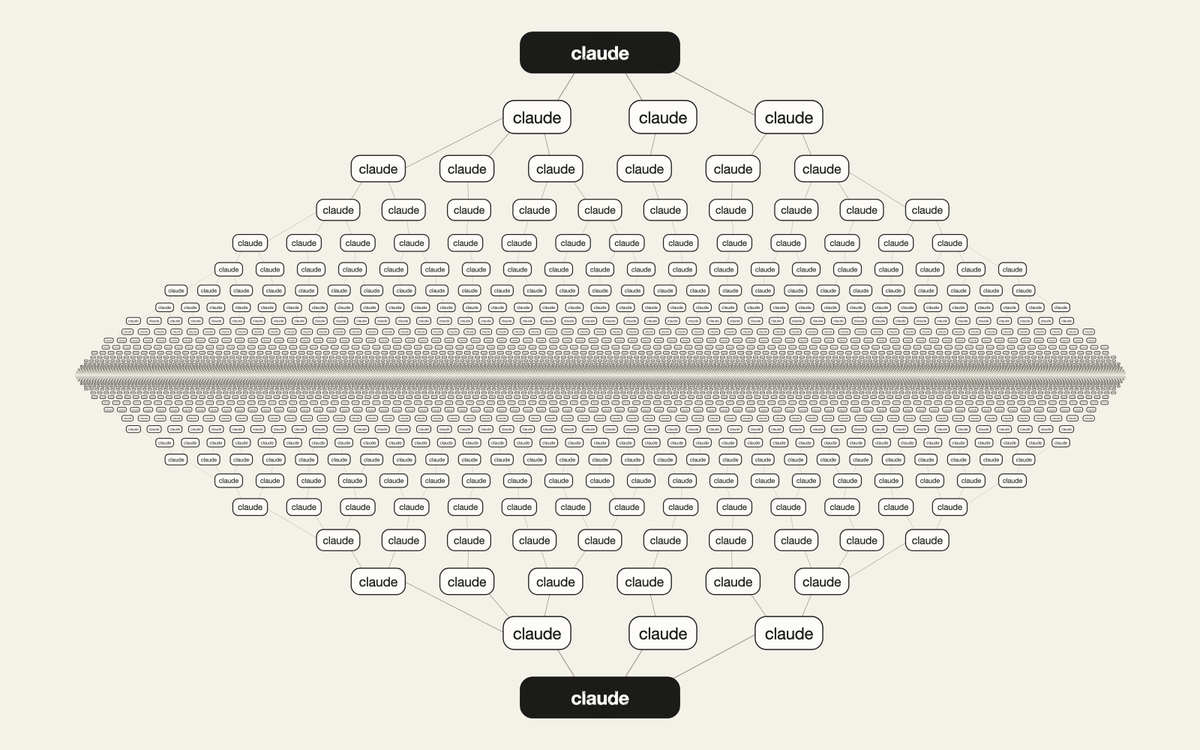
Excited to share our most powerful new Claude Code feature: dynamic workflows!
Mention "workflow" in a prompt and Claude will dynamically create an orchestration plan that it strictly follows, allowing you to confidently trust that every stage happens in the right order even across 100s of agents.
A few, see acknowledgements in post. I think it's more bullish than consensus, as far as there is one. I guess SpaceX itself would be an exception, at least going by their stated aims.
There is strong (and correct) consensus that space data centers don't make sense today. It's hard to get commercial signals since most the analysis depends on launch getting much cheaper thanks to Starship, which is too speculative and far out for contracts to be in place or whatever.
Also note @AviParr takes almost all the credit for the analysis
I'm not sure I follow your first paragraph, sorry. I agree that there are more-or-less hard constraints on how much growth you can get at a time, and on peak absolute growth rates we could eventually get.
But growth rates can be superexponential at any absolute rate, up until those limits. Indeed over the long run of human history growth rates have clearly been increasing; and if you squint enough the best fit looks roughly hyperbolic*
I don't think the argument that one actor could grow much faster than others involves thinking this would be desirable, indeed it seems worrying for obvious reasons.
I also agree that today's measures of real output probably distort and break in unpredictable ways with much AI-driven growth, while measures like energy production are crude but harder-to-game.
*https://t.co/b97IViSyso