Swaraj Suitings
- Incorporated in 2003
- Business: Textile Mfg (Yarn Dyeing, Weaving, Processing, Finishing of Fabric, & Development of Denim & Cotton Fabrics) & trading.
- Mfg Units: 2 in Bhilwara (Raj.) & 1 in Neemuch (M.P.). 1 additional Unit is upcoming in Neemuch (M.P.)
🚨 BIG UPDATE FOR SHARE MARKET TAXPAYERS! 📈
Share Market Transactions: AIS ➡️ Pre-filled ITR
Till now:
📊 Purchase & Sale transactions of Shares & Mutual Funds were reflected in AIS.
➡️ Taxpayers had to independently prepare Capital Gain computation using broker reports and then report it in the ITR.
From Tax Year (TY) 2026-27:
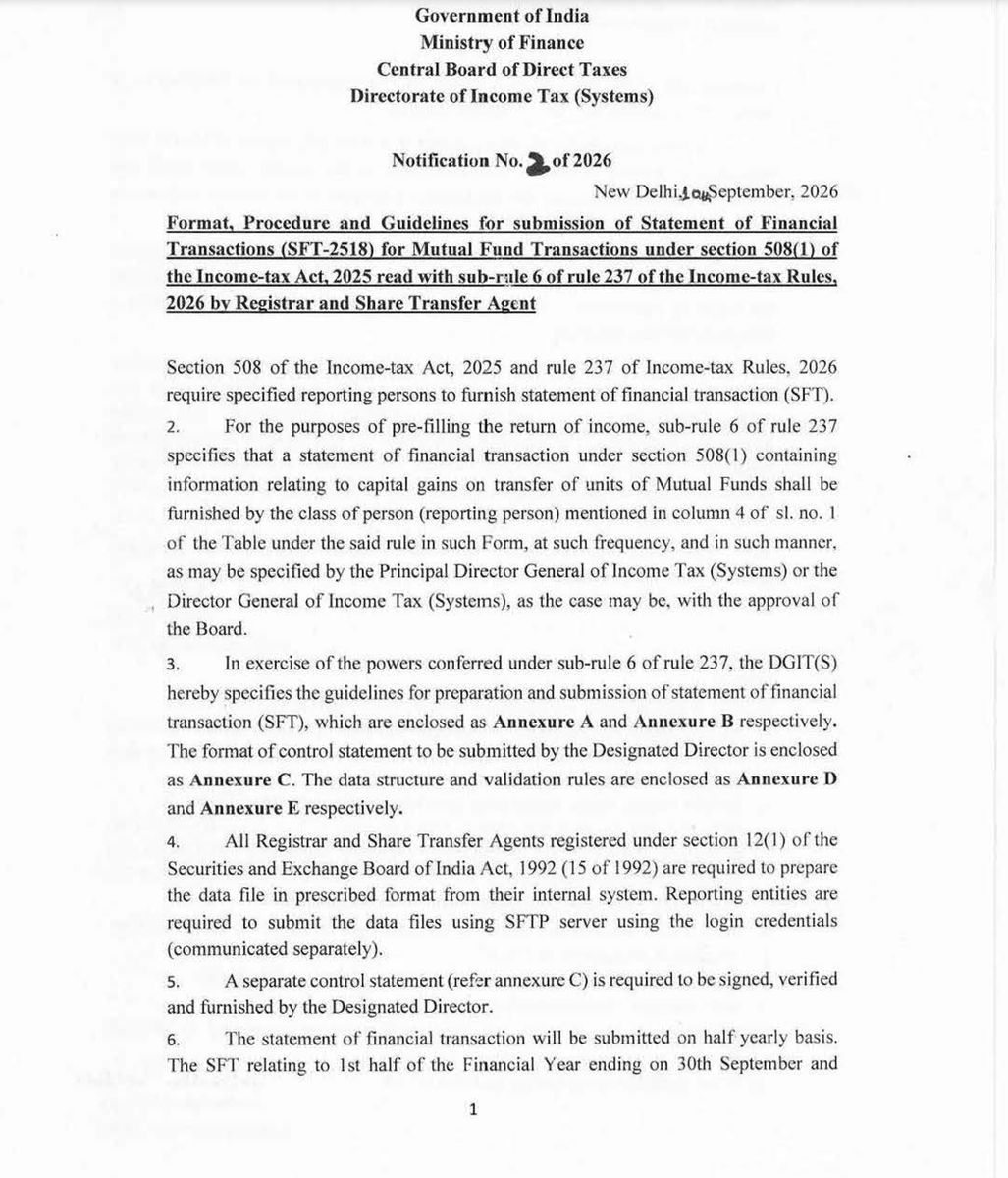
🟢 Share market transaction data will be used for pre-filling the ITR, following the new SFT-2517 & SFT-2518 framework notified on 10 September 2026.
📌 Relevant Notifications:
🔹 Notification No. 1/2026 – SFT-2517 for Depository Transactions
🔹 Notification No. 2/2026 – SFT-2518 for Mutual Fund Transactions
Both were dated 10 September 2026.
🔹 What will be pre-filled?
✅ STCG & LTCG → Capital Gains
✅ Intraday & F&O → PGBP
✅ Dividend → Other Sources (already pre-filled; no change)
🔑 FIFO Method Matters
FIFO-based matching will help determine the holding period and capital-gain classification.
✏️ Pre-filled ≠ Final
The pre-filled figures will remain editable. Taxpayers should verify and correct the data using their broker statements and actual records before filing.
⚠️ Special caution for traders: Certain business transactions may potentially be classified incorrectly in the pre-filled data. Therefore, traders should carefully verify the pre-filled information before filing ITR.
📌 THE KEY CHANGE
Earlier:
AIS → Transaction Data → Manual Capital Gain Computation → ITR
TY 2026-27:
SFT Data → Pre-filled ITR → Verify & Correct → File
👉 Less manual work. More automation. But verification remains essential!
Save this post & share it with investors, traders and tax professionals.
#ShareMarket #ITRFiling #TaxYear202627 #AIS #SFT2517 #SFT2518 #CapitalGains #STCG #LTCG #IntradayTrading #FNO #IncomeTax #TaxUpdate #ITR #Taxation #FinTaxPro
This month, instead of writing about market view, trend or an opportunity, we are writing about our own mistakes. We revisit five of them in our most candid letter yet:
- Mistake vs. Accident: One "golden question" separates a bad decision from plain bad luck. Most investors never ask it.
- The Capex Sizing Trap: When a company bets on expansion far bigger than its own track record, that's a red flag we now model for explicitly.
- Turnaround Traps: When a thesis breaks due to supply-chain shocks, hesitation is expensive. Exit fast, or pay for it.
- Anchoring Bias: Comparing a new bet to your last big win quietly blinds you to the warning signs in front of you.
- The Phantom Success: Sometimes a profitable trade is just a rushed, under-researched call that got lucky. Profit ≠ process.
- Opportunity Cost (Type C Risk): Exiting early over a minor industry convention and never revisiting can quietly cost you massive compounded returns.
Learning from each of them, we have built sharper guardrails around these blind spots. Today, we ask harder questions before deploying capital.
”Don’t miss to read on our Mistake vs Accident framework”
Click here to read our latest letter: https://t.co/2sbQ328S9h
@vikaskhemani; @manoj_bahety; @khemani_swati
#InvestingJourney #SmartInvestor #Lessons #WealthCreation
🚨BREAKING: PEOPLE KNOW WHEN YOU'RE USING CHATGPT AND CLAUDE.
The structure, the tone, the excessive polish. It all gives you away.
7 prompts that fix this:
🍭 मान लो तुम टॉफी का बिज़नेस करते हो
तुमने 100 टॉफी खरीदी और बेचनी शुरू की।
1️⃣ Debtor Days (पैसा कब मिलेगा?)
तुमने दोस्त को टॉफी दे दी, लेकिन वो बोला:
👉 “मैं पैसे बाद में दूँगा”
पहले: 2 दिन में पैसे मिल जाते थे
अब: 10 दिन बाद मिल रहे हैं
👉 मतलब: तुम्हारा पैसा फँस गया
2️⃣ Inventory Days (स्टॉक पड़ा हुआ)
तुम्हारे पास टॉफी पड़ी है:
पहले: 5 दिन में बिक जाती थी
अब: 15 दिन तक पड़ी रहती है
👉 मतलब: माल बिक नहीं रहा / demand slow है
3️⃣ Cash Conversion Cycle (CCC)
अब सोचो पूरा cycle:
टॉफी खरीदी
बेची
पैसे वापस मिले
👉 पहले पूरा काम 5 दिन में हो जाता था
👉 अब वही काम 30 दिन ले रहा है
💣 अब समझो असली problem
अगर पैसा जल्दी नहीं आएगा तो:
तुम नई टॉफी कैसे खरीदोगे?
फिर तुम क्या करोगे?
👉 उधार लोगे (loan)
⚠️ यही कंपनी में हो रहा है
Debtor Days ↑ → पैसा अटका
Inventory Days ↑ → माल अटका
CCC ↑ → पूरा सिस्टम slow
👉 मतलब: Business cash खा रहा है, दे नहीं रहा
“Profit दिखाना आसान है…
Cash बनाना असली खेल है”
अगर कंपनी बोल रही है:
👉 “हम profit में हैं”
लेकिन:
👉 पैसा account में नहीं आ रहा
तो समझ जाओ ⚠️
“जिस बिज़नेस में पैसा घूमने में ज्यादा समय लगे, वो धीरे-धीरे कमजोर होता है”
It was 4 pm at a plush Wealth Management office in Nariman Point, Mumbai.
Arjun, 40 years old, a high-frequency trader from London, walked in straight from the airport. He was wearing a bespoke suit and carried two iPhones that buzzed incessantly with market alerts. His father, Vishwanath, a retired government clerk, had passed away a week ago.
Arjun looked at his watch. "I have exactly forty minutes. I need to liquidate my father’s portfolio, sign the probate documents, and head back to the airport. I have a major opening on the London Stock Exchange tomorrow."
Vikram, the family’s long-time financial consultant, sat across from him. He had a thick file ready on the desk.
"Arjun, your father was a very disciplined man," Vikram said softly. "He started investing with me thirty years ago."
Arjun tapped his fingers on the mahogany table. "I’m sure he was. But let’s be realistic—he was a clerk. How much could he have saved? Five lakhs? Ten? Just give me the total Net Asset Value (NAV). I’ll sign the papers, and you can wire the money to my UK account. I don’t have time for a presentation."
Vikram didn't open the digital spreadsheet. Instead, he handed Arjun a small, old-fashioned leather diary and a single envelope.
"Your father told me that on the day you come to 'collect' your inheritance, I should give you this first. He said the numbers won't make sense without the words."
Arjun sighed, visibly annoyed, but opened the envelope. The handwriting was shaky, the ink slightly faded.
"Dear Arjun,
I know you are looking at your watch right now. I know you are calculating the 'opportunity cost' of sitting in this office instead of a trading floor.
Son, I watched you grow up. I watched you turn into a man who knows the price of everything but the value of nothing. You always told me, 'Dad, money makes money.' But you forgot that money is also supposed to buy time.
In this folder, you won't find a massive fortune. You will find something else. I have invested in 'Time.'
Every year, instead of buying a bigger car or a luxury watch, I bought 'Freedom.' I have cleared the mortgage on our ancestral home. I have set aside a fund that yields exactly what you earn in a month in London. I did this so that if one day you felt tired—if your heart felt heavy from the race—you could stop.
I didn't invest so you could become richer. I invested so you could afford to be 'Poor' for a while and spend time with your daughter, the way you couldn't spend with me.
The compounding I cared about wasn't just interest. It was the compounding of memories. Please, don't liquidate this. Use the dividends to buy a Sunday afternoon. Use the principal to buy a peaceful sleep.
Your father, who always had enough because he had you."
Arjun stopped tapping the table. The buzzing of his iPhones suddenly felt like noise, not signals.
He looked at the portfolio. It wasn't billions, but it was enough. It was a safety net woven out of thirty years of his father’s sacrifices—small SIPs, avoided luxuries, and quiet discipline.
His father hadn't been building a "Portfolio"; he had been building a "Prison Break" for his son.
The phone in Arjun’s hand vibrated again. A "Sell" alert. Arjun looked at it for a long second, then turned the phone face down.
"Vikram," Arjun’s voice was thick. "I’m not liquidating anything today."
"Are you going to miss your flight?" Vikram asked.
Arjun looked at the old leather diary, where his father had noted down every dividend he ever received, alongside notes like "Arjun’s 10th birthday—bought 10 extra shares today."
"The market will open tomorrow without me," Arjun said, a tear finally hitting the glass of his expensive watch. "But my daughter’s childhood won't wait for a bull market."
The Lesson
In the world of investing, we often obsess over CAGR, Alpha, and Portfolio Diversification. We treat money as a scoreboard to prove we are winning.
But the greatest return on investment (ROI) isn't more money—it is Autonomy. * Real Wealth is the ability to say "No" to a job you hate or a meeting you don't want to attend.
True Legacy isn't leaving behind a pile of cash; it's leaving behind the gift of "Time" for those you love.
Don't just invest to retire. Invest so that your loved ones don't have to sacrifice their soul for a paycheck.
Obviously, most small cap funds haven’t delivered meaningful returns over the last 5–6 quarters. In fact, one shouldn’t even invest in small cap funds without at least a 7-year time horizon.
But SIPs were never meant to be judged by near-term returns. Their real power lies in building the habit of saving and investing first, before spending, and that discipline makes all the difference over the long run.
Even if your SIPs haven’t shown exciting returns yet, the steady expansion of your corpus through continued investing is quietly setting the stage for a powerful compounding phase when the cycle turns.
Whether it takes 3 months, 6 months, a year, or even longer, the turn will come. Markets always move forward.
Until then… Lage Raho!
SME stocks are going down when there are Good Announcements!
When announcement hits, people remember "Oh! I have this Stock! Chal bech de!"
Market Ration. Incentive Program😆
Concall Update 5% Cut
Order Win Update 2.5% Cut
Credit Rating Update 3% Cut
Business Presentation 4% Cut
Loan Approval 2% Cut
Pref/Bonus/Split Cut, Cut, Cut!
Quiet.👍 No Update Flat to 5% UP!
For Companies, chup chap baithna behtar hai!