Who here is still holding $WLD? Because World is starting to look VERY different in 2026.
The internet has a new problem.
AI can now write, talk, shop, sign up, create accounts and interact almost like a human.
So proving who is actually human is becoming valuable infrastructure.
That is exactly where World ID is positioning itself.
World already reports 18M+ verified humans and more than 450M World ID uses.
But the names connecting to that identity layer are what really caught me:
👉Zoom for verified humans in meetings.
👉Docusign for proving a signer is human.
👉Tinder / Match Group for verified profiles.
👉Razer for human-first gaming identity.
👉Okta for connecting verified humans to AI agents.
👉Vercel for human approval inside automated AI workflows.
Then there is AgentKit, where a verified person can authorize an AI agent and give that agent cryptographic proof that a real human stands behind it.
Think about where the internet is going.
More bots.
More autonomous agents.
More fraud.
More AI-generated accounts.
That makes proof-of-human infrastructure more useful, not less.
And this is where $WLD enters the economic side.
World's 2026 design says applications using World ID can maintain WLD-funded wallets, with World ID application fees ultimately payable in WLD.
So the thesis is no longer just:
“Scan → receive token.”
It is becoming:
Humans verify → apps use World ID → applications pay for verification → WLD becomes part of the network economics.
World says its goal is to build the world's largest identity and financial network as a public utility.
With AI exploding this fast, I understand why they chose identity as the battlefield.
$WLD is one I’m watching VERY closely.
If you hold $XRP, remember this name: Rosie Rios.
Her signature once appeared on roughly $1.8 TRILLION in U.S. currency. Then she joined Ripple.
That career path still blows my mind.
Rosie Rios served as the 43rd Treasurer of the United States.
She worked around Treasury, the Federal Reserve ecosystem, the U.S. Mint and the Bureau of Engraving and Printing.
She literally helped oversee the machinery behind America's physical money.
Then in 2021, she joined Ripple’s Board of Directors.
And she didn’t speak about crypto like some speculative casino.
She said:
“Blockchain and crypto will underpin our future global financial systems.”
Then came the line every $XRP holder should know:
“XRP’s primary purpose is facilitating cross border payments.”
Think about who said that.
Someone who spent years around the U.S. monetary system, public finance and institutional investment management.
Years later, her message to banking executives became even more direct:
“We are moving from fiat cash to computer code.”
That transition is exactly what fascinates me.
Physical dollars
→ digital money
→ blockchain settlement
→ global payments.
And Ripple has kept building deeper into that direction with Ripple Payments, RLUSD, Ripple Prime, Ripple Custody, Ripple Treasury and XRP Ledger.
Meanwhile XRP still does what Rosie highlighted years ago:
bridge currencies and move value across borders in seconds.
She went from helping oversee physical U.S. money to helping guide a company building digital financial rails.
That connection alone deserves more attention from the $XRP community.
I AM BULLISH!
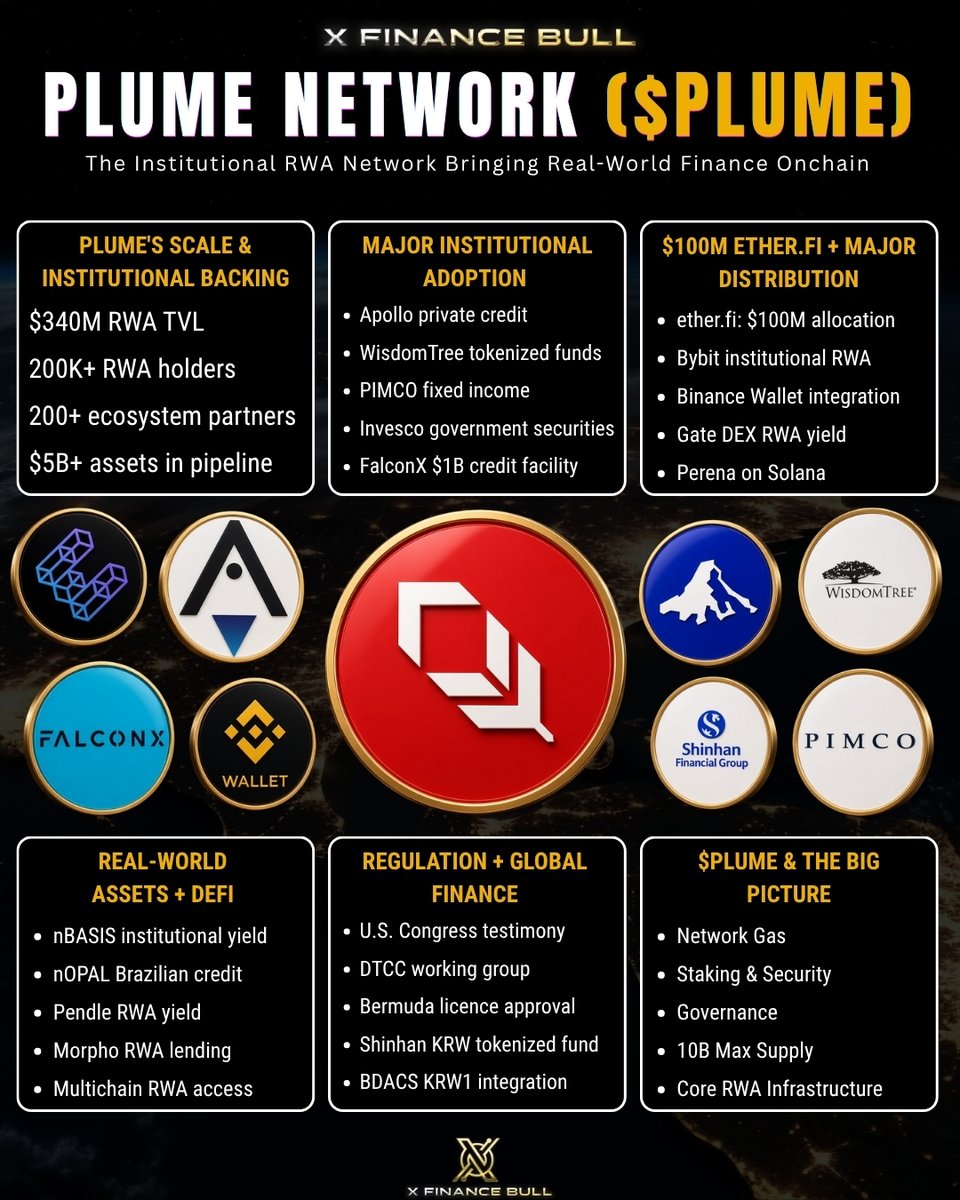
Where are the $PLUME holders? I think people are missing what Plume is actually trying to become.
Imagine you manage real institutional assets.
You already have the bond fund.
The Treasury strategy.
The private credit.
The structured product.
Your problem is no longer creating the asset.
Your problem is distribution.
How does that product reach millions of onchain users without rebuilding everything from scratch?
That’s the lane Plume has been attacking all year.
A WisdomTree money-market fund was used in an onchain payroll pilot.
etherfi’s $6B+ customer-deposit base was connected to Plume RWA vaults, with $100M allocated.
PIMCO and CMB International fixed-income exposure reached users through Bybit.
Bitwise and Invesco strategies became accessible through Binance Wallet.
Then FalconX brought institutional prime-brokerage credit into Plume’s Nest infrastructure.
Suddenly RWAs aren’t sitting in isolated wallets waiting for somebody to admire them.
They can become:
-salary
-yield
-collateral
-lending positions
-fixed-income exposure
-DeFi strategies.
That distinction matters to me.
Tokenization creates the digital asset.
Distribution creates the market around it.
Plume reported more than 200,000 RWA holders by the end of Q2 and now says roughly $5B of assets are in its pipeline.
That’s the $PLUME thesis I find interesting.
Not another chain trying to do everything.
A network trying to make real financial assets actually circulate through the onchain economy.
Imagine U.S. banks issuing regulated dollar stablecoins on the $XRP Ledger.
Ripple already showed what XRP escrow can do.
Now imagine banks using programmable escrow to manage liquidity automatically.
At U.S. financial-system scale? The $XRP narrative would go nuclear.
BREAKING 🚨🚨🚨 $XRP just took the #1 spot over Bitcoin on Upbit🇰🇷
South Korea is heating up!
Forget the narratives for a minute and just read the leaderboard.
#1 XRP/KRW — $511.16M
#2 BTC/KRW — $305.69M
#3 USDT/KRW — $275.55M
#4 ETH/KRW — $171.35M
#5 SOL/KRW — $54.86M
XRP isn’t barely leading.
It is sitting hundreds of millions of dollars ahead of some of the biggest assets in crypto on this 24-hour snapshot.
And here’s the part I love:
24.17% of Upbit’s entire reported trading volume is XRP.
One asset.
Almost a quarter of the exchange.
Upbit’s total 24-hour spot volume is roughly $2.11B, so seeing more than $511M concentrated in XRP/KRW tells me Korean market interest is VERY real right now.
I’ve always paid attention when XRP gets unusual strength in Asia because volume tells you something price alone can’t:
where traders are actually choosing to deploy capital.
Today, that choice is putting XRP above Bitcoin, Ethereum, Solana and every other pair shown.
That kind of positioning can change sentiment very quickly.
The chart can move.
Headlines can change.
But when the volume leaderboard turns into this?
I’m watching.
$XRP is running the show on Upbit right now.
HIGHER!🚀
OMFG! 🚨🚨🚨The Ripple vs SWIFT thesis just got a REAL banking blueprint in South Korea.
$XRP holders, look at what is forming.
Don’t view JB Jeonbuk Bank by itself.
Put it beside what Ripple has already built across Korea in 2026.
🟢Kbank
-Digital-asset wallets + Ripple Custody + stablecoin remittance infrastructure.
🟢Kyobo Life Insurance
-Tokenized government bonds + institutional custody + near-real-time blockchain settlement.
🟢JB Jeonbuk Bank
-Ripple Payments + international business remittances + replacement of the traditional SWIFT/intermediary process.
Three different doors into the same financial system:
👉Banking.
👉Capital markets.
👉Payments.
That’s where this gets insane to me.
Ripple is no longer approaching Korea with one product.
It is touching how money is stored, how assets are tokenized and how international value moves.
Jeonbuk Bank President Park Choon-won even described the partnership as a new growth engine and talked about reshaping the financial paradigm.
Now plug $XRP into that ecosystem.
Ripple says XRP and RLUSD underpin its solutions.
RLUSD can handle stable dollar settlement.
XRP can bridge currencies where liquidity is needed.
XRPL provides the settlement rail.
So imagine this Korean model spreading through APAC:
Korean banks
→ Ripple Payments
→ more currencies
→ more FX routes
→ deeper XRP liquidity
→ larger institutional XRP inventories.
That’s my hyper-bullish thesis.
The huge XRP price catalyst isn’t a bank buying XRP once.
It’s banks and liquidity providers needing XRP again and again as working liquidity while real businesses continuously move money across borders.
South Korea may be showing us the blueprint first.
The rest of the world will follow.
Remember this? This is how $XRP starts taking over
Brad called out what SWIFT couldn’t do years ago
Now JB Jeonbuk Bank is replacing multi-day SWIFT transfers with Ripple Payments
Brad talked about capturing 14% of SWIFT liquidity by 2030
It begins👇
Where are the $RENDER holders? Because Render just crossed into a completely different kind of demand.
Most people still think Render Network means one thing:
Artists need GPUs → GPUs render frames.
That story is getting much bigger.
SaladCloud is bringing a network of 60,000 daily active machines across 180+ countries into Render as an exclusive subnet.
And the important part isn’t simply more computers.
It’s what happens when companies actually PAY for that compute.
Customers can already deposit RENDER to buy SaladCloud GPU capacity.
GPU providers can already receive RENDER for supplying that capacity.
Now Milestone 3 is designed to connect the whole commercial marketplace to Render’s Burn-Mint Equilibrium.
For Salad Container Engine:
60% of the economic allocation goes toward RENDER burns.
And customers don’t even have to own crypto.
They can pay with cards, bank transfers or stablecoins, while the architecture can programmatically acquire the RENDER needed for settlement and burns.
That is what gets me excited.
Normal company pays for AI compute
→ compute gets consumed
→ RENDER gets acquired/settled
→ RENDER gets burned
→ GPU providers receive RENDER.
Real business activity feeding directly into token economics.
Then add Coinbase working on x402 payments and the Solana Foundation helping build the settlement infrastructure.
And this isn’t only rendering anymore.
AI inference.
-Voice AI.
-Computer vision.
-Scientific compute.
-Generative video.
-Distributed containers.
Render is connecting Runway, Black Forest Labs, Luma Labs, Stability AI, OctaneRender, Redshift, Blender Cycles and now Salad’s commercial compute network.
The more I look at $RENDER, the less I see a rendering token.
I see a marketplace trying to turn global GPU demand into an onchain economy.
And AI’s appetite for compute is only getting bigger.
You holding?
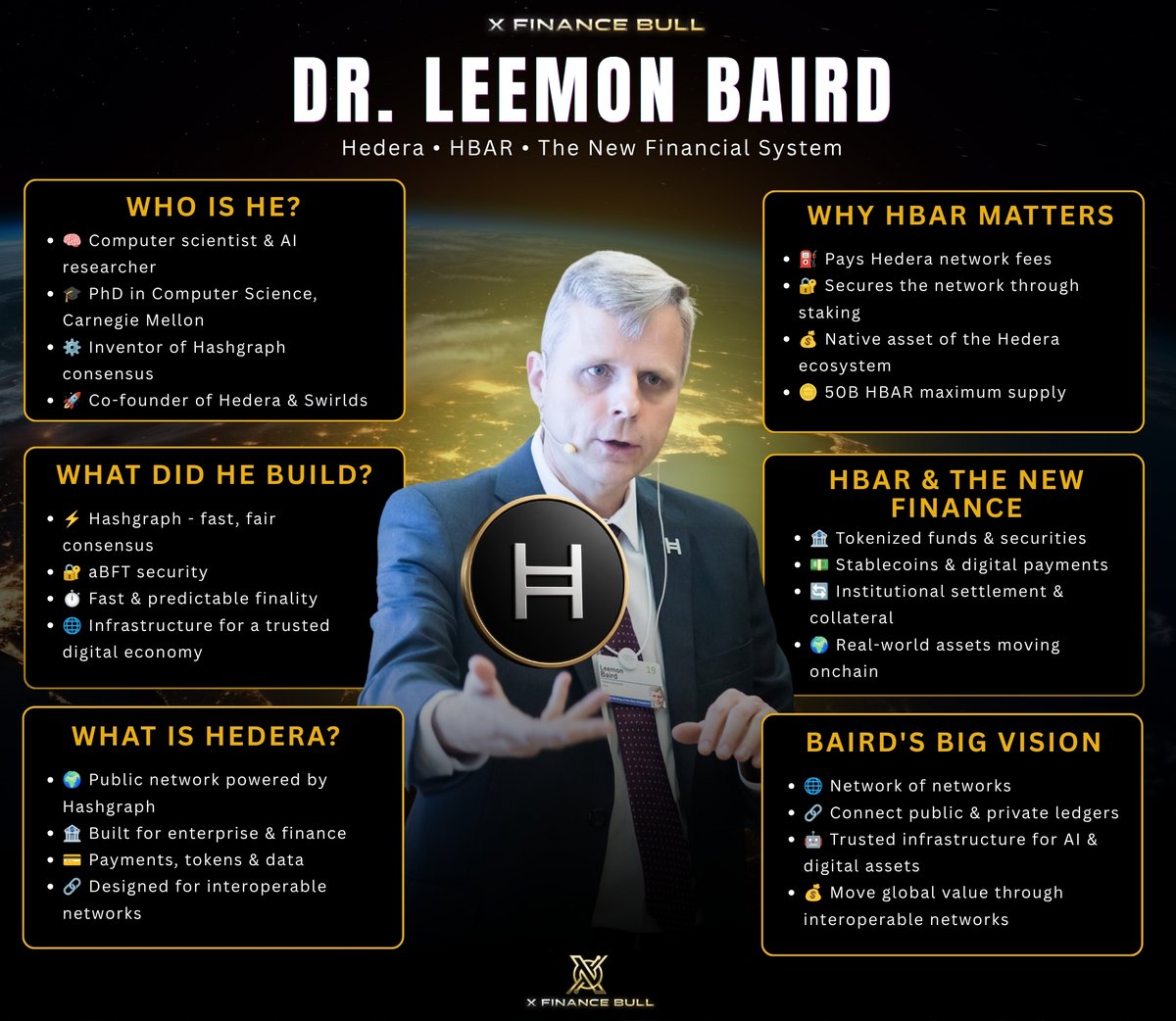
You’re holding $HBAR… but do you know the man who invented the engine underneath it? 👇
Meet Dr. Leemon Baird.
Before Hedera, he earned a PhD in Computer Science from Carnegie Mellon, researched reinforcement learning decades before today’s AI boom, served in the U.S. Air Force, and taught computer science at the U.S. Air Force Academy.
Then between 2012 and 2015, he created the hashgraph consensus algorithm.
That invention eventually became the foundation of Hedera.
What gets me is where his work has gone since.
Hashgraph started as a way for computers to agree on truth without one central party controlling everything.
Today that same idea is touching real finance.
Lloyds Banking Group, Aberdeen Investments and Archax used tokenized assets on Hedera as collateral for institutional FX trades.
The Reserve Bank of Australia selected Hedera for Project Acacia, testing tokenized bonds, repo, funds, private credit and wholesale central-bank settlement infrastructure.
Accenture joined the Hedera Council in 2026 and is building around tokenization and AI-driven payments.
And Baird is now pushing the architecture even further with CLPR, designed to connect separate public and private financial networks.
Banks.
Tokenized assets.
Stablecoins.
AI.
Different blockchains.
All communicating through shared trust infrastructure.
And underneath Hedera’s public network sits $HBAR.
HBAR pays the fees.
HBAR secures consensus.
More real activity on Hedera means more HBAR being used by the network.
That’s why I don’t only study the partnerships.
I study the person who designed the machine they’re plugging into.
Leemon Baird is one of the biggest reasons I take Hedera seriously.
🚨 THIS IS THE SHIFT $XRP HOLDERS HAVE BEEN WAITING FOR 🇺🇸🚨
SEC Chair Paul Atkins says the agency is moving to modernize securities rules for crypto.
From regulation by enforcement to actual rules.
America is finally building the framework.