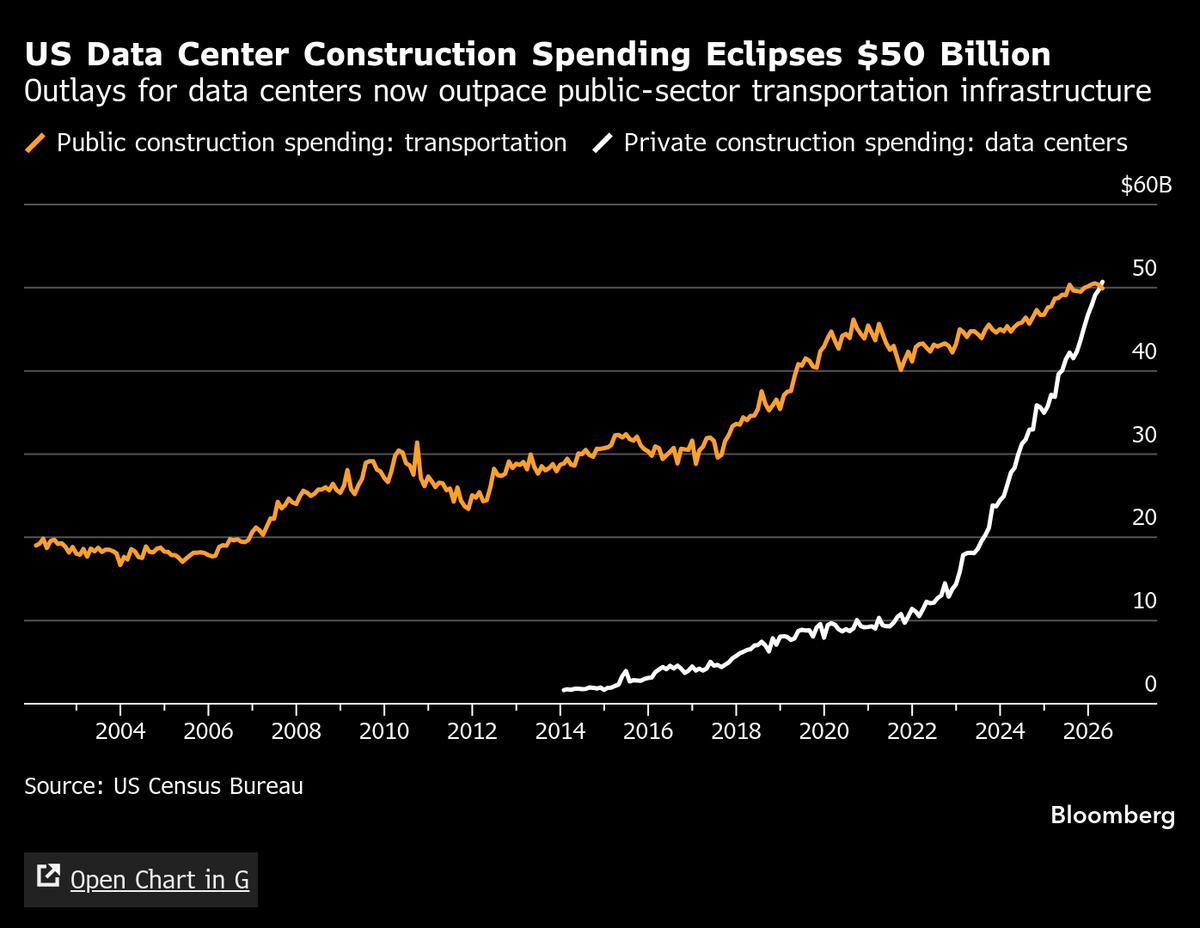
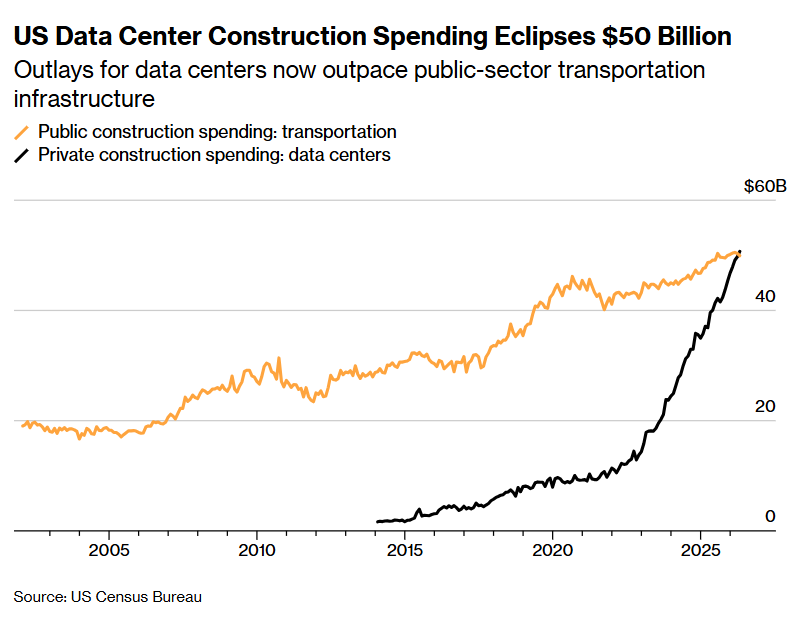
The U.S. is now spending more on data center construction than on public transportation infrastructure, according to new Census Bureau figures out today (https://t.co/2SonuBrsvY)
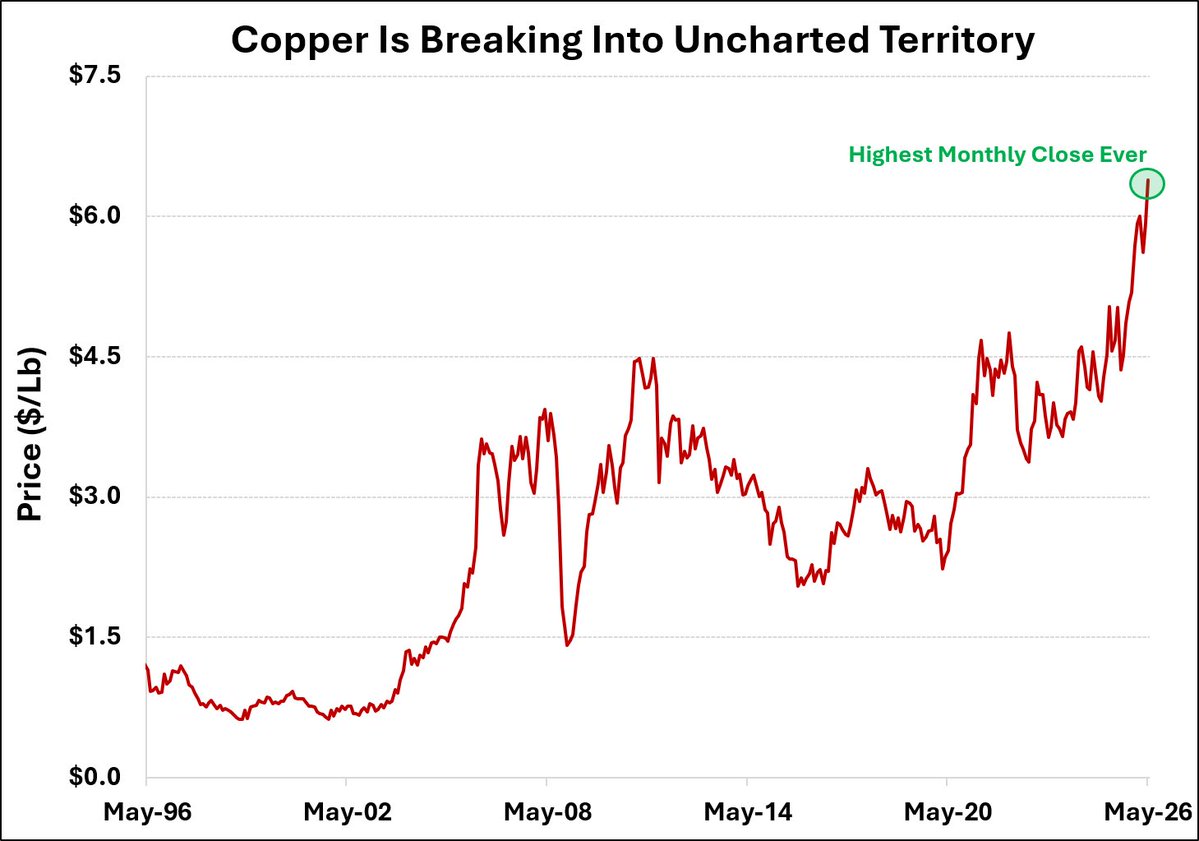
got energy? got metals?
Spending on data-center construction in the US eclipsed $50 billion in April for the first time, according to Census Bureau figures.
Data centers now account for 2.3% of all US construction spending, according to the report, which provides annualized rates that are not adjusted for inflation. Private-sector outlays for data centers also outpaced public spending on transportation-related structures — a category that includes airport facilities, marine terminals and mass transit — for the first time.
Iranian negotiators will stop exchanging messages with the U.S. through intermediaries, and Tehran will move to fully close the Strait of Hormuz, in retaliation for ongoing ceasefire violations, Iran’s state-affiliated news outlet Tasnim said Monday.
The report, in a translated post on the social media site Telegram, homes in on Israel’s military strikes in Lebanon against Hezbollah.
Read more: https://t.co/EhhS0d1VHa
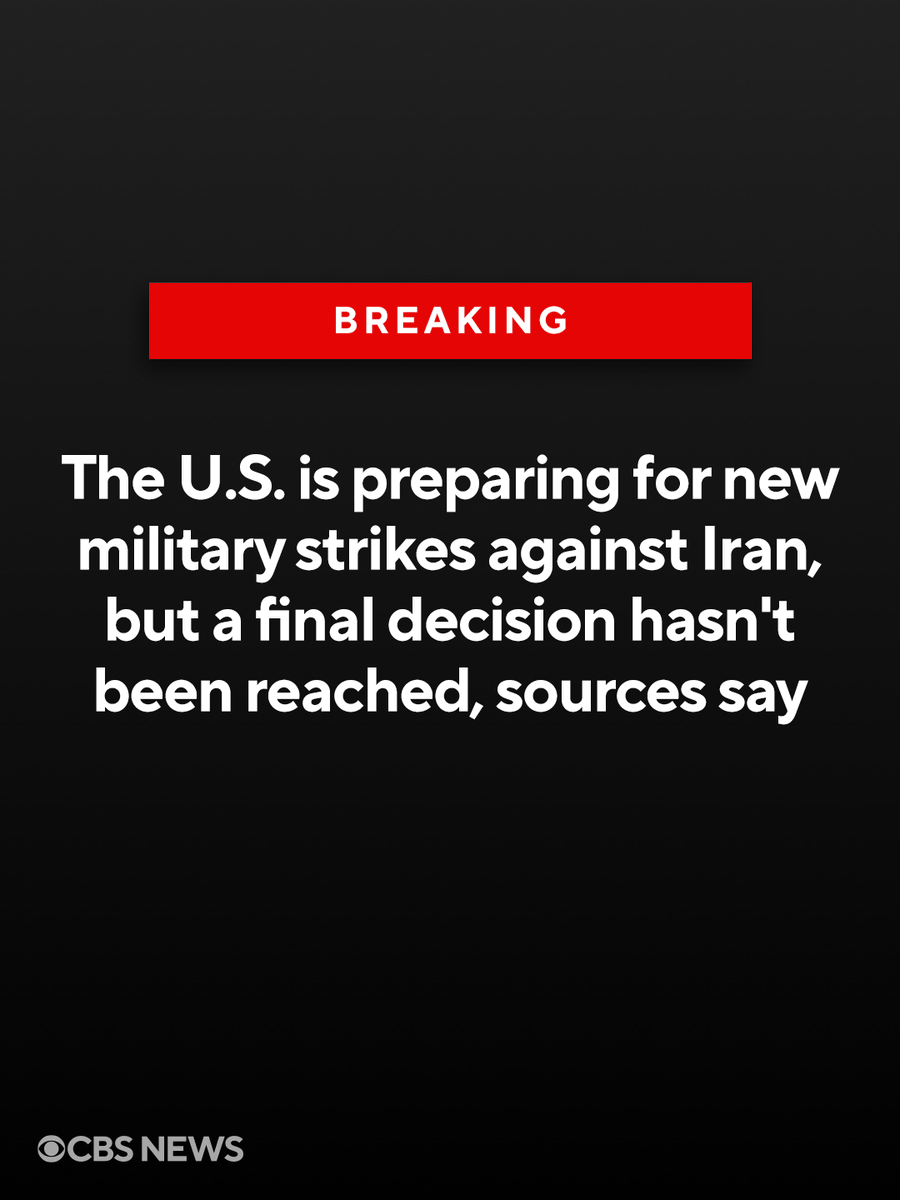
BREAKING: The Trump administration was preparing Friday for a fresh round of military strikes against Iran, according to sources with direct knowledge of the planning, even as diplomacy continued.
No final decision on strikes had been reached as of Friday afternoon. https://t.co/hHSKjebcW1
We are currently seeing the fastest growth in US money supply in four years.
And again, let’s stop solely blaming the war for this:
Inflation is fundamentally a monetary phenomenon.
https://t.co/ITckVME2Dy
Russia is selling its gold reserves at a rapid pace:
The Bank of Russia's gold holdings dropped -900,000 ounces in the first 4 months of 2026, to 73.9 million ounces, the lowest since February 2022.
Gold prices averaged ~$4,800 per ounce over the same period.
Therefore, if Russia sold gold at the market price, the sales are estimated to have generated ~$4.3 billion in proceeds.
Russia's central bank began reducing its gold reserves last year after the Finance Ministry liquidated gold and foreign currency assets from the National Wellbeing Fund to offset budget deficits driven by declining energy revenues.
Before the pandemic, the Bank of Russia used to be one of the world’s largest official gold buyers, taking in nearly all domestically mined output until it halted purchases in early 2020.
Russia is increasingly selling gold to raise cash.
Interview: @steven_kotler discusses his latest book, We Are as Gods, co-authored with @PeterDiamandis, on resurrecting extinct species from the grave, curing blindness, merging with superintelligence, and extending human life https://t.co/iv3HK9E75d
Food is set to become even more expensive:
World fertilizer prices have surged +44% since the start of the Iran War, to the highest since 2022.
This comes as ~33% of globally traded fertilizers pass through the Strait of Hormuz, which remains effectively closed.
This includes 23% of global ammonia, 34% of urea, the world's most widely used nitrogen fertilizer, and nearly 20% of global phosphate supply.
Furthermore, the Bloomberg Agriculture Subindex has increased ~9% since the Iran war.
The index tracks the futures prices of key agricultural commodities, including wheat, corn, soybeans, sugar, coffee, and cotton.
In the past, world fertilizer prices have acted as a leading indicator for agricultural output prices, as rising production costs eventually force farmers to reduce supply, pushing crop prices higher.
A new wave of global food inflation is imminent.
BREAKING: The Trump Administration is investing $2 billion in quantum computing companies and will receive equity stakes in return, per WSJ.
Details include:
1. $1 billion of the package will be awarded to IBM, $IBM
2. Chip maker GlobalFoundries, $GFS, is receiving $375 million in funding
3. The rest of the companies will receive $100 million each, except for startup Diraq, which is slated to get $38 million
4. Multiple other public companies will receive funds including D-Wave Quantum, Rigetti Computing, and Infleqtion
Trump's next big bet is on quantum computing.
Iran said it would take the war beyond the Middle East if the US and Israel resume attacks, after President Donald Trump threatened new strikes: Here’s your Evening Briefing https://t.co/77kLjpwTxk
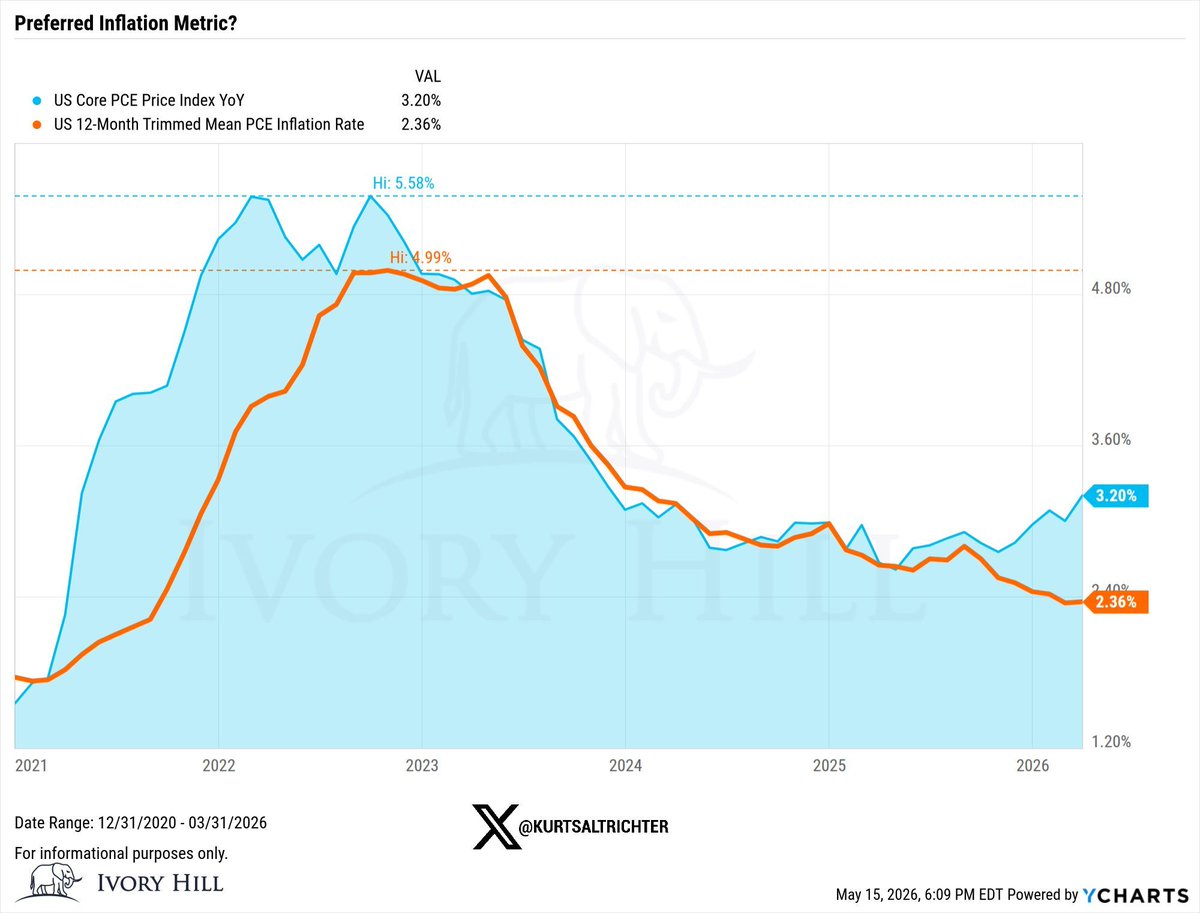
Warsh has signaled he wants to change the Fed’s preferred inflation gauge.
The Fed has used Core PCE, which excludes food and energy, as its benchmark since 2000. Warsh favors Trimmed Mean PCE, which removes the most extreme price movements each month instead of excluding whole categories.
The practical difference: Trimmed Mean PCE currently reads 2.36%, well below the 3.20% reading on Core PCE. Depending on which measure the Fed follows, the case for rate cuts looks very different.
This is not a minor procedural change. The metric the Fed uses to gauge inflation directly determines when it judges the economy to be at target.
If Warsh moves the committee toward Trimmed Mean PCE, he is mathematically moving the Fed closer to a declared victory on inflation, which creates runway for rate cuts even as headline readings stay elevated.
You’d think with 400+ Ph.D. economists and 500+ researchers on the payroll, the Fed would run the most sophisticated macro forecasting operation on the planet, leaving Bloomberg and every major hedge fund in the dust. Not even close. When the data doesn’t cooperate, just change the data.
Same thing I saw in the Army when time or weather worked against higher leadership, and we would quietly move the goalposts rather than admit the standard couldn’t be met. Can you tell why I didn’t stick around for the full 20 years?