Hitting the creative resistance buffers this week on the big Edwardian editing project. How do you get out of the doldrums?
#WritingCommunity#AmWriting#AmEditing
The Sunday quote is from Lucia Berlin (again 😊):
The dappled coral clouds had turned a fluorescent pewter, crests of waves shattered silver on the grey-white beach below.
Todo Luna, Todo Ano, from A Manual for Cleaning Women.
#bookx#booklovers
For an in-depth and fascinating intro to the late Victorian and Edwardian period, try Simon Heffer’s ‘The Age of Decadence’. Such an interesting portrait of a troubled age, despite all the swagger and glitter on the surface.
The Sunday quote:
His supper remained spread; and going to the front door, and softly setting it open, he returned to the room and sat as watchers sit on Old-Midsummer eves, expecting the Phantom of the Beloved.
Jude the Obscure, Thomas Hardy
Van Gogh painted this in one of the darkest years of his life, and it might be the most hopeful thing he ever made...
The painting is Almond Blossoms, made by Vincent in 1890. Branches of white blossom open against a clear blue sky, and there is nothing sad in it anywhere, which is remarkable, because of when he painted it.
His brother Theo, the person who had loved and supported him his whole life, had just had a son, and named the boy Vincent, after his struggling uncle. When the news reached Van Gogh, he started painting right away.
He chose almond blossom on purpose. In the south of France the almond is the first tree to flower, sometimes as early as February, breaking into blossom while winter is barely over. It is the tree that announces that life is starting again. For a new baby carrying his own name, Van Gogh painted the most beautiful symbol he knew for new life.
He was, at that very moment, seriously ill. This was the period of his breakdowns in the asylum at Saint-Rémy, and not long after finishing the picture he suffered one of his worst attacks and could not paint for weeks. And yet what he made for his nephew has no shadow in it at all. He gathered whatever strength he had and poured all of it into something joyful, a gift for a child he wanted to welcome into the world.
Theo and his wife hung it above the piano in their home, and it stayed one of the most treasured paintings the family owned. The baby it was painted for, Vincent Willem van Gogh, grew up, kept it safe, and went on to found the museum in Amsterdam that holds most of his uncle's work to this day.
This, to me, is what makes the painting extraordinary: a man at the limits of his strength, who would be gone within months, looked at a new life just beginning and painted hope. He reached past everything that was breaking in him and made, for a baby, a picture that says the same thing the almond tree says every year: winter does not get the last word. Something is starting again…
Delving into the world of Old English words for my research on Anglo Saxons. My favourite saying so far is ‘eagan bryhtm’, loosely translated as ‘an eye twinkle of time.’
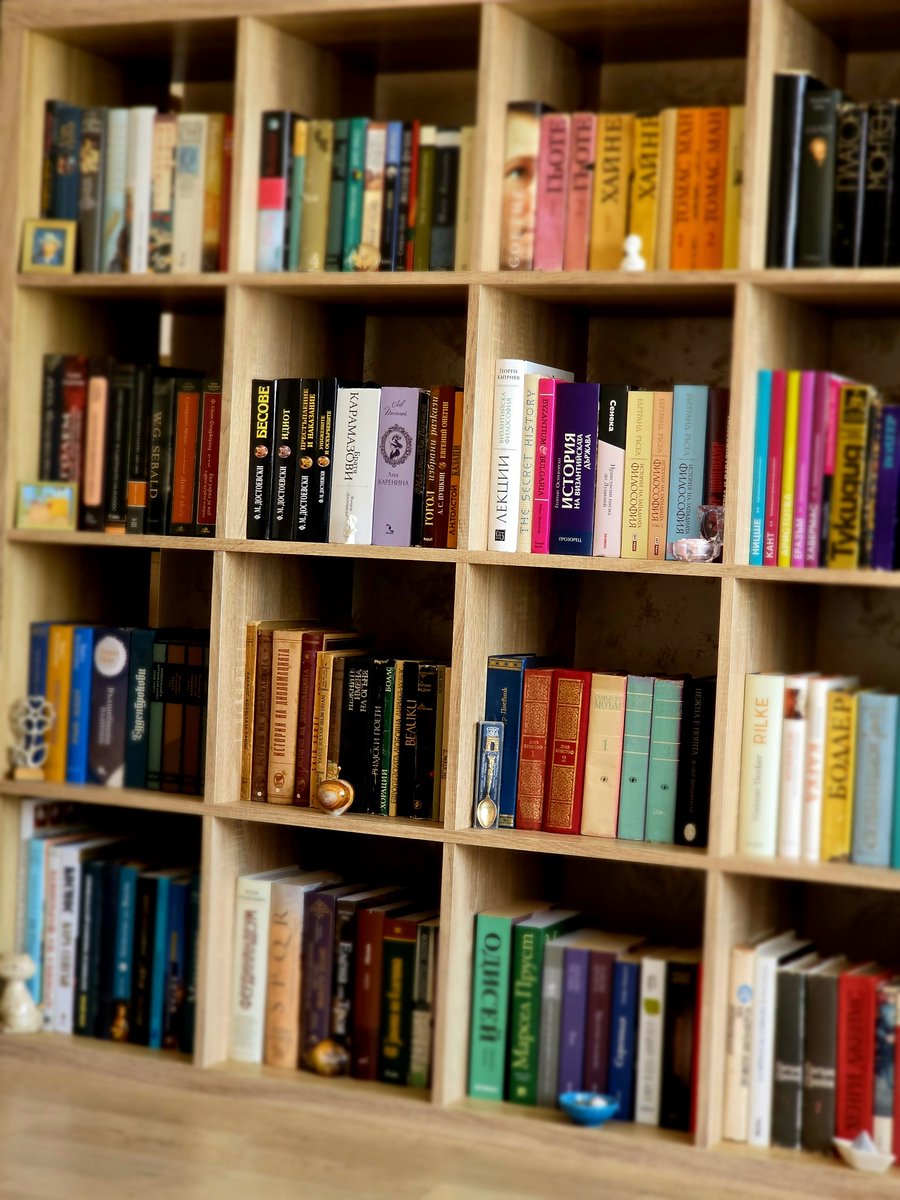
Thinking Zone. Tuesday afternoon in my small Black Sea village, my Greek coffee is in front of me, and humanity has once again done something so exquisitely absurd that for a moment one wonders whether history is not being written by a satirist: after spending decades removing books from our homes, giving away our grandparents’ libraries because “they take up space,” leaving old editions to gather dust and, with admirable technological cheerfulness, moving memory outside our own heads, we have suddenly discovered that old books contain... knowledge.
The news is almost perfect. Companies connected with the development of artificial intelligence are buying enormous quantities of old, rare and out-of-print books because they contain something that is beginning to become scarce on the internet: text written by humans before the invasion of machine-generated content. There are already documented cases of millions of books being purchased, their bindings cut off, their pages scanned, and the physical copies subsequently destroyed. The latest investigation from yesterday traces a shipment of rare books all the way to a facility used for AI training.
The horror! Books have turned out to be useful.
This is exactly where I thought of Emperor Claudius.
Not the Claudius of the popular image, the stammering, disabled and slightly ridiculous uncle of Caligula whom the Praetorians find after the emperor’s assassination and, by virtue of one of the splendid jokes of Roman history, turn into Caesar, but the other Claudius, the scholar, the insatiable reader, the man who wrote histories of the Etruscans and Carthaginians, an autobiography and a work on the Roman alphabet, almost all of it lost.
Here is the first unpleasant fact about human civilisation: knowledge can disappear.
Then I thought of Umberto Eco, which, where books are concerned, is almost a professional reflex, because Eco understood perfectly well that a library is not a warehouse for information but a machine against oblivion, and he built an entire novel around a library in which power over books means power over what people are allowed to know.
And somewhere between Claudius and Eco stand we.
With a phone containing practically the entire world, and with an ever diminishing need to contain anything within ourselves.
Once, a person had to remember a poem, a date, a name, an argument, a route, a telephone number; then we decided that memory was a tedious administrative function and successively delegated it to the notebook, the computer, Google, the cloud, and finally artificial intelligence, until knowledge gradually ceased to be something we possess and became something to which we have access.
The difference seems insignificant only until access disappears.
And now comes the magnificent reversal: the machines to which we delegated knowledge are setting off in search of the books we no longer considered it necessary to read, because they need precisely the human knowledge we left to gather dust.
The circle is almost complete.
The human says: “Why should I know it? I’ll ask AI.”
AI replies: “Excellent. Just let me buy your grandfather’s library.”
And at this point Claudius would probably begin stammering with indignation, while Eco would ask for another bottle of wine and write six hundred pages.
I have only Greek coffee.
But I am beginning to look at my own books with a certain smugness.
It turns out they are not gathering dust.
They are waiting for humanity to remember why it wrote them.
“I was still trying to pretend to be brave.” 🌺
Charles Carrington was only 20 years old when he commanded a front-line company of the Royal Warwickshire Regiment during the Battle of Passchendaele.
He had already survived the Somme and the brutal winter of 1916-17. By the time Passchendaele came around, he admitted he was getting close to the end of his strength.
Then came the bombardment.
Shells screamed overhead. The ground shook. Men around him were terrified.
And so was he.
But he was their officer. His men were looking to him, so he tried to hide it.
Decades later, Carrington could look back and admit just how frightened he had really been.
That honesty makes his story even more powerful.
He wasn't fearless.
He was afraid and carried on anyway. 🇬🇧🌹
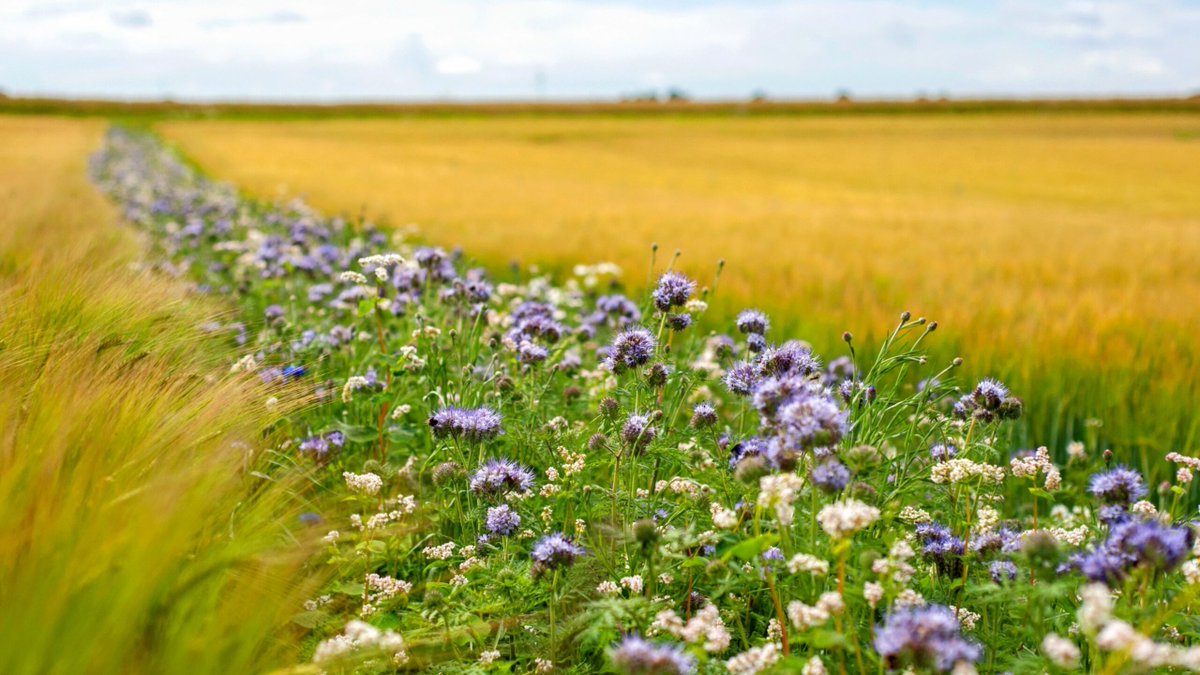
Farmers have figured out that the cheapest pesticide is a strip of flowers, and the scientists have verified it.
Swiss researchers sowed flower strips through 10 winter wheat fields and compared them to 15 fields without. Cereal leaf beetle larvae dropped 40%. Second-generation adults dropped 53%. Damage to the wheat fell 61%.
That pushed the pest below the threshold where spraying pesticides is even worth the money.
A follow-up study on perennial strips found beetle larvae down 66%, and yield in the wheat beside them up 10%.
The catch is that this only works when the strips are built for it. Those Swiss trials used specific plants chosen to feed specific predators: cornflower, coriander, buckwheat, poppy. A generic wildflower mix along the field edge doesn't reliably do this.
The same principle scales down to a garden. Plant a strip of yarrow, dill, fennel, or mountain mint through the middle of your vegetable beds, not just around the outside.
Then leave it alone and let the bugs go to work.
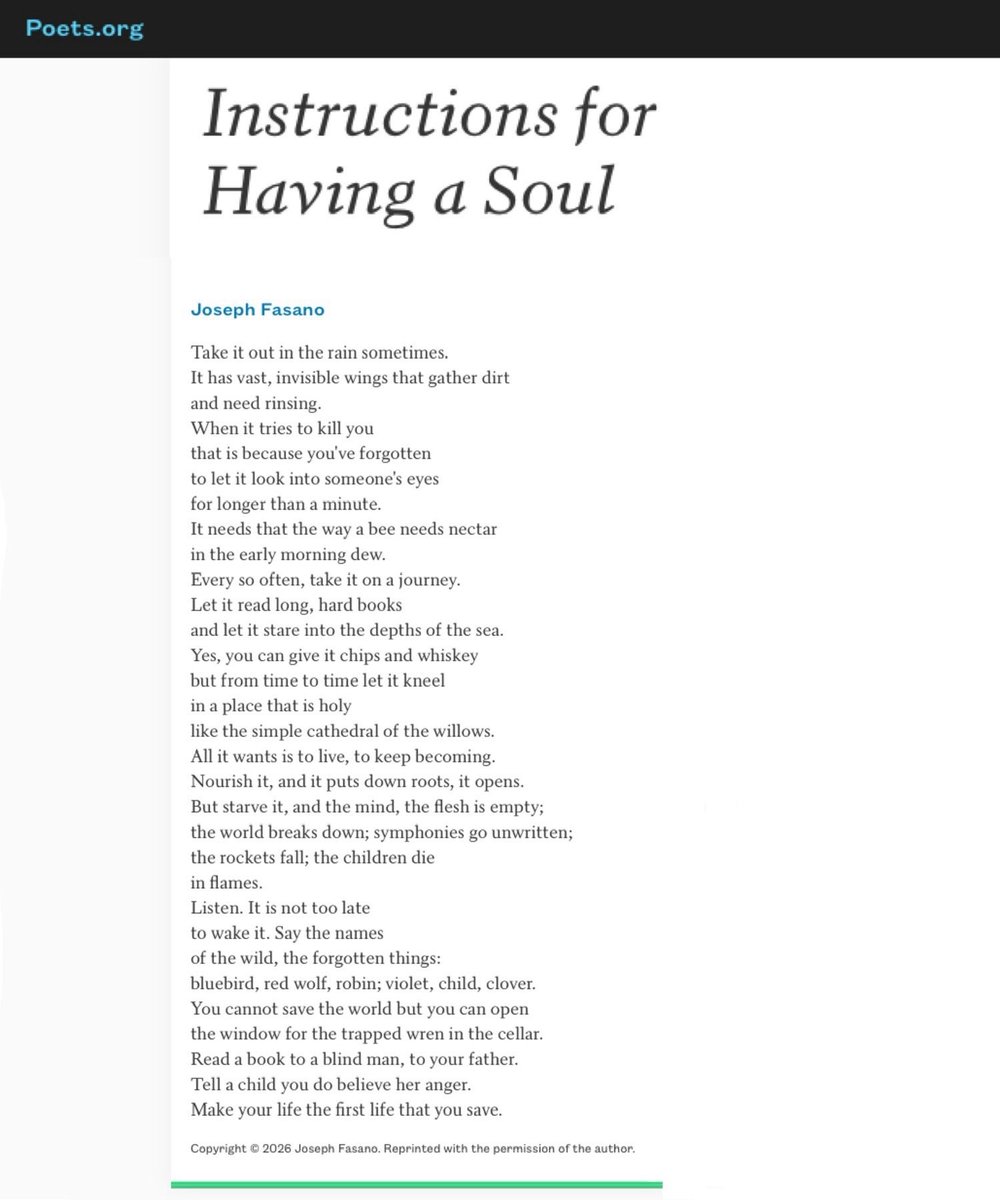
When I wrote "Instructions for Having a Soul," I had no idea it would be read by over 5 million people, shared in so many voices, & be a way for us to feel some hope together. Today it's been shared by The Academy of American Poets.
Thank you all for being human in a dark time.
The Sunday quote:
“Then very quickly the birds left, in whiteness, with the sound of shuffling cards.”
Lucia Berlin, Teenage Punk, from A Manual for Cleaning Women
The Wednesday research bite:
Old English (550 - 1150) used inflection (word endings) to express meaning, rather than syntax (word order) like modern English. It goes hand in hand with a tradition of oral, rather than written, storytelling.
Today’s Sunday quote comes from The Finest Hotel in Kabul (Lyse Doucet):
‘A people who had survived decades of war, who knew how swiftly the living could become the dead, knew that the only solution was to live. Live as if it was your last day. It could be.’