We are excited to share that our paper “A closed-loop platform for the embodiment of supernumerary robotic limbs during augmented tasks” by Iandoli M., Deiana D., Pinardi M., Noccaro A., Formica D. and Di Pino G. has been presented at IEEE EMBC 2025 in Copenhagen 🎉.
🧠✋ Why does the brain prefer the thumb-down/fingers-up hand posture?
Our new TMS study reveals this configuration engages specific circuits between the premotor cortex and M1, boosting motor performance.
https://t.co/BeHdp6y56N
#Neuroscience#TMS#MotorControl
📢 Excited to announce the 4th edition of #BayesHSC School, happening June 9–13, 2025 in beautiful Verona! 🎉with the patronage of @SIPFNC and @italianrepro
👉 Explore details here: https://t.co/QsVPCbEltV
#Bayesian#RStats#BayesHSC2025
The aging brain is adaptable! we might help everyone maintain better movement control as they age 🔬
Interested in knowing more? Check out our paper for the full story!!
@SoniaTurrini@FioriFr@Mariagr86963450 AlessiaTessari @GiuseppediP18@AAvenanti
Mirroring Minds: How Brain Circuits Drive Imitative Behavior
Recent research has identified specific neural circuits in the brain's motor system responsible for automatic and controlled imitative behavior, highlighting its fundamental role in social interaction and cohesion.
Using advanced brain stimulation techniques, scientists discovered how different brain regions influence our ability to mimic others and control these impulses when necessary.
This insight into the brain's mirror-like functions opens new therapeutic avenues for enhancing cognitive performance and treating social dysfunction disorders.
The findings underscore the complexity of neural pathways involved in imitation, providing a clearer understanding of how we connect with others.
1/3
🎉 Excited to share our latest paper in @PNASNews! Our study delves into the brain's imitation mechanisms. We used network-based #TMS to reveal how specific premotor-motor pathways contribute to our automatic tendency to imitate others' actions 🧠https://t.co/Eyileu65bn… #ccPAS
📢 Exciting News! 📚 Our work on mixed effects models has just been published in AMPPS @PsychScience! 🎉#R#OpenScience@rstats_tweets
Reliability and Feasibility of Linear Mixed Models in Fully Crossed Experimental Designs @Scandle @letstido https://t.co/rmavlh7OtB
I’m glad to share my first paper as first name!
With @SoniaTurrini, @FioriFr, Chiara Saracini, Boris Lucero, Matteo Candidi and @AAvenanti we revealed, using #ccPAS, different physiological mechanisms in premotor-motor pathways.
See the full text here:
https://t.co/VLyj82lNXZ
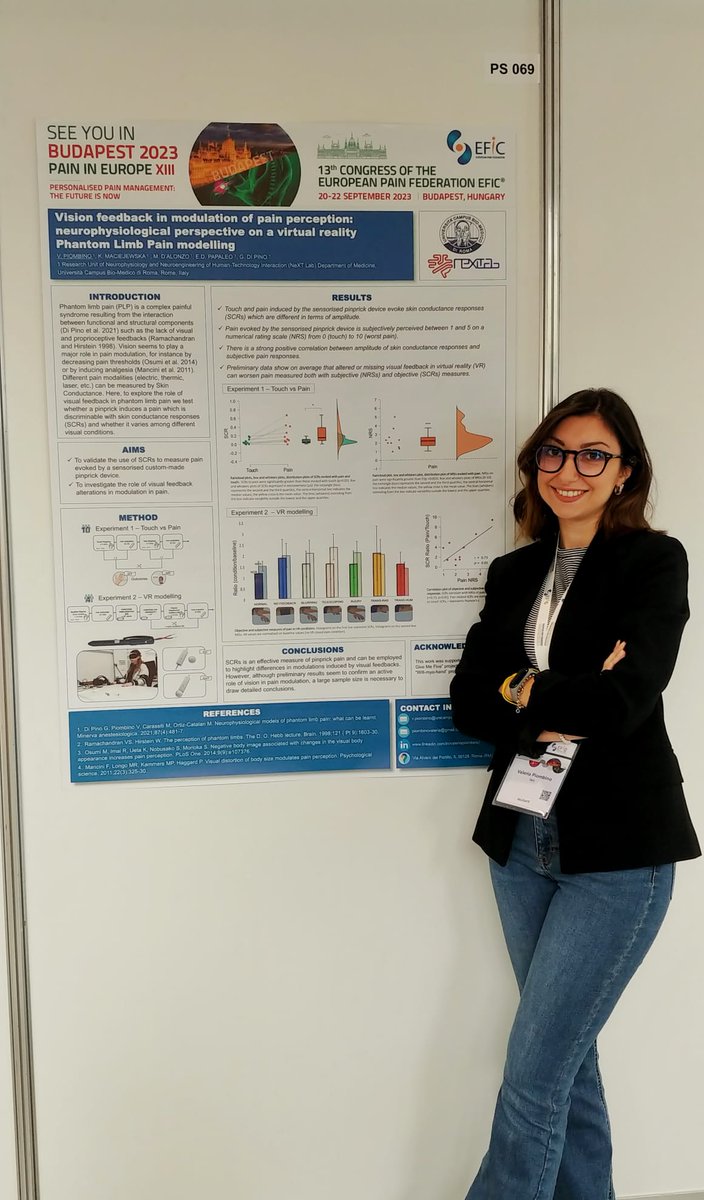
Find my poster at PS 069
Visual feedback in modulation of pain perception: neurophysiological perspective on a virtual reality Phantom Limb Pain modelling
#EFIC2023#Pain#PhantomLimbPain#Nextlab#UCBM
[Can we manipulate brain connectivity?] Hernandez-Pavon et al.: "This review summarizes existing literature and stimulation parameters that have proven effective in changing electrophysiological, behavioral, or neuroimaging-derived measures."
Open access:
https://t.co/IJS5H6WeM0
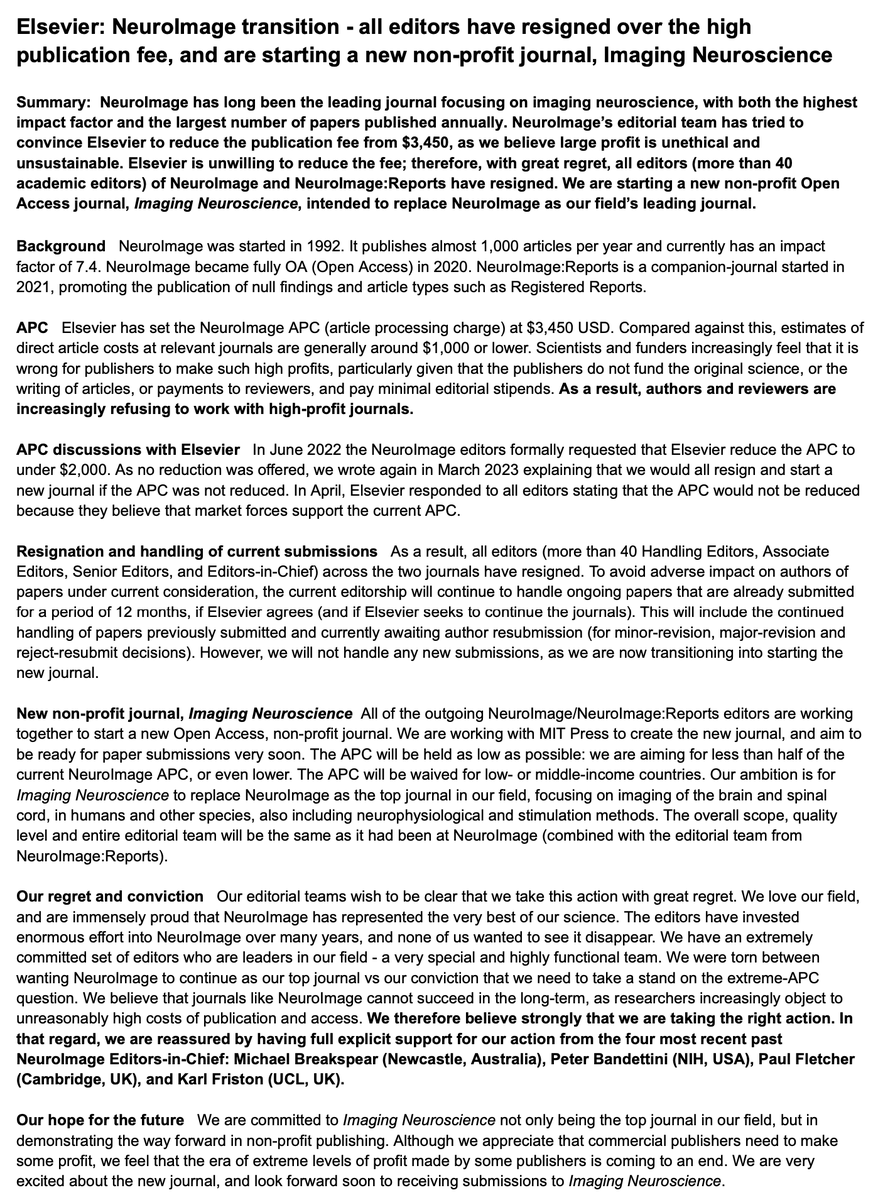
All NeuroImage and NeuroImage:Reports editors have resigned over the high publication fee, and are starting a new non-profit journal
https://t.co/DmnwDKVCK7
This comes with great regret, and a huge amount of thought and discussion- please read announcement to get more details.
Happy to share the first results of #MNESYS, just out in @NeuroImage_EiC We applied brain stimulation to strenghten connectivity from premotor to motor cortices via #Hebbian#plasticity and investigated local physiological changes over M1 #TMS#ccPAS https://t.co/Z0LfDPEHqz
Parliamo di ricerca e progresso ogni giorno però non si parla di ricercatori che ricevono stipendi da fame e che non raggiungono neanche il salario minimo.






![ClinicalNeuroph's tweet photo. [Can we manipulate brain connectivity?] Hernandez-Pavon et al.: "This review summarizes existing literature and stimulation parameters that have proven effective in changing electrophysiological, behavioral, or neuroimaging-derived measures."
Open access:
https://t.co/IJS5H6WeM0 https://t.co/3xu5DRmxX3](https://pbs.twimg.com/media/F0g2sDoWYAAnWhD.jpg)